Coalition lawmakers say the move allows them to control the election timetable, while opposition members argue the political process may no longer be reversible
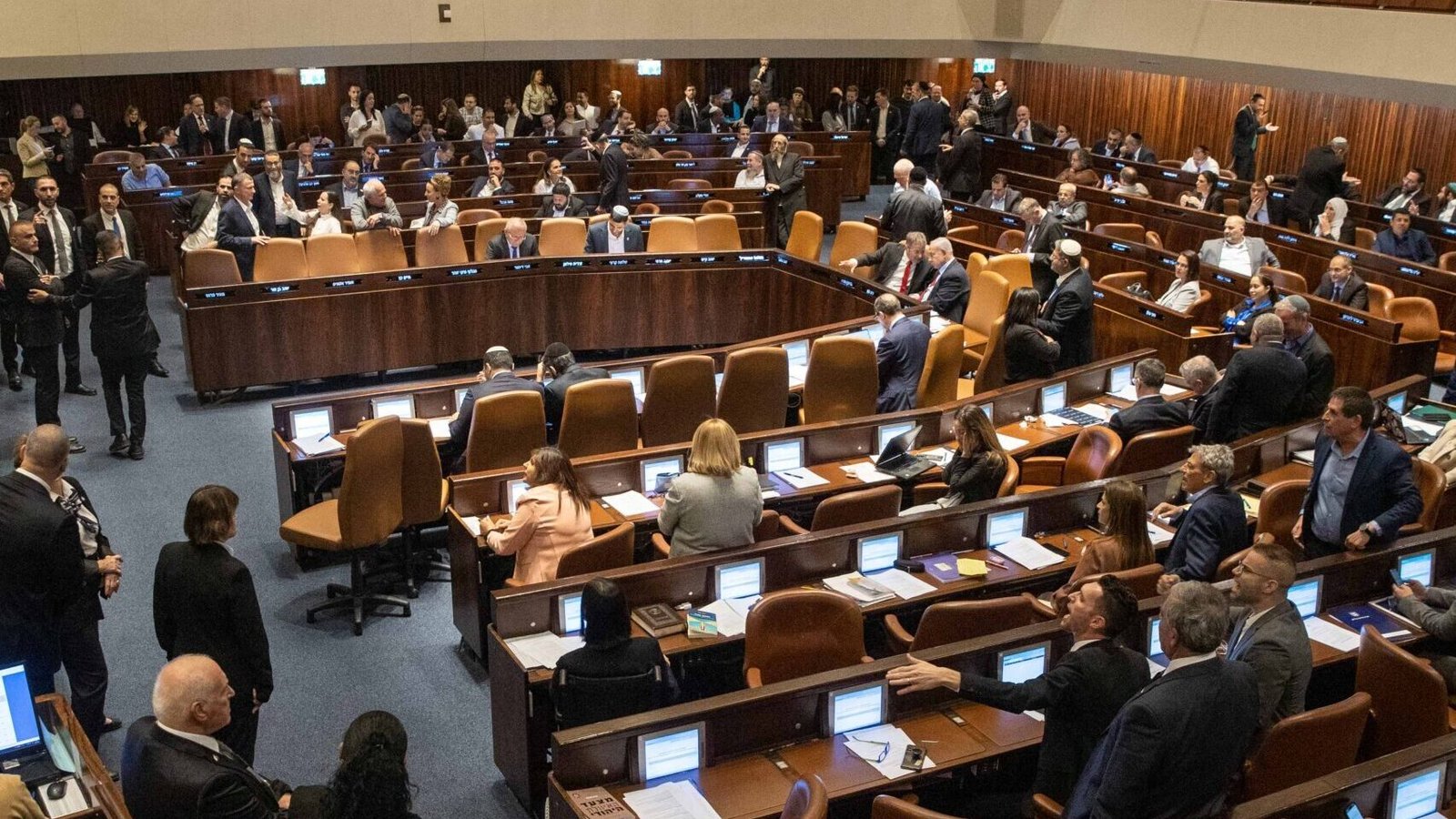
Israel’s governing coalition moved Wednesday to advance legislation that could dissolve the Knesset, turning a long-running dispute over ultra-Orthodox military service into a formal parliamentary process and raising the prospect of elections before the currently scheduled date in October.
The vote did not immediately dissolve parliament. The bill must still pass additional legislative stages before elections are formally triggered. But the political meaning was difficult to miss. This was not simply another opposition attempt to embarrass the government. Coalition members themselves backed a dissolution bill, placing Prime Minister Benjamin Netanyahu’s government in the unusual position of advancing a mechanism that could end its own term.
Deputy Foreign Minister Sharren Haskel said the move should not be read from abroad as a sudden collapse of Israeli governance. Speaking with The Media Line at the Knesset, she argued that the coalition was trying to control the process rather than allow the opposition to dictate the timetable.
The first thing is that the international community needs to understand that in their external view there’s no drama
“The first thing is that the international community needs to understand that in their external view there’s no drama,” Haskel said. “The date that the elections are going to be are going to be the date that Netanyahu is going to choose.”
Haskel said Israel’s strategic posture would remain largely unchanged regardless of the domestic political crisis. “We have a lot of drama internally,” she said, but added that “defending Israel against six armies and six fronts of enemies, that policy is not going to change.” According to Haskel, the turbulence is mainly domestic, centered on “how we’re shaping the recruitment bill” and the composition of the coalition.
The draft issue has become one of the most combustible questions in Israeli politics. After nearly three years of war following October 7, reservists and their families have faced repeated rounds of service, while the government has struggled to produce legislation addressing ultra-Orthodox enlistment. For many coalition lawmakers, the dispute is no longer an abstract debate about religion and state. It is about who carries the burden of national defense, and whether the current government can survive its own answer to that question.
Haskel was blunt in her criticism of the proposed arrangement. “The vast majority of the coalition is against this bill and are being forced to vote because the ultra-Orthodox party is literally extorting the prime minister in order to pass this bill to exempt an entire group out of the service,” she said.
She described the issue in personal and political terms. “I was a combat soldier at the time of the second intifada,” Haskel said. “It was very difficult, you know, being two and a half years in the war. Us, the ones who are serving on the front lines, who are contributing the most, there has to be some kind of equality. You can’t just exempt an entire sector from that.”
Still, Haskel said the coalition’s decision to push its own dissolution bill was not unprecedented. “So let me give you a scoop,” she said. “Every election, this bill usually comes from the coalition so they can control the process and the dates of the elections.”
Every election, this bill usually comes from the coalition so they can control the process and the dates of the elections
Complicated issues require complicated solutions
The opposition saw the day very differently. Vladimir Beliak, a Yesh Atid lawmaker, said the preliminary passage of the dissolution bill marked a political break that may be difficult for the coalition to reverse.
“I think the most important thing that happened today is that ultimately the Knesset dissolution bill passed in the preliminary vote, and the train left the station,” Beliak told The Media Line. “Now, it may take a little more time, but the dynamics that emerged today, I’m not sure it can be stopped.”
Beliak said he doubted the coalition could still secure a majority for the draft bill, despite pressure from the prime minister, the coalition leadership, and government officials. “I don’t see, I’m not sure they have a majority to approve the draft bill,” he said. “Sooner or later, in a short period of time, the Knesset will be dissolved.”
We are in favor of elections as soon as possible. We are prepared.
If that happens, Beliak said, elections could be held in September. “We are in favor of elections as soon as possible,” he said. “We are prepared.”
He accused the coalition of trying to extend its term while failing to resolve core issues of governance, security, and social responsibility. “Every day that this Knesset continues to live in the coalition, trying to pass it, is a loss for the economy, a loss for security, a loss for social justice,” Beliak said. “The time has come to go to the elections. We will win. We will form a different government here, a centralized government, and we will take the State of Israel on a new path.”
Wednesday’s vote left Israel in a political gray zone. The government has not fallen, and coalition lawmakers insist they remain in control of the calendar. But by backing a dissolution bill themselves, they also acknowledged that the crisis has moved beyond routine coalition discipline.
The draft dispute remains the immediate trigger. But the deeper question now is whether the coalition can still govern while preparing, openly and formally, for the possibility of its own end.