NASA’s Nancy Grace Roman Space Telescope is gliding toward its distant observation post on a pinpoint trajectory so precise that engineers estimate the spacecraft’s fuel load will last twice as long as their initial expectations, the space agency confirmed Monday.
The $4.3 billion observatory’s designers originally planned to load enough propellant into Roman’s four fuel tanks for a minimum lifetime of five years, plus a potential five-year mission extension. That was a conservative estimate. NASA officials knew an on-target launch and perfect execution of the observatory’s first post-launch course correction maneuver would leave Roman with a hearty fuel reserve.
“As a result of exquisite planning by our orbital dynamics team, brilliant execution by the operations team, and a precise launch from SpaceX, Roman has fuel for at least 22 years of potential science operations,” Jamie Dunn, center director at NASA’s Goddard Space Flight Center, said in a press release.
The James Webb Space Telescope received a similar lifetime boost after a picture-perfect launch on a European Ariane 5 rocket in 2021.
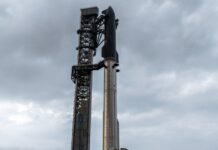
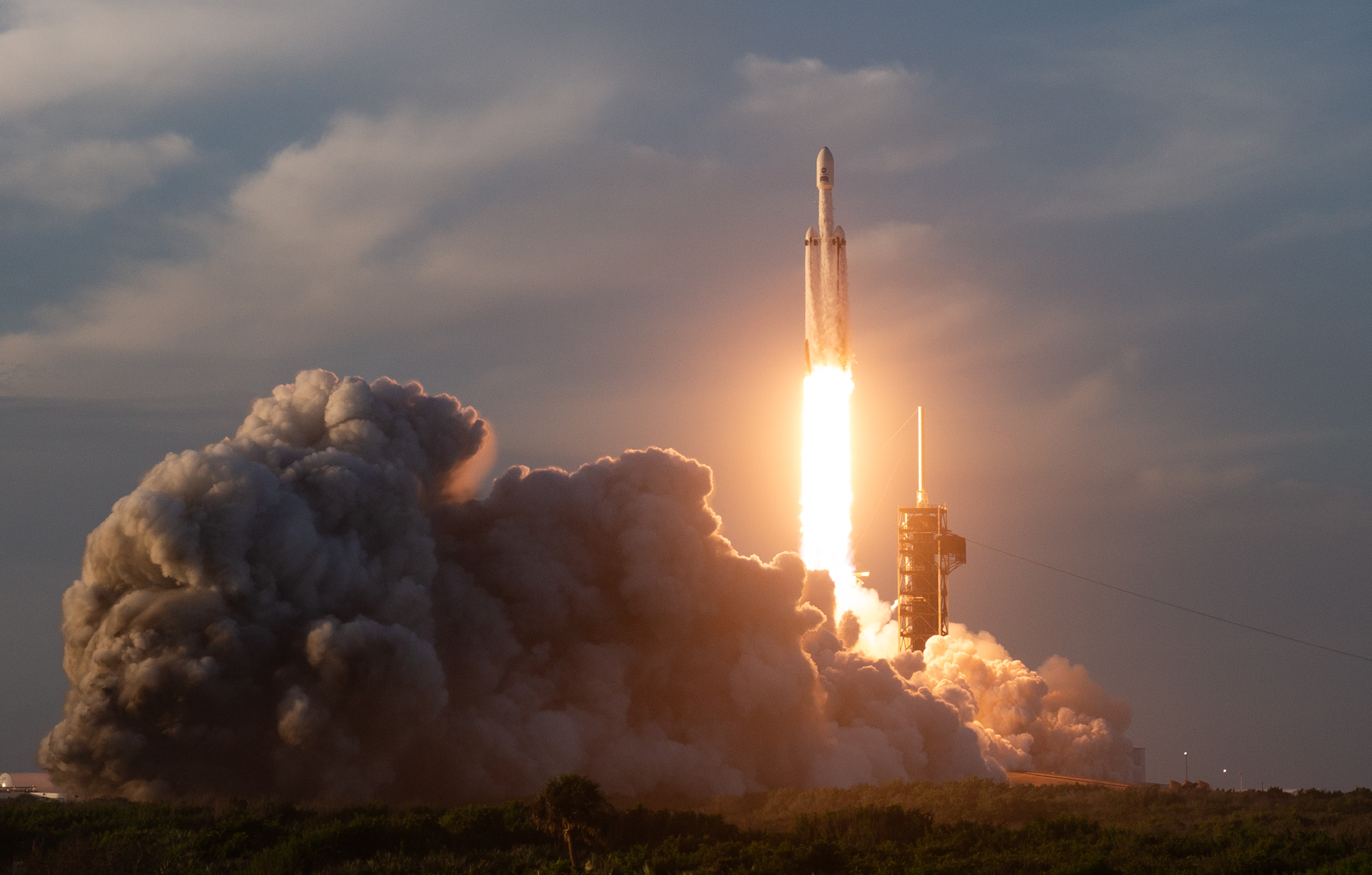
The Roman telescope launched August 30 from NASA’s Kennedy Space Center in Florida aboard a SpaceX Falcon Heavy rocket, kicking off a mission to widen our view of the Universe. Roman’s telescope and scientific instruments will provide astronomers with images of the sky at the same resolution as NASA’s Hubble Space Telescope, but with 100 times the field of view. It would take Hubble a century to observe what Roman will see in a month.
Astronomers hope Roman’s broad vision will reveal insights into the largest structures in the Universe. Roman’s Wide Field Instrument, fitted with 18 near-infrared detectors, will produce images equivalent to those of a 300-megapixel camera. Its wide viewing area will allow Roman to map galactic clusters, along with the filaments of matter and dark matter that string through the cosmos. Mapping so much of the sky could help astronomers study the nature of dark energy, scientists’ name for the elusive force driving the acceleration of the Universe.
Right on the money
The Falcon Heavy released Roman on a trajectory that will take it a million miles from Earth, where the spacecraft will loop into a “quasi-halo” orbit around the Sun-Earth L2 Lagrange point, a point of balance between the gravitational pull of Earth and the Sun. It will take Roman about three months to reach L2.
The launch was so accurate that the first big burn with Roman’s control thrusters, executed one day into the mission, consumed just 40 pounds (18 kilograms) of hydrazine fuel, down from the preflight allocation of 441 pounds (200 kilograms), NASA said.
“I do thank SpaceX for putting us down the middle. It’s going to help us in terms of long-duration performance, how long we can stay at L2, as well as our positioning capability,” said Amit Kshatriya, NASA’s associate administrator, during a talk Tuesday at the American Astronautical Society’s Glenn Space Technology Symposium.
Roman launched nine months ahead of the schedule set by NASA during the mission’s confirmation review in 2020. It also launched lighter than planned. Both are rather unusual in the annals of NASA science missions.
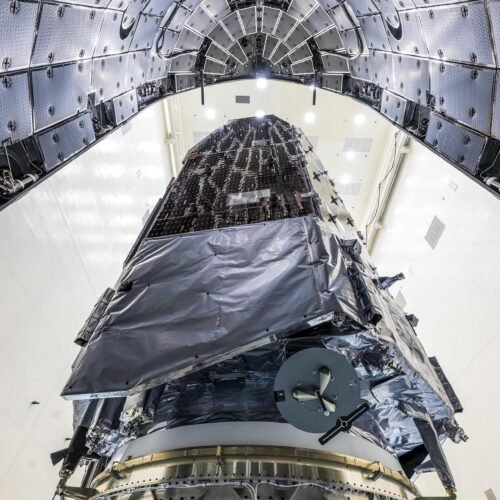
The observatory’s actual weight at completion was 17,760 pounds (8,056 kilograms), approximately two tons less than its maximum allowable weight. This allowed ground crews at Kennedy Space Center to load 290 gallons of hydrazine into Roman’s fuel tanks, more than engineers anticipated early in the mission’s design phase. The hydrazine feeds 24 thrusters scattered around the outside of the observatory.
At launch, the fully fueled Roman observatory weighed 20,224 pounds (9,173.5 kilograms), still a half-ton below its weight limit, a NASA spokesperson told Ars. In addition to the extra fuel, Roman’s lower mass meant its thrusters did not have to fire as long for the course correction maneuver the day after launch.
“A spacecraft’s mass changes throughout the design and build process, so we base the propellant budget on a set maximum value so we won’t come up short,” said Alison Rao, the Roman propulsion lead at NASA Goddard. “We track the propellant needed based on actual mass throughout integration and testing as well, to make sure we have wiggle room. Since Roman’s was lower than we budgeted for, we were able to fill the propellant tanks to their capacity rather than only filling them as much as we needed to for the 10-year requirement.”
A second course correction planned for later this month will give Roman the last tiny boost to get into position for another maneuver in early December to slip into its final orbit at L2. “According to current projections, both maneuvers will use less fuel than planned, potentially saving even more for future science,” NASA said.
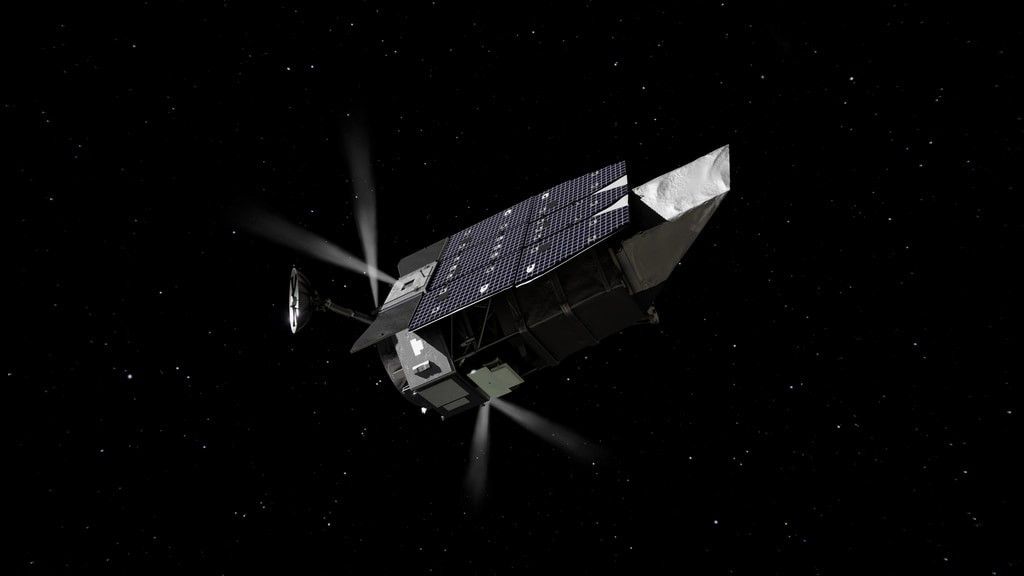
Roman’s thrusters will perform additional station-keeping burns roughly every 28 days. The observatory will also use its propulsion system to periodically unload momentum from its six reaction wheels, which normally control Roman’s pointing.
Refueling deferred
The mission’s exceptional fuel savings lower the likelihood of NASA having to send a refueling mission to Roman anytime soon. The observatory’s life-limiting resource will likely be propellant, and NASA set a requirement early on in Roman’s development that the spacecraft be refuelable.
NASA has serviced a space telescope before. Astronauts on five Space Shuttle flights visited Hubble to carry out a range of tasks, including repairs of the telescope’s aberrant vision, maintenance work, and the installation of more powerful science instruments. Hubble does not have a propulsion system, so visiting Space Shuttles also boosted the observatory’s orbit around Earth.
Officials prepared Roman to receive a potential uncrewed servicing mission. NASA attached a grapple fixture on the bottom of Roman similar to those used by the robotic arms on the International Space Station and the Space Shuttle. Roman also has navigation aids—a retroreflector and external reference points—to help guide a servicing mission on final approach.
“While Roman is nowhere near as serviceable as the Hubble Space Telescope was, we do have everything that’s necessary to enable the rendezvous and capture and docking with a hypothetical servicer; that’s the point of the grapple fixture,” said Jackie Townsend, Roman’s project manager at NASA Goddard. “Then, in 2020, when we were baselined, we were told that we would focus on refueling. So the blanketing around the fueling port has been designed especially so that it’s easier for a robot to get in there if we needed to refuel.”
The blanketing around the fueling port also has a magnetic closure to simplify opening and re-closing by a robotic servicer, Townsend told Ars.
There are no servicing spacecraft currently available that could travel out to Roman’s position a million miles from Earth. Several US companies are developing refueling satellites for use in low-Earth orbit and geosynchronous orbit, primarily for the US Space Force. Two Chinese spacecraft docked last year to conduct the first satellite-to-satellite refueling in geosynchronous orbit.
Everything else onboard Roman has been working well for more than two weeks since launch, according to Kshatriya, NASA’s highest-ranking civil servant. The telescope opened its aperture cover on September 1, allowing starlight to fall on its primary mirror for the first time.
“All the preliminary checks are good,” Kshatriya said. “In fact, we got some data on the Wide Field Instrument just a couple days ago. All the mirrors, all the CCDs are chilling down in the right way. We do false current tests to make sure that we’re getting the right connectivity, etc. All that’s green across the board on all 18 (detectors), which is awesome.”
Roman’s other instrument, a coronagraph designed for direct imaging of exoplanets, also performed well during preliminary checkouts.
“When we get first light, it’s going to be a big party,” Kshatriya said.