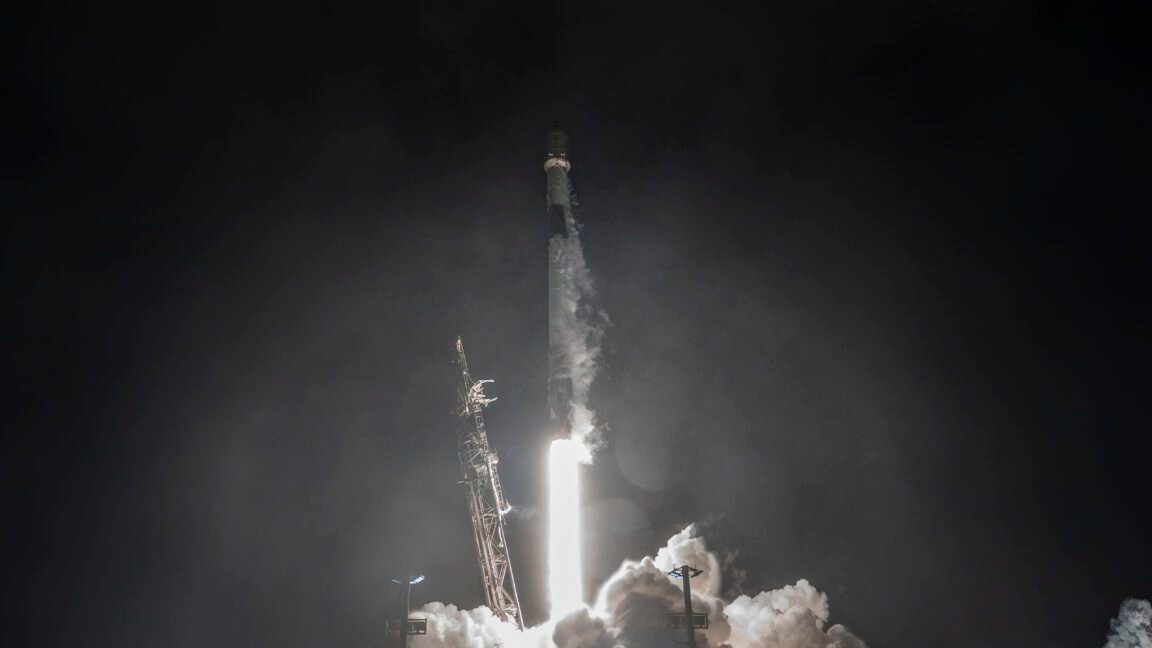
A new report from the analytics firm Quilty Space confirms that, outside of China, the world faces a significant shortage of rockets over the next five years.
The firm estimates that between now and 2030, there will be a shortfall of about 150 launches compared to demand from satellite operators and civil space agencies. If demand from the US military is added in—and SpaceX does not extend the Falcon 9 and Falcon Heavy program to accommodate increased national security needs—the shortage could be doubled.
“What we wanted to get at is to understand how severe this launch crisis is and when will it be resolved,” said Caleb Henry, director of research at Quilty Space. “What we learned is that the launch crisis is more severe than we thought and that it will not go away this decade for sure, and it might not abate until sometime late in the 2030s.”
The report tallies a number of familiar factors that have gone into this crisis: the war in Ukraine taking Russian rockets off the Western market; Amazon Leo demand; developmental delays in a new generation of rockets, from New Glenn and Vulcan to Neutron, Terran R, and Nova; and more recently, the retirement of the Falcon 9 as a rocket for commercial service.
At a time when the supply of commercial rockets is contracting, demand for satellite launch is soaring, from megaconstellation operators such as Amazon to a flurry of small satellite startups. The report estimates the crunch will become most acute in 2028 but should then slowly improve.
“How should people react and plan around this?” Henry asked. “To be honest, I don’t have a good answer. If you haven’t booked your launch already, and you need one, you’re late.”
Starship’s lack of a regular fairing
Henry said several key uncertainties could change the outcome. Most importantly is what SpaceX will do. The company has intensified the shortage by winding down its prolific Falcon 9 rocket program. Starship has the potential to solve the launch crisis given its massive payload capacity and potential for rapid reuse.
But SpaceX has not been aggressively selling Starship as a commercial launch option. “SpaceX has also stopped affirming Starship as a commercial launcher,” the Quilty report states. And as Ars reported this week, there is no evidence that the company is putting effort into developing a conventional payload fairing door for the vehicle to accommodate traditional satellites and spacecraft. Rather, the company seems set to continue to fly the vehicle with its Starlink-optimized narrow door, which ejects satellites into space like a PEZ dispenser.
SpaceX has not offered any public commitment recently to developing a larger payload fairing door, but some of its customers have indicated they don’t expect that to happen any time soon.
On Thursday, the president and chief executive of Telesat, Dan Goldberg, was asked during an earnings call about what rocket the company’s future satellites might launch on. In short, to book on Starship, the company may need to build flat satellites.
“First and foremost, they’ll focus on the deployment of their own satellites and their own requirements,” Goldberg said of SpaceX and Starship. “Secondarily or right alongside of that, the US government will be a priority customer for them, and maybe other governments as well. I do believe that so long as our next-gen satellites are configured in a way that can go into their dispenser, the same dispenser that they’ll be using to deploy their own satellites, we’ve got some expectation that Starship would be available to Telesat to support future missions.”
What about Blue and Uncle Sam?
Another mitigating factor could be the rapid acceleration of Blue Origin’s New Glenn rocket launch cadence. Henry said Quilty adopted a conservative forecast, predicting eight New Glenn launches in 2028, 12 in 2029, and 16 in 2030.
“I’d be happy to be proven wrong,” he said. “And Blue has been in development for so long, they could come out of the gate swinging.”
Blue Origin, he noted, is building the production capacity for up to 150 upper stages annually, but it will of course take time to launch such a large rocket at a high rate.
A final wild card is the US military. The current phase of the national security launch program has two lanes. The first lane is for missions with a higher risk tolerance. Any company that has launched a rocket successfully a single time is eligible to bid on these missions. For now, this includes the Falcon rockets, New Glenn, and United Launch Alliance’s Vulcan, but they should be joined by a new generation of medium lift rockets within the next year or two. Lane 2 is reserved for SpaceX and United Launch Alliance.
Earlier this year, the US Space Force announced a dramatic increase in forecast demand for both Lane 1 (from an estimated 30 to 60 launches to about 170) and Lane 2 (from 54 launches to 79 launches). These missions would be ordered between 2025 and 2029.
This surge in military launch demand was not included in Quilty’s calculations, Henry said, because he believes the US military will be able to require SpaceX to perform launches it deems national priorities. Moreover, he said, SpaceX is already building a number of these satellites, such as the Space-Based Airborne Moving Target Indicator constellation.
“I think the US government will compel them to do this,” Henry said. “SpaceX is already building a non-trivial number of these satellites.”