Russian satellites have been identified as the cause of mysterious, seconds-long bursts of GPS interference across Europe—a rare example of human-made GPS interference coming from space. But uncertainty still hangs over whether such interference is intentional and if it could be more powerfully weaponized as GPS jamming with continental reach in the future.
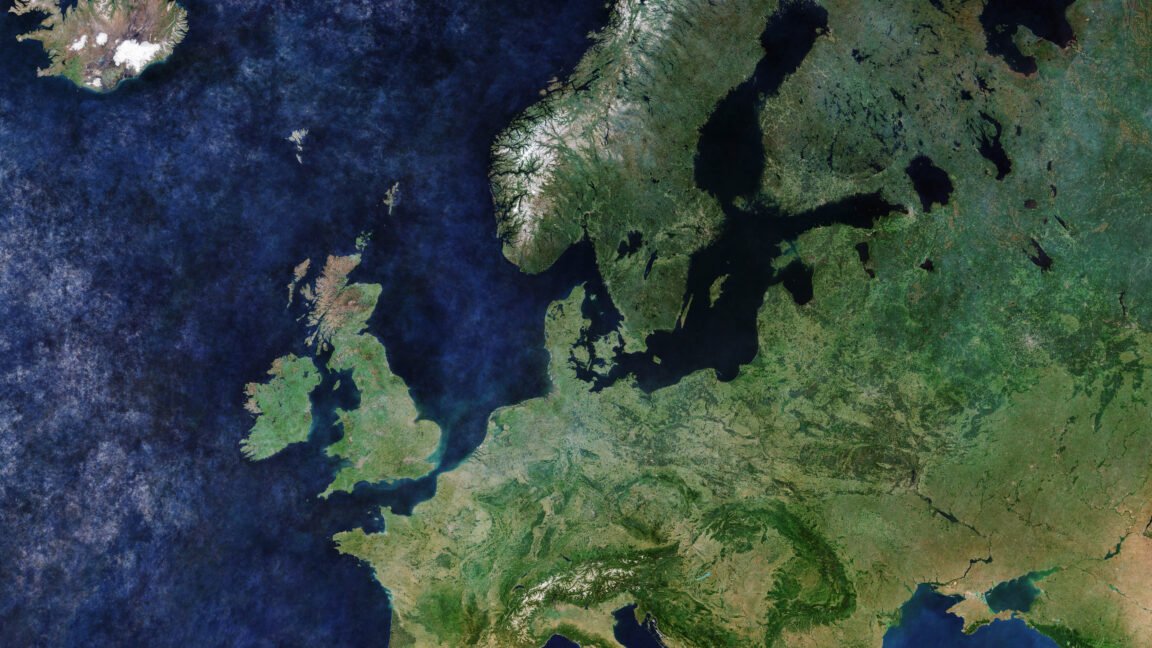
The discovery came from an investigation detailed in a June 2 preprint paper by Todd Humphreys and his student Zach Clements at The University of Texas at Austin, along with Argyris Krizise at Stanford University in California. By sifting through public data from ground-based stations with global navigation satellite system (GNSS) receivers, they identified a pattern of high-powered interference lasting less than 10 seconds each time but simultaneously detectable by ground stations across Europe from Norway to Spain to Poland, and even reaching as far west as Greenland and Canada.
By analyzing the ground station data from January 2019 to April 2026, the researchers found 75 days with at least one widespread GNSS interference event overlapping with the GPS L1 frequency band centered on 1575.42 megahertz. That represents the main band used for signal transmission by the US-made GPS satellite constellation and GNSS constellations from other countries.
Such interference patterns happened mostly on Tuesdays, Wednesdays, and Thursdays during business hours in Europe, Humphreys told the YouTube channel Veritasium. Because such “continental-scale” interference was simultaneously affecting GPS receivers across Europe and beyond, Humphreys and his colleagues calculated that the source had to be at least 1,200 kilometers above the Earth.
By examining which satellites were above the horizon over the affected region during each interference event, the researchers narrowed their search to a handful of suspect satellites. But they couldn’t go further because they only had data processed by the GNSS receivers of the ground stations—they needed to capture the raw radio signal data from the interference source.
In September 2025, the researchers sought help from the broader community at the Institute of Navigation conference in Baltimore, Maryland, according to Veritasium. Months later, Humphreys received a breakthrough tip about the raw interference signal data having been captured by stations in Amsterdam, Netherlands, and Trondheim, Norway, during an interference event on February 11, 2026.
By examining the difference in timing when that signal arrived at the two different stations, Humphreys and Clements calculated a “quasi-hyperboloid surface”—the term they used in the paper—stretching tens of thousands of kilometers into space where the interference satellite must have been located. As explained by Veritasium, the margin of error represented by the thickness of that surface was only five meters.
A comparison of suspect satellite orbits with the quasi-hyperboloid surface showed that only one satellite’s orbit aligned perfectly—the Russian satellite Kosmos 2546. That discovery, in turn, pointed them to six satellites in the Russian Edinaya Kosmicheskaya Sistema (EKS) constellation, including Kosmos 2546, which are designed to provide early warnings when they detect ballistic missile launches.
Such satellites sit in highly elliptical Molniya orbits extending far above the high latitudes of the Earth that provide long-duration coverage of the northern hemisphere. The analysis by Humphreys, Clements, and Krizise showed that there was at least one such Russian satellite well above the horizon for every single reference ground station during all the GPS interference events.
The uncomfortable why
There is still the open question of why the Russian satellites appear to be periodically engaging in short bursts of targeted GPS interference over Europe—especially because the jamming signal is slightly offset from the usual GPS frequency band.
In the Veritasium video, Humphreys speculated that the Russians may have been testing the satellites’ GPS interference capabilities only briefly on a neighboring frequency adjacent to the typical GPS band. “And then in the eventual future when there is a hot conflict, they go ahead and tune their transmitter down to the GPS band, but it’s much more damaging now that it lies right on that band,” he said.
Incidentally, the raw data also revealed a second interference burst from the Russian satellites in a lower-frequency band used by China’s BeiDou navigation system.
“I can no longer say this is accidental with confidence,” Humphreys told Veritasium. He also described the Russian satellites’ quiet demonstration as a “massive escalation in the electronic warfare background conflict that is going on right now.”
But Richard Bowden, division head of assured and resilient PNT at the multinational technology company GMV in Spain, shared a different theory with Veritasium about how the interference bursts may actually represent short communication messages being sent from Russian satellites. Bowden’s team independently identified at least two of the Russian satellites as the source of the GPS interference pattern.
“These signals are, without a doubt, intentional and placed on or around GNSS signals, and have the potential to disrupt legitimate use of GNSS services,” Bowden wrote in a LinkedIn comment. “But from our side at least, we can’t be sure they are intentionally malicious or intended as an EW [electronic warfare] weapon.”
An active space-based, human-made source of GPS jamming is still extremely rare. Most sources of GPS jamming originate from ground stations or vehicles, and potentially from ships and aircraft.
Experts interviewed by The New York Times expressed skepticism that Russia would use its only known early-warning satellites for a secondary GPS-jamming purpose. The European Union said it had been investigating but could not share results because they were classified. The Russian Embassy in Washington, DC, told the newspaper it had no comment.
But Russia has been demonstrating a growing number of systems that can potentially neutralize space-based assets belonging to the United States and Europe. In April 2026, the leader of US Space Command warned that Russia had operationalized anti-satellite weapons capable of targeting US government satellites. In May 2026, open source orbital tracking data revealed that at least four Russian military satellites performed orbital maneuvers to match the orbit of a Finnish-American radar surveillance satellite.