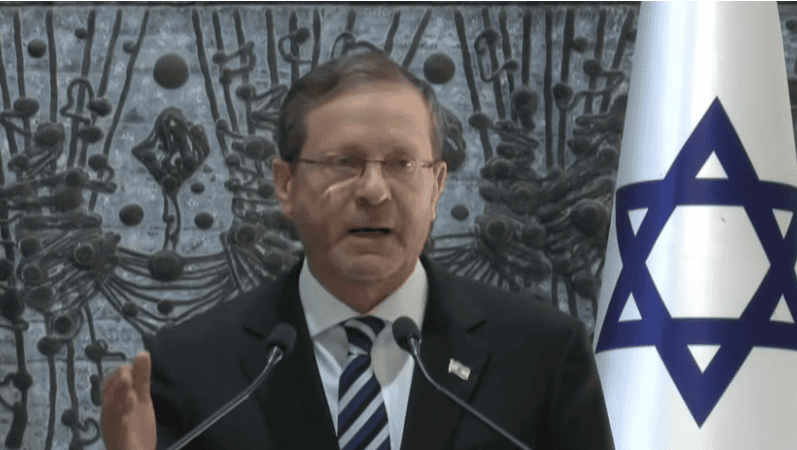
Israel marked the anniversary on October 22, 2026, with official ceremonies at the President’s Residence in Jerusalem and at Mount Herzl cemetery. Rabin was assassinated on November 4, 1995, with the anniversary commemorated according to the Hebrew calendar.
“Thirty-one years after the horrific murder, there are still people in Israel who dare to utter— and type on their keyboards—appalling threats to murder elected officials, from the prime minister to ministers, members of Knesset and political leaders,” Herzog said at the President’s Residence. “There is no place for political violence in a civilized country. There is no place for violence, period.”
Herzog also condemned public calls for Amir’s release, recounting seeing a roadside sign on Route 1 between Tel Aviv and Jerusalem advocating for the assassin to be freed.
“The very possibility that such a call could appear in a public space and be met with a shrug should keep us awake at night,” Herzog said, insisting that “the murderer must never be released. He must spend the rest of his life in prison.”
Amir assassinated Rabin after the prime minister attended a mass peace rally in Tel Aviv’s Kings of Israel Square, which was later renamed Rabin Square. The gathering was held to demonstrate opposition to violence and public support for Rabin’s efforts to negotiate peace with the Palestinians.
Herzog rejected the idea that the passage of more than three decades should lessen the significance of the assassination or its consequences.
“Thirty-one years do not constitute a cooling-off period for the murder of a prime minister. The passage of time does not diminish the severity of the crime,” Herzog said.
He called keeping Amir behind bars permanently a national obligation that should extend beyond the current generation.
“The national imperative that must be passed from our generation to those that follow is clear and unequivocal: The murderer must never be released. He must spend the rest of his life in prison. He must never receive any reduction of his sentence or any form of pardon. This must not be challenged under any circumstances.”
Herzog said Amir’s actions represented an attack not only on Rabin but on Israel’s democratic system and the principle that political disagreements must be decided without violence.
“The despicable murderer did not aim his weapon at Yitzhak Rabin alone. He aimed it at the heart of the nation,” he said.
“The murderer of the prime minister sought to place his weapon above the will of the people, to resolve a disagreement through violence, through murder, threatening our very existence here as a Jewish, democratic, and sovereign state.”
A separate state memorial ceremony was held at Mount Herzl in Jerusalem. Science and Technology Minister Gila Gamliel represented the government at the service.
Herzog said the lessons of Rabin’s assassination remain relevant more than three decades after his death, particularly as threats continue to be directed at Israeli political figures.