
Amid all the tensions in the Middle East, the situation in East Asia looks a lot calmer. That’s especially true after a visit to Beijing by Taiwan’s opposition leader Cheng Li-wun, a positive sign for peace and an encouraging step toward Washington’s longstanding interest in peaceful cross-strait relations.
Cheng’s visit to China was not unprecedented. The opposition party in Taiwan, the Kuomintang (KMT), has held several rounds of direct talks with Beijing in a “party-to-party” format since 2005.
It would be better if the leader of Taiwan, Lai Ching-te of the Democratic Progressive Party (DPP), had made the journey, but he is unfortunately reviled by Beijing due to his pro-independence inclinations.
Still, even a visit by the opposition party can’t be discounted. The cross-strait situation has become so fraught to the point that U.S. intelligence agencies once predicted that a war there could occur as early as 2027. This estimate has thankfully been dialed back.
Many experts regard the Taiwan Strait as the world’s most dangerous powder keg. Any step toward peace in that volatile situation is welcome.
The trip carried deep meaning. Cheng stayed in China for a whole week and took in Nanjing, the highly symbolic city on her way to Beijing. Nanjing is famous in modern Chinese history not only for the heinous Japanese massacre of hundreds of thousands of Chinese innocents but also as the historical capital of the Republic of China, which is the official name Taiwan’s government uses.
Nanjing is also the site of the Sun Yat-sen mausoleum, sacred for cross-strait relations since Sun, an American-educated medical doctor and founding father of modern China, is deeply revered in both Taipei and Beijing.
I have visited this memorial myself and it’s extraordinary to behold Taiwan’s national flag, the white sun on a blue field, above the crypt in the middle of this bustling Chinese city. Sun’s portrait hangs very prominently in Taiwan’s legislature to this day.
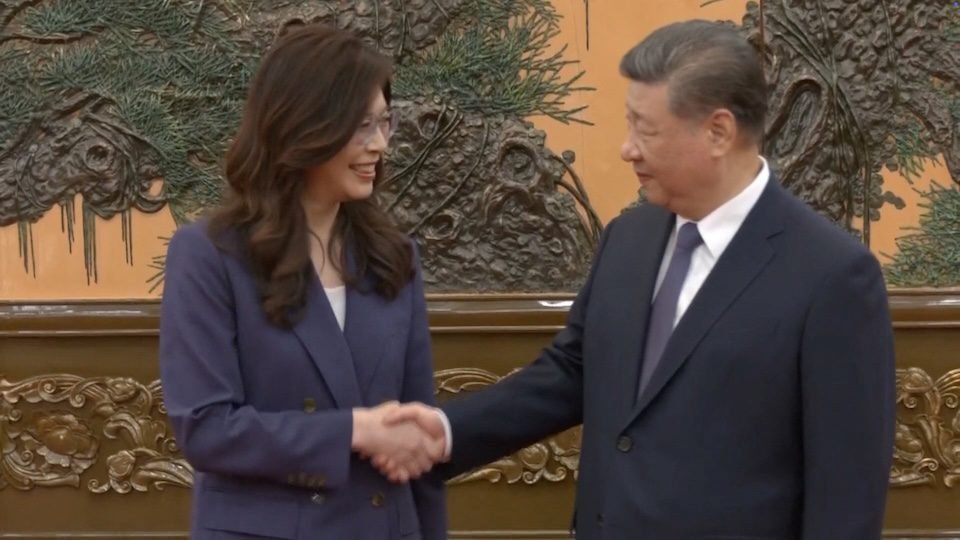
Cheng met with Chinese President Xi Jinping during her trip, where Xi stated: “Taiwan compatriots have never forgotten that their roots are on the mainland,” adding that their “Chinese roots… come from our bloodlines, are grounded in history, and are etched in our hearts. They can never be forgotten, nor can they ever be erased.”
Notably, Xi did not insist on near-term unification, instead stating that the tendency of “both sides of the Strait becoming closer, more connected, and coming together will not change.”
At the meeting, Cheng did not mince words about Taiwan’s identity. She explained that the “overwhelming majority of people in Taiwan are descended from ancestors who crossed from the Mainland to Taiwan. They bear Chinese surnames, speak Chinese languages, celebrate Chinese festivals, and worship Chinese deities.” She added that “Chinese culture has always been part of the DNA of Taiwanese society…”
Cheng also made a point to propose some constructive areas for cross-strait cooperation, noting that “our experiences and strengths can be mutually complementary.”
These are hard words for most American strategists to hear, since they have spent the better part of the last decade trying to find ways to stabilize China-Taiwan relations through military deterrence rather than through diplomatic engagement or reconciliation.
Cheng’s approach is a breath of fresh air because she realizes that Taiwan cannot win an arms race with China while the US is far away, distracted and has limited military power.
Cheng’s brave peace-oriented initiative will no doubt be sharply criticized. The Wall Street Journal stated with evident sarcasm: “The charitable interpretation of Ms. Cheng’s visit is that her party thinks Taiwan’s best bet is to soothe Mr. Xi and push off a crisis. Nice kitty.”
Yet most Americans will agree that US involvement in another Asian civil war is not what America or the region needs. US analysts would be wise to take a close look at Cheng’s motives for the journey, since she seems to represent new thinking on Taiwan’s future.
This new approach focuses on pragmatism and stability; it does not in the least threaten the US strategic position in the Asia-Pacific. To the contrary, this is profoundly good news for US national security. Americans are more safe if there is peace across the Taiwan Strait and American service members are in considerably less danger.
These are early days for a new rapprochement across the Taiwan Strait. Cheng is brave but she has a long way to go before she can truly fulfill her goal of cross-strait reconciliation.
Yet Cheng and her diplomacy-first approach deserve a careful hearing by Americans, including national security professionals. If her approach succeeds in defusing the China-Taiwan powder keg, she would have made an enormously significant step toward US-China peace and stability in the 21st century.
Lyle Goldstein is director of the Asia Program at Defense Priorities

Lyle Goldstein is the director of Asia engagement at Defense Priorities and a visiting professor at the Watson Institute of Brown University. Follow him on Twitter @lylegoldstein.