In 1825, Fath Ali Shah, King of Iran, marched on Isfahan with his troops to bring an unruly tribesman to justice. The Shah had received complaints about a Lur tribesman named Hashim Khan, who had been involved in raiding people’s homes, extorting money, using torture, killing people including one sayyid or descendant from the family of the Prophet Muhammad (PBUH), sexually assaulting women. Despite these outrages, the governor of Isfahan was either unwilling or unable to act against him. Hence the Shah came to dispense justice in person by killing 200 of Khan’s supporters and detaining Khan.
While being questioned by the Shah, Khan cursed him and said ‘the world does not remain without a sovereign, when one leaves another takes his place.’ Although an important Friday prayer leader tried to intercede on his behalf, the Shah had Khan’s beard shaved off with a dull razor in order to challenge his honour and manhood, blinded and then executed. A contemporary eye-witness source says ‘carried [Khan] through all the bazaars, amidst the ridicule of the spectators; he underwent the severe punishment of bastinado on the main road Ghaysery.’ Khan tried to challenge the power of the Shah locally, but his story sits at the nexus of the changing notions of law, sovereignty and political power in 19th century Iran.
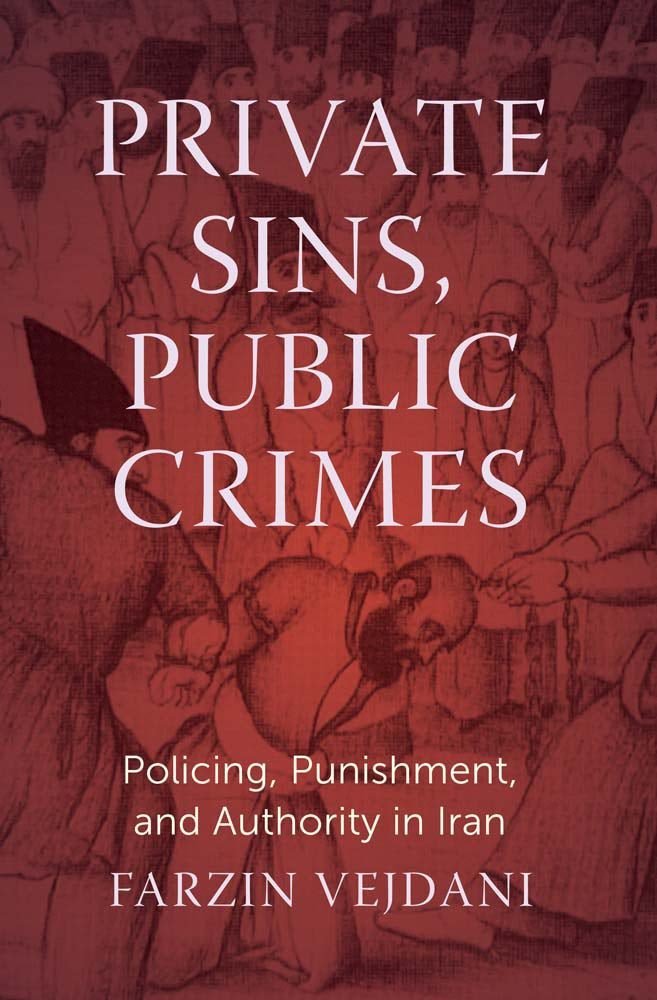
Farzin Vejdani’s Private Sins, Public Crimes: Policing, Punishment, and Authority in Iran traces the rise of the modern Iranian legal regime through the Qajar period. The 19th century was a period when the central state grew more powerful and its ability to intervene into people’s lives across the country increased. A central conflict emerged when the traditional understanding of the private and public sphere started to break down and a new understanding started to emerge. Changes occur in Shariah, customary law and governmental-bureaucratic law called siyasat. That shifted the boundaries of crime and punishment in Iran. Using Arabic and Persian sources, Vejdani looks and traces the changes in Fiqh [Shariah], Shia Jurisprudence, advice pamphlets, reformist literature and a category of literature called A Mirror for the Princes. The feeling was the Iran desperately needed reform as Iranians began interacting with Europeans as well as the Ottoman Tanzimat reforms. Vejdani brings all these together and enables us to see how the political landscape changed after the Qajars from the time the Qajars came to power.
The public-private distinction is key in many societies throughout the world and Iran is no different. The notion of private with regards to law is slightly different in Islamic thought from modern western notions. Vejdani points out that when he speaks about public/private, he does not mean in the Habermas sense, where the public sphere is where civil society gathers to rationally debate issues; nor does he mean in the sense of public ownership of government. What he means by public is associated with the profane and debased, while private is associated with the secret, sacred and inviolable. An example would be in the hadiths, a hidden wrong that is not known to anyone else, only harms the wrongdoer and thus is exempt from public punishment. It’s often seen as something the wrongdoer must repent for on their own accord.
Vejdani observes, ‘In general, the government respected household privacy and refrained from punishing offenses committed out of the public eye.’ Crimes like assault, robbery and murder could be punished as public crimes even they are committed in private. However, classical Fiqh required a very high evidential standard and circumstantial evidence that violated the private space was largely prohibited for death punishments. Spying was proscribed in Fiqh, but seen as an acceptable practice in A Mirror for the Princes literature. This represents one of the tensions that existed during the legal reforms of the 19th century. A common critique by Iranian reformers was that Iran was a lawless society, crimes rarely went punished, and the central state needed to take greater control.
An interesting aspect of the book examines the role of sanctuaries played in the administration of criminal justice. Someone being pursued by the authorities after being accused of a crime could seek refuge in a number of places where the authorities could not apprehend them. Some of these include mosques, shrines and religious significant sites due to religious prohibitions on the use of violence inside sacred spaces. Other places included foreign embassies, shah’s palaces, royal stables and telegraph offices. These sanctuaries came under attack by reformers, ‘the issue of sanctuary was framed alongside the principle of equality before the law. It stated that asylum has caused disorder because thieves, evildoers, and murderers had abused it.’ The city of Qom was particularly affected by these issues, as governors and legal reformers clamped down on places where people could seek asylum. Given its religious significance and the prevalence of shrines, Qom became a sizable asylum zone for criminals in 1860. However, this led to an increase in the city’s crime and prostitution levels, which caused considerable problems for locals and pilgrims. Private Sins, Public Crimes is the tale of the emergence of modern Iran. Scholars would benefit from the multilayered analysis to put different legal traditions next to each other in Iran, while the lay reader will benefit by seeing how Qajar Iran influences the Iran we see today.