
When surgeons dug into a man’s groin to repair a painless bulge, they made the unexpected discovery of a living, 10-inch-long (26 cm) worm snug in his abdomen. Adding to the oddity, the man told the surgeons that this had actually happened to him before, according to a case report in the New England Journal of Medicine.
The 71-year-old man had opted to have surgery to repair the bulge, which was an inguinal hernia. These types of protrusions are fairly common, particularly in older men, and occur when a small amount of abdominal contents, such as fat or a bit of intestines, slips through a gap or weak point in the muscles and tissues of the abdominal wall. This bodily leakage creates an external bulge that, in some cases, can be painful and uncomfortable. If the bulge’s contents become stuck and pinched off, it can even create a life-threatening situation called a strangulated hernia. But, in other cases, the escaped innards are painless and loose and can be temporarily put back in place by simple, gentle massage.
Most people with inguinal hernias will need surgery at some point to patch up their weak abdominal wall. But, for older men with no pain or discomfort, doctors may suggest watchful waiting, delaying surgery until the need is clear. This was the case for the man. But he elected to repair the inguinal hernia, which was on his right side.
Surgeons noted that the man appeared in good health before the surgery, reporting no symptoms besides the painless protrusion. His blood work likewise appeared normal, giving no indications of anything amiss, such as an elevated white blood cell count that might signal a parasitic infection. Surgeons opted for a laparoscopic procedure, making small incisions to insert tools to fortify the abdominal wall.
As they worked, they noticed something whitish and stringy. It was wedged between his bladder and pubic bone. The surgeons used forceps to grab at a loop that was poking into view and then needed multiple tugs to gently slide out the rest. When they carefully pulled it out in its entirety and unfurled it, they recognized it as a 26 cm-long (10.2 inch) tapeworm. It was still alive, and slithered and squirmed on the surgical table. A picture of the surgical find is here.
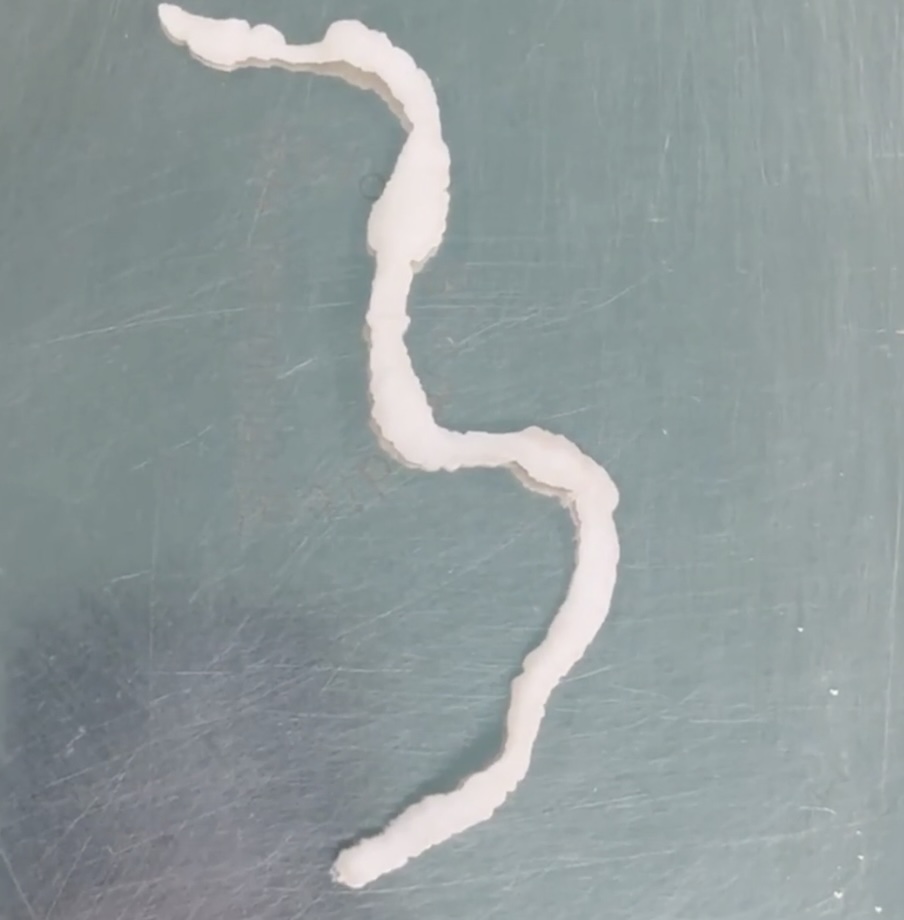
Wandering worms
After the surgery, a genetic test identified the worm as Spirometra erinaceieuropaei, which causes a tapeworm infection called sparganosis. These worms can be found in animals worldwide but are generally rare in humans. Their lifecycle is relatively complicated. Adult worms parasitize dogs and cats, which shed eggs in their feces. The eggs hatch in water, and the larvae are taken up by small crustaceans (copepods), the first intermediate host. The larvae develop and move into their second intermediate host—fish, amphibians, and reptiles—that eat the crustaceans. Normally, the larvae would complete their lifecycle when a cat or dog eats an infected second intermediate host. The developed larvae mature into adults and begin shedding eggs from the animals’ intestines. But humans disrupt the cycle by picking up eggs in contaminated water or eating undercooked fish, reptiles, or amphibians.
Humans aren’t definitive host for the worms, and they become destined to aimlessly wander through our meat sacks. In rare instances, they can mature in the intestines and spew out eggs to complete their lifecycle. But most often, they migrate around and nestle elsewhere. They can be found almost anywhere in the body. Their movement is generally painless, but symptoms of the infection vary widely based on where they decide to settle. If it’s in the brain or spine, it can cause a range of neurological symptoms, for instance. In the man’s case, the worm’s final destination was apparently his abdominal cavity.
Oddly, the man told doctors that this wasn’t the first worm that had been pulled from his abdomen. Four years prior to his surgery for his right-side inguinal hernia, he had undergone surgery for a left-side inguinal hernia. In that procedure, surgeons had incidentally come upon another worm, which was 18 cm (7 inches). For unexplained reasons, the worm was not identified, and he was not treated with anti-parasitic drugs after the discovery.
After this second surgery and worm discovery, his doctors put him on anti-parasitic medication to kill off any possible remaining worms lurking in him. They also tried to figure out how the worms got there in the first place. The man’s only recollection of a possible exposure was eating raw snake meat during military service 50 years prior. While Spirometra are known to have long lives in humans, the lifespan is typically reported as being around 20 to 30 years.