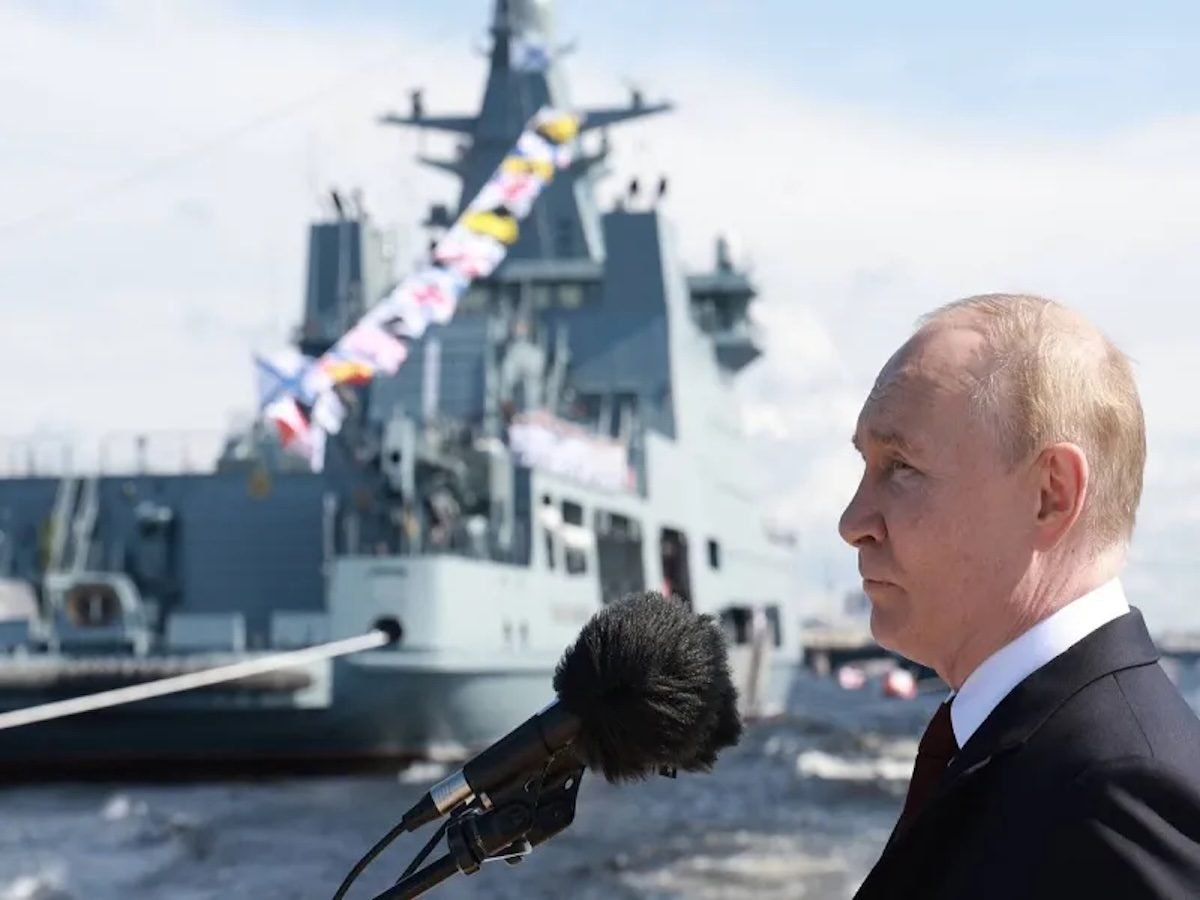

Commander of the Estonian Navy Ivo Vark told Reuters that Estonia won’t board vessels that are part of Russia’s “shadow fleet” any more since “The risk of military escalation is just too high.”
He elaborated: “The Russian military presence here in the Gulf of Finland has become much, much more evident” due to new, permanent Russian naval patrols but “in the Atlantic Ocean and also the North Sea there’s very little Russian presence.” Russian vessels are thus more likely to be boarded there than in the Baltic.
The aforementioned patrols are the result of Chairman of the Russian Naval Board Nikolai Patrushev’s efforts, which he spoke about in an interview in mid-February that was analyzed here at the time. Reuters also reported that the news service’s “reporters aboard an Estonian navy vessel in the Gulf of Finland on Friday observed a Russian navy corvette near a large group of idle tankers awaiting their turn to enter a nearby Russian port and load oil.” That, too, is due to Patrushev.
All that it took was the Russian Navy’s presence to get Estonia to back down, thus suggesting that escort missions could get other countries to back down in waters farther afield. For that to happen, however, the Russian Navy would have to escort groups of “shadow fleet” vessels since it doesn’t have enough ships to accompany every single vessel on a one-by-one basis. Most go to China and India so these would be lengthy missions practically circumnavigating Eurasia via the Suez Canal.
It’s around there where the US and/or its allies could more easily board these vessels if they have the will – but likely only with Egypt’s approval since they’re not expected to violate their ally’s sovereignty by staging such missions in its territorial waters at the entrance or exit of the canal. The British bases in Cyprus could be employed in support of such missions in that scenario as could the US base in Djibouti if the decision is made to intercept these vessels near the Bab el Mandeb chokepoint instead.
The UK isn’t expected to unilaterally board Russian “shadow fleet” vessels escorted by the Russian navy so that would only happen with US approval. The UK might also seek American participation in any such mission as a guarantee that it won’t be hung out to dry if Russia escalates. The US might not approve of that, let alone take part in it, since Putin likely authorized his navy to act against any forces that attempt to board escorted tankers and Trump doesn’t seem interested in an escalation right now.
To ensure that neither the Americans nor the British recklessly assume he’s bluffing, Putin might make a public statement to this effect, though the Anglo-American Axis might then resort to supporting Ukrainian drone attacks against Russia’s escorted “shadow fleet” so that Kyiv is the one against which Moscow might then retaliate. Ukraine is already suspected of having a drone base in Libya from which it bombed two “shadow fleet” vessels so far, and it might expand its presence there with its patrons’ support to stage more attacks.
All in all, while the Russian Navy got Estonia to back down from boarding any more of its “shadow fleet” vessels and might deter others, too, if they begin escorting groups of these ships, Ukrainian drones are still a threat. Other than including anti-drone technologies in future convoys, Russia might request that the US order Ukraine to end its attacks as part of a series of mutual compromises for ending the conflict, which is the best way to ensure the safety of its energy exports at sea since Ukraine won’t defy the US.