A year or so after the full-scale invasion of Ukraine, the city of Murmansk in Russia’s Arctic north-west marked its annual regional day with a celebration for children. Alongside the sons and daughters of Russian soldiers stood children taken from the occupied Prymorskyi district of Ukraine’s Zaporizhzhia region.
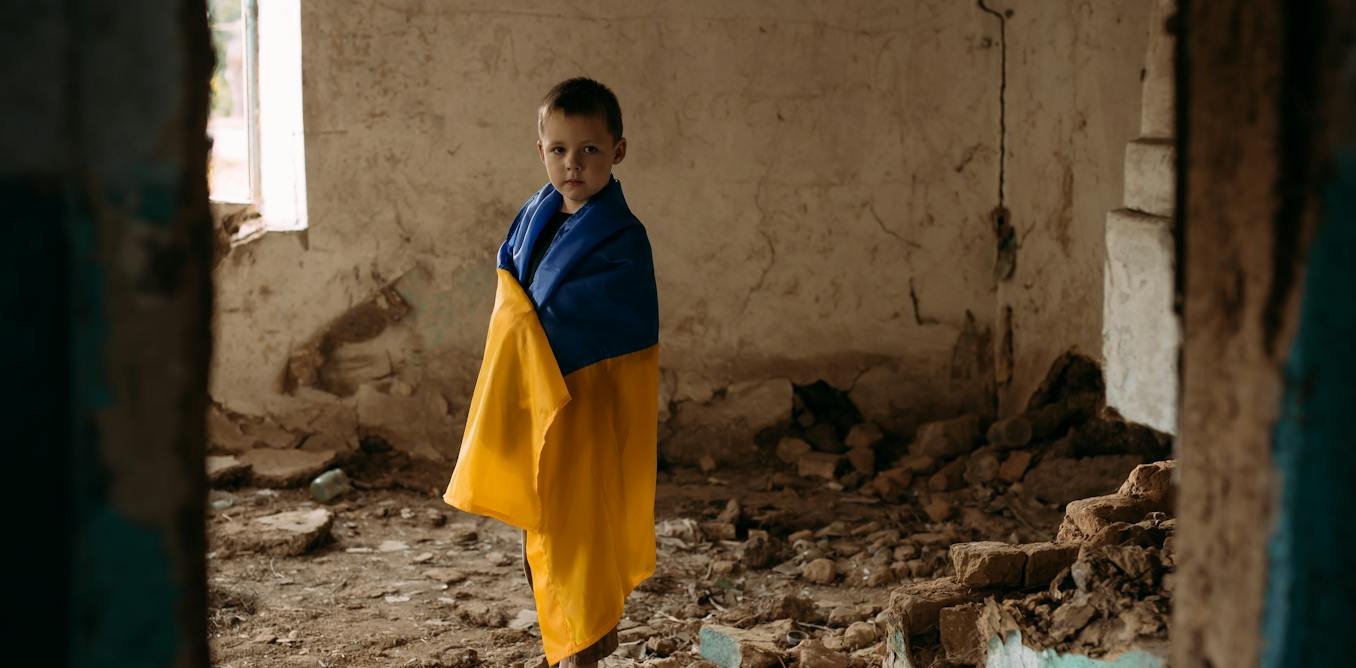
Ukraine’s authorities have verified 20,651 cases of children deported or forcibly displaced to Russia and Belarus since 2022. Some estimates, including figures shared by Russian officials themselves, run as high as 744,000. As of September 2026, just 2,644 Ukrainian children have been returned.
The International Criminal Court issued arrest warrants for the Russian leader, Vladimir Putin, and his children’s commissioner, Maria Lvova-Belova, in March 2023 for their roles in this campaign.
But the Where Are Our People? project, which I work alongside, has identified at least 47 Russian and Belarusian individuals directly involved in the deportations. These people range from regional governors to business executives. Only some of them are under western sanctions.

My work, which I carry out with colleagues at King’s College London, involves tracking the fate of deported Ukrainian children through regional government documents and the social media posts of Russian officials. Our findings suggest that child deportation is not a byproduct of war, but a systematic instrument of occupation.
In the short term, the deportation of children means control over families in occupied Ukraine. Children are removed from occupied areas under the banner of “rehabilitation” or “health holidays” to escape active conflict. They are then placed thousands of miles away in Siberia, the Arctic or far east.
Their personal data is concealed and some children are placed with Russian families. For parents left behind in occupied cities such as Melitopol or Mariupol, preserving the possibility of getting their children back means complying with the Russian authorities on their terms.
Russia’s longer game is to ensure the next generation of Ukrainians from the occupied territories do not think of themselves as Ukrainian at all. Researchers at Yale University’s Humanitarian Research Lab have mapped 210 facilities inside Russia where deported Ukrainian children are held and subject to re-education or militarisation.
This harm will outlast any ceasefire. Researchers say deported children who eventually return to Ukraine face a “dual adaptation” – not a restoration of pre-war life but a renegotiation of it. They have to adjust to new surroundings while rebuilding an identity that has been suppressed for years. Ukraine has no unified state programme to support these people.
A reserve for the army
Children who remain in occupied Ukraine are subject to re-education and militarisation, too. Roughly 1.6 million Ukrainian children are currently living under occupation, of which at least 582,000 are of school age.
These children are taught to Russian standards. Mandatory weekly lessons called “Conversations about important things” began in 2022 in schools throughout the occupied territories. Russia’s education ministry specifies what these important things are.
In occupied Zaporizhzhia, these lessons teach students about the region’s liberation from the Nazis in the second world war and the supposed “return of Nazism” to Ukraine after 2014, when the pro-Russian government of Viktor Yanukovych in Kyiv was ousted from power. The lessons cast Russia’s invasion as a second liberation.
Children who have since left occupied territory describe teachers praising Russia’s so-called “special military operation” in Ukraine, showing films that glorify the war and inviting Russian soldiers to class who urge pupils to stand ready to defend the “motherland”.
Inside Russia, the “Conversations about important things” lessons are meant to reinforce loyalty to the state. In occupied Ukraine, they serve a different purpose: replacing children’s Ukrainian identity with a Russian one.
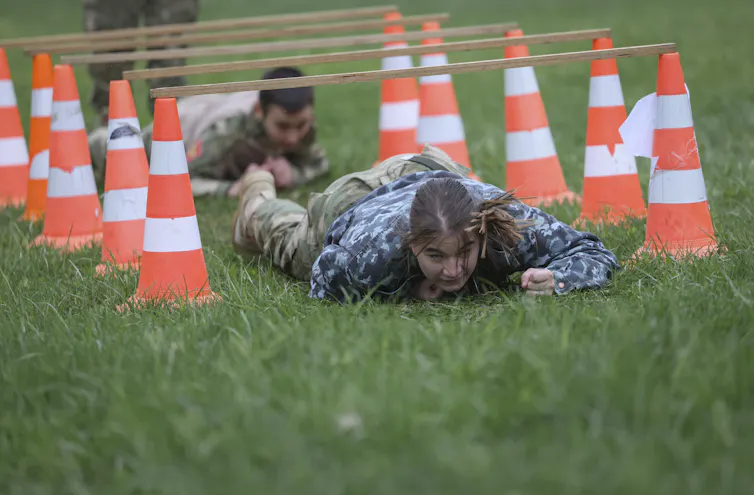
Primary school pupils in occupied Ukraine are also enrolled in Orlyata Rossii (Eaglets of Russia). This is the junior wing of the Kremlin’s Movement of the First for Russian children and a revival of the Soviet-era “Little Octobrists”, which provide children with military training such as assembling weapons and operating drones.
In occupied Zaporizhzhia alone, the programme is thought to have more than 10,000 participants across 97 schools. Children are ceremonially “consecrated” as eaglets, and the results can be stark.
One Ukrainian girl, deported from Donetsk in eastern Ukraine in 2022 and enrolled in the programme at a school near Moscow, was photographed a year later beside boxes of aid collected for Russian soldiers fighting against her own country.
Tens of thousands of young people from occupied Ukraine have also been enrolled into the Yunarmiya (“Youth Army”), which was founded with Russian military support in 2015 and now has more than 2 million members. The Yunarmiya trains children and teenagers in basic military skills and physical conditioning, while also providing them with patriotic education.
None of this is new. The Ukrainian region of Crimea, which Russia formally annexed in 2014, was the testing ground for this system. The overall number of cadet classes in schools in occupied Crimea rose from 12 in the 2016-17 academic year to 260 in 2024-25, indicating a systematic militarisation of the educational space.
Children living in Russia or occupied Ukraine are being taught that Ukraine is the enemy – and are becoming the soldiers sent to fight it.
Ukrainian officials say that between February 2022 and July 2025, Russia mobilised over 46,000 residents in occupied territories into its army. In occupied Donetsk alone, more than 3,500 students were mobilised in the first year of the full-scale war, and 70 were killed.