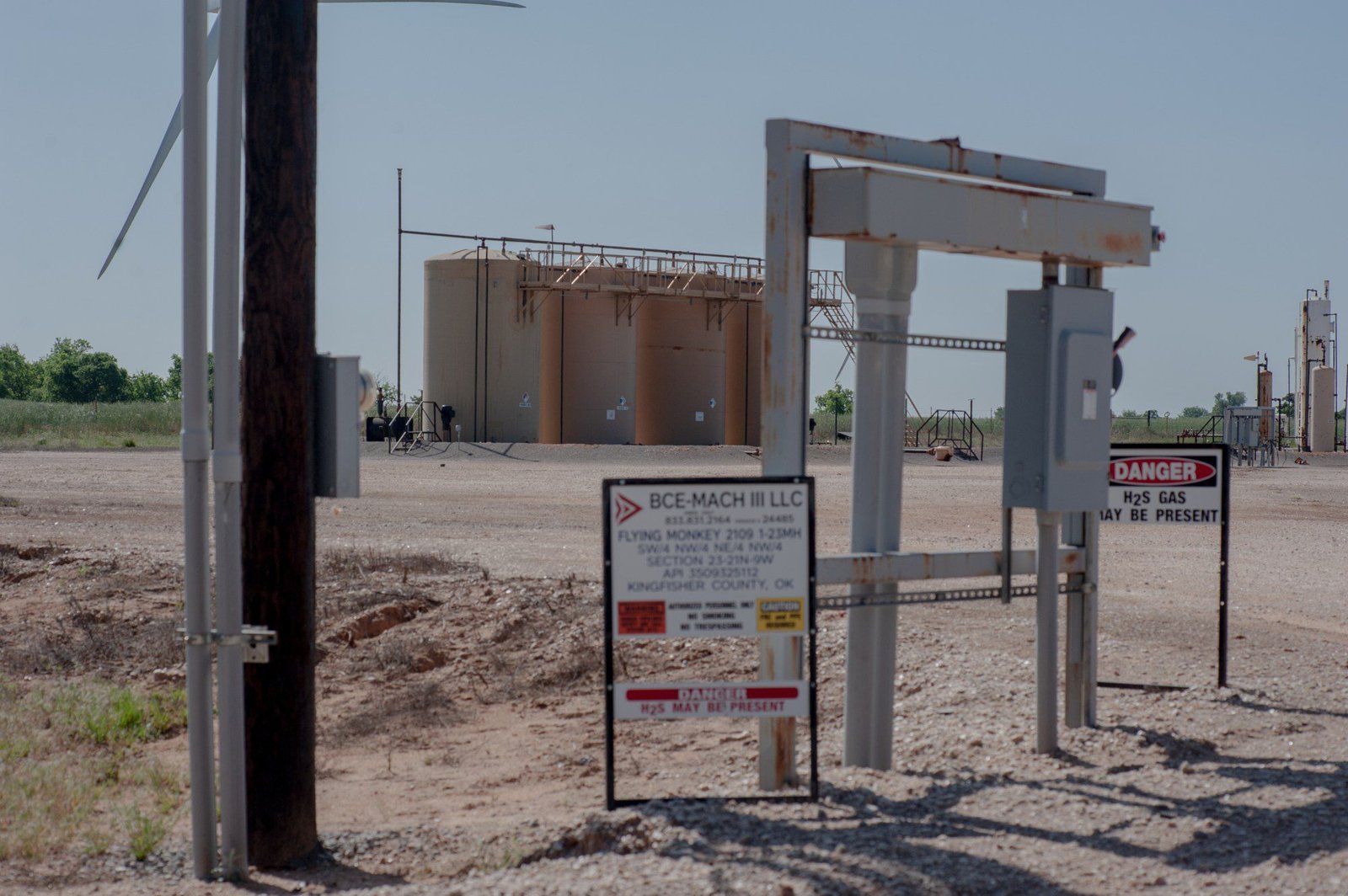
An Oklahoma oil and gas company plugged a well that disposes of oil production’s toxic byproduct after an investigation by The Frontier and ProPublica revealed that regulators had approved the well in violation of state rules meant to protect public groundwater supplies.
The disposal well, named the Flying Monkey, injected oil field wastewater underground and sat roughly a quarter-mile from two municipal groundwater supply sites that served the small city of Enid in northwest Oklahoma. Wastewater injection operations are banned within a half-mile of public water wells unless regulators hold a hearing to ensure that this activity will not pollute groundwater. Regulators at the Oklahoma Corporation Commission did not hold a hearing before approving the well in 2018.
The city of Enid filed a complaint last year asking the state to revoke the Flying Monkey’s permit to operate.
On Sept. 14, with the complaint still active in the agency’s administrative law court, employees of the Flying Monkey’s current owner — BCE-Mach III Midstream Holdings LLC — dropped a cast iron plug into the bottom of the well, followed by more than 200 sacks of cement, to permanently seal it off, according to a report the company filed to the corporation commission. A representative of the state was on site to witness the plugging.
Eric Huddleston, an attorney representing BCE-Mach III Midstream Holdings, which acquired the Flying Monkey in 2020, said the company decided to permanently shut the well after determining it was “underutilized and operationally unnecessary.” A spokesperson for the corporation commission did not respond to requests for comment, including about the agency’s role in the well’s closure.
Enid city officials said they did not know the well had been plugged until our reporter informed them.
“This decision is, for lack of a better word, thrilling because this is such a vital issue,” said Frank Baker, an Enid city commissioner. “Our water sources have been put in danger, and for this one well to have been plugged, this is the best possible outcome.”
In Enid’s 2025 complaint to the state, its lawyers noted that the Flying Monkey’s original operator, Hinkle Oil & Gas, had incorrectly checked a box on its permit application stating that the injection well was not within a half-mile of a public water supply well. “This was demonstrably false,” Enid’s lawyers wrote. Hinkle previously declined to answer questions about the Flying Monkey. Earlier this year, BCE-Mach III Midstream Holdings refiled a permit application for the Flying Monkey, where it acknowledged the proximity of the city’s water supply wells.

The Flying Monkey had a checkered operational history. In the last five years, the state has shut down the wastewater disposal well repeatedly after it failed tests of its structural integrity. These failures can indicate a problem that might allow wastewater to escape, potentially threatening drinking water sources. The well had failed five of these tests since 2021.
In early July, nine days after the newsrooms’ investigation published, the Flying Monkey’s owner reported another leak in the well’s tubing. The state gave BCE-Mach III Midstream Holdings 90 days to fix the leak or to permanently plug the well.
Our investigation identified two other wells in Enid that violated the state distance rule between wastewater injection wells and the city’s groundwater supply sites. Both of those wells, which are owned by other companies, remain active.
Read More
The proximity of wells to drinking water isn’t only an issue in Enid. Across Oklahoma, the news outlets identified at least 114 injection wells that were located within a half-mile of a public water supply well. More than 300,000 Oklahomans live in communities that rely on these water wells, according to our analysis.
Baker, the Enid official, told The Frontier and ProPublica that he hopes the corporation commission will begin to plug other injection wells that threaten public water supplies.
“I hope and pray this is an example that we’ll start to see replicated across the state in the near future,” he said.
In addition to its request to plug the well, the city of Enid has asked the corporation commission to impose stronger regulations on oilfield wastewater disposal near its water supply, including a wider distance buffer between the injection sites and the city’s water wells. This request comes amid a recent uptick in wastewater injection in the Enid area, according to a legal filing made by the city. The commission previously declined to comment on Enid’s complaint because it is an active case. The case will continue to be heard in the agency’s administrative law court later this year.