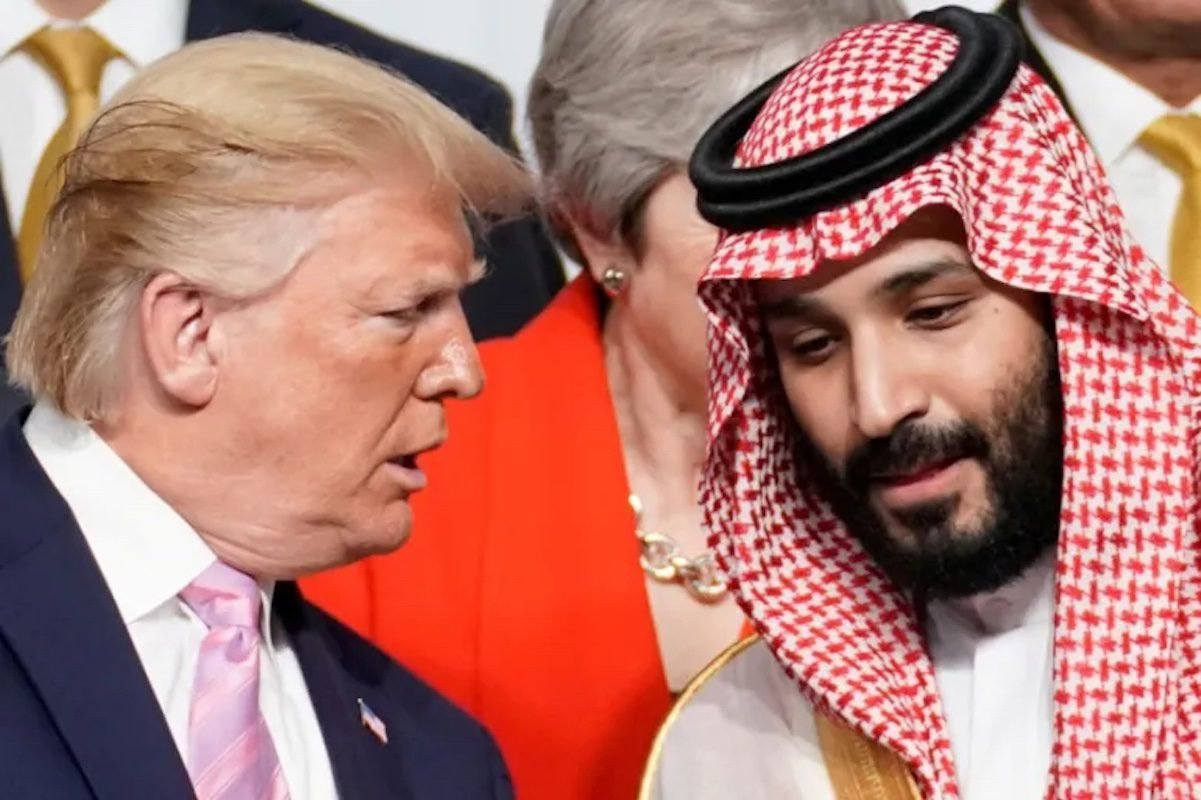
“Saudi Arabia does not want to acquire any nuclear bomb, but without a doubt, if Iran developed a nuclear bomb, we will follow suit as soon as possible.”
This sentiment from Saudi Crown Prince Mohammed bin Salman might come true sooner than expected. The recent US-Saudi nuclear agreement, set against this stated intention of the Saudi leadership, raises serious concerns about whether the program will stay confined to civilian use.
A shift toward weaponization would push the entire region into a nuclear arms race, resulting in overt militarization of the Middle East.
Saudi Arabia, a major US ally, is already locked in fierce competition with Iran. The US-Israel war on Iran has seriously jeopardized Saudi security, raising concern in the kingdom over its own sovereignty. Those concerns have deepened following Iranian retaliatory strikes on Gulf states, including Kuwait, Bahrain, Qatar and Oman.
Iran’s main Yemeni proxy, the Houthis, are currently attacking the Saudi mainland and its oil facilities. As the crisis escalates, a direct Iranian attack on Saudi territory cannot be ruled out, which would draw the kingdom into direct conflict with Iran.
The signing of the nuclear deal amid this security environment raises concerns about whether the civil nuclear agreement will stay confined to its stated civilian purposes. The 30-year deal permits the kingdom to build an enrichment facility and to reprocess nuclear waste.
That marks a clear departure from the 2009 “gold standard” civil nuclear deal with the United Arab Emirates, under which Emirati leaders voluntarily forwent enrichment capability and agreed to import enriched uranium for energy purposes.
Saudi leadership, however, has refused such restrictions and aims to build an enrichment facility under the agreement, enabling domestic enrichment for civilian purposes at a globally accepted rate of 6%.
The leadership has also dismissed the International Atomic Energy Agency’s additional protocols and strict inspection mechanisms. This approach further amplifies concerns about possible weaponization of the civil nuclear program.
US President Donald Trump has added a few stipulations to the deal, including a denial of a domestic enrichment facility. If enforced, Saudi officials may view that condition unfavorably.
Even so, Saudi leadership is unlikely to accept it and will continue pursuing enrichment capability. They will not accept a nuclear deal as restrictive as the 2009 gold standard agreement between the US and the UAE.
The US has also indicated it will require strict inspection mechanisms to prevent weaponization of the civil nuclear program. Still, there are clear precedents for a civil nuclear program being diverted to build weapons — India’s 1974 “Smiling Buddha” test is one clear example.
Aside from Saudi Arabia, no country has stated its intention to build nuclear weapons so explicitly before even beginning a civil nuclear program. Given that history, the kingdom’s openly stated intentions, and tangible security concerns, the prospects for future weaponization of the Saudi nuclear program appear real.
President Trump has also made acceptance of the Abraham Accords a precondition for the agreement. Saudi leadership is unlikely to agree to that demand, though that alone would not derail the deal’s long-term prospects. Negotiations have been underway since the Biden administration and, even if delayed, are expected to resume.
If President Trump remains in office through the midterm elections and completes the remainder of his term, he will likely be compelled to follow through on the agreement, since the US cannot risk Saudi Arabia turning to a Chinese or Russian nuclear deal instead.
Should Trump leave office early, his successor would likely be even more receptive to completing the deal, given that Saudi Arabia is America’s most important Middle East partner and Washington cannot strain ties with the kingdom indefinitely.
The US-Saudi nuclear deal will likely be finalized sooner or later, but its implications for the regional strategic order will be graver than expected. Weaponization of the Saudi nuclear program cannot be ruled out, and that could push other regional powers to follow the same path.
Iran’s new supreme leader, Ayatollah Mojtaba Khamenei — who succeeded his assassinated father, Ali Khamenei, and is backed by hardline Revolutionary Guard commanders — is seen as more open to pursuing nuclear weapons.
The credibility of the elder Khamenei’s anti-nuclear fatwa is fading, and the prospects for Iranian nuclear weaponization loom larger amid Saudi nuclearization.
The Saudi leadership’s nuclear ambitions will also likely push other regional powers, such as Turkey and Egypt, to pursue a similar path, driving the region into a severe nuclear competition and triggering a broader arms race. The nonproliferation regime is already under severe strain following the announcement of the US-Saudi nuclear deal.
A volatile region like the Middle East — already gripped by conflict involving Iran, the US, Israel and Gulf states — cannot easily absorb the added complication of a nuclear dimension. The deal will likely heighten nonproliferation concerns and deepen security anxieties across the region.
Hamza Zaman is an assistant research associate at the Islamabad Policy Research Institute, Pakistan. He holds an M.Phil. degree in international relations from Quaid-i-Azam University, Islamabad.