
Eoin Higgins is the author of “Owned: How Tech Billionaires on the Right Bought the Loudest Voice on the Left.”
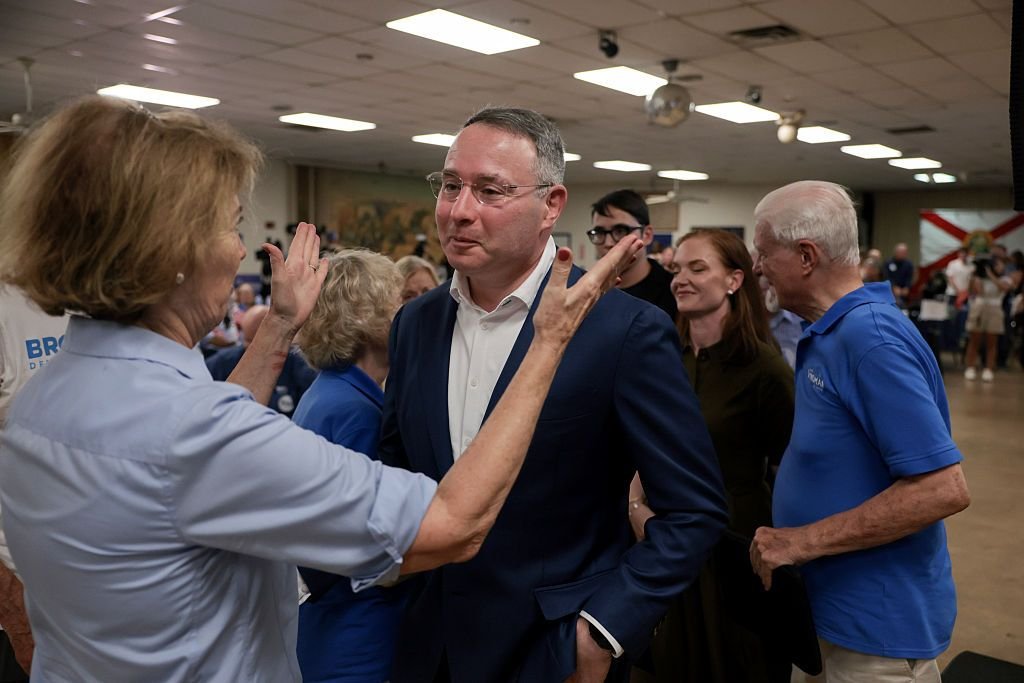
Alexander Vindman lost to Angie Nixon in the Florida Democratic senatorial primary on Tuesday, marking a long-overdue end to one of the worst liberal mass delusions of the Trump era: Russiagate.
Vindman’s loss offers a number of opportunities for schadenfreude, from the comeuppance for his wife’s sneering at Nixon’s clothes to the staggering spending advantage he had over his opponent, a Democratic Socialists of America member — but it’s the bell tolling for neocons cynically taking advantage of conspiracy theory-minded liberals that’s the most gratifying reason for the loss.
This cohort faltered at the ballot box in 2026. Vindman follows heroes of the Trump 1.0 #Resistance like George Conway and Dan Goldman, both of whom found that resting on the laurels of opposing Trump six years ago wasn’t enough to push back against more dynamic opponents who offered actual policy plans.
Over the past decade, these conservative Democrats and “Never Trump” Republicans relied on liberal fears of Russian election interference and shadowy Moscow kompromat over the president to leverage influence in the party.
Many Democrats and their allies in the media bought into the idea that only a nefarious, Kremlin-driven plot could have led to America electing Trump.
From the beginning, Russiagate was used by a shellshocked liberal establishment to explain away Trump’s victory in a way that didn’t implicate the Democrats. Rather than address what it was about Hillary Clinton’s political platform — and the preceding eight years of President Barack Obama — that opened the door to MAGA, many Democrats and their allies in the media fully bought into the idea that only a nefarious, Kremlin-driven plot could have led to America electing Trump.
This was an attractive proposal, and it found an enthusiastic, if niche, audience. Democratic voters responded well, notably to commentators at MSNBC like Rachel Maddow, who went all in on the conspiracy and pushed it far beyond what was plausible.
As MSNBC and, to a lesser extent, CNN, found ratings success with the largely fabricated scandal, the infection spread across legacy media. The New York Times published Louise Mensch, a serial fabulist whose Twitter feed was a laundry list of delusions, in the opinion section. The Washington Post reported an implausible story that Russians were targeting the Vermont energy grid.
Grifters of all stripes quickly adapted their cons to the new game. In one notorious example, a Twitter user named Eric Garland skyrocketed himself to online notoriety by spinning up a “game theory” Russiagate fantasy where a secret, Avengers-esque team of liberal politicians were using the scandal to beat Vladimir Putin at realpolitik (how, exactly, this was going to happen went unaddressed). The thread was praised as “great writing” by notable media figures; today, Garland is a gutter-level antisemite aligned with far-right gadfly Chuck Johnson whose conspiracy theories are utterly incomprehensible.
In one of the more amusing, and egregious, examples of the hysteria, pundit Jonathan Chait improbably claimed that Trump may have been an agent of the KGB going back to the early 1980s — a preposterous story that nevertheless netted him primetime appearances on cable news.
In Washington, Russiagate mania supplanted actual policy priorities for Democrats both before and after they retook the House in the 2018 midterms. As I wrote nearly nine years ago at Fairness and Accuracy In Reporting, establishment media allies like Maddow were so narrowly focused on Russiagate in the early Trump years that they often ignored or papered over instances of corruption and corporate power in lieu of fomenting the conspiracy theory.
Establishment media was so narrowly focused on Russiagate in the early Trump years that they often ignored or papered over instances of corruption and corporate power in lieu of fomenting the conspiracy theory.
Whether this effort was intentional or not is somewhat irrelevant; the net result was the stifling of the Bernie Sanders wing taking over the party and a reassertion of the neoliberal, corporate-friendly establishment’s control of the levers of power.
Unsurprisingly, many of the same figures are endorsing that approach again as progressives are winning primaries by focusing on affordability and ambitious policy proposals rather than simply “Trump bad.” In an essay for The Atlantic on Thursday, Chait argued Vindman’s loss didn’t detract from the correctness of resistance liberalism and its singular focus on Trump — and instructed Democrats not to try to offer voters any actionable policy: “Rather than promise to change everything about American politics, focus relentlessly on Trump’s unfitness.”
That’s a message that’s soothing to the elite liberal class Chait writes for, but it’s unlikely to find much purchase among voters, Democratic or otherwise. The public is burnt out on one-trick-pony versions of escaping the Trump era. And Trump’s second administration has exposed the rotten house of cards keeping the U.S. state afloat, making systemic change an imperative.
For Democrats, that has meant turning to candidates like Nixon, as well as Michigan’s Abdul El-Sayed and Maine’s Troy Jackson. It leaves the neocons who used Russiagate as a way to pivot and rebrand their way out of a party singularly devoted to Trump and into the welcoming arms of the Democratic establishment in a predicament. They’re realizing, with rising panic, that they’re not going to be able to dictate the party’s future as Democrats shift away from Israel and express their support for Palestine and a robust welfare state.
The public is burnt out on one-trick-pony versions of escaping the Trump era.
Some of the Russiagaters are already pivoting back to the right, like Michael Cohen, the former Trump lawyer who became the toast of liberal media after deciding to oppose the president in a self-serving effort when facing prison time. On Thursday, Cohen had his former client on the radio Thursday for a friendly chat.
Others, like The Bulwark’s Bill Kristol, are bullish on liberalism (although, as anyone who remembers the Iraq War knows, they still can’t be trusted an inch). Count Vindman, for now, in the latter camp; however, despite his disagreements with Nixon on Palestine and domestic politics, he endorsed her and promised to support her in November.
If this is truly the end of Russiagate’s stranglehold on U.S. politics — and we should all hope that’s the case — then its beneficiaries had a good run. Grifters and partisans were able to use the conspiracy theory to push their agendas and further their careers. Neocons secured a foothold in the liberal establishment which will be difficult, though not impossible, to excise. And the Democratic leadership was able to put off actually offering voters tangible policy that would improve their lives for a decade by focusing on delusional fantasies — a strategy that’s now coming back to bite them at the ballot box.
But for the rest of us, Russiagate was a black hole of political inertia at a time when the country needed strong moral leadership and new ideas. Let’s bury it for good by moving past the conspiracies toward more progressive policy prospects and to political change that does more than focus on Trump.