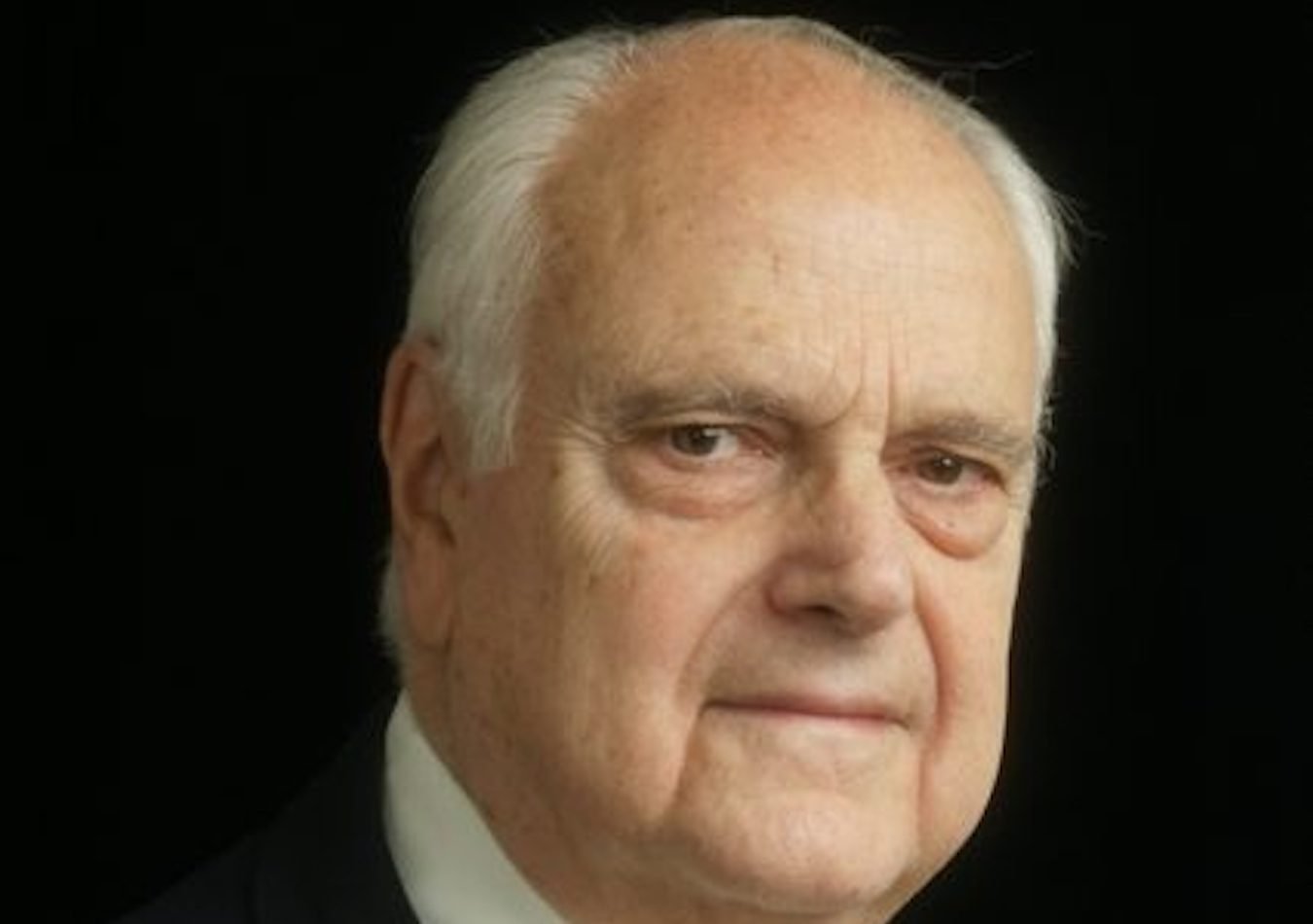
Dr. Norman A. Bailey passed away after a long illness on August 18 in Greensboro, NC. He was 95. A distinguished public servant and teacher, Bailey played a leading role in the Reagan administration’s strategy to defeat the Soviet Union in the Cold War.
Standard histories of the period fail to capture the almost unimaginable temerity of Reagan’s core team, a handful of visionaries who eschewed the conventional wisdom of the early 1980s and did what the Washington consensus deemed impossible.
I first met Bailey in 1981, six months after Reagan took office. He told me that the Reagan administration would achieve an economic recovery and military buildup that together would bring down Communism by 1987. He was off by two years. I thought him mad and immediately agreed to work for him.
The small group of Reaganauts ensconced at the National Security Council – then a team of just 120 staffers – swam against an enormous tide. Former Secretary of State Henry Kissinger was famously quoted in Admiral Zumwalt’s memoirs as predicting a Soviet victory in the Cold War. But Kissinger simply repeated the elite consensus on both sides of the Atlantic.
To the astonishment of the Establishment (and this writer), Reagan’s team led the Free World to victory.
“In the 1980s, the convulsive and enormously expensive Soviet effort to match US sea, air and space power was easily countered and surpassed by the United States…and Soviet reliance on its weapon of true projective power, its missile force, was threatened by a technology-driven defensive strategy (Strategic Defense Initiative),” Bailey wrote in a 1988 monograph.
Even inside the Reagan administration, the advocates of Cold War victory were a minority. Most of Reagan’s advisers thought missile defense an oddball curiosity. But Reagan trusted the great physicist Edward Teller, the father of the hydrogen bomb, whom he met when Reagan was California governor and Teller ran the Lawrence Livermore Laboratory.
The National Security Council staff led by William Clark backed SDI. As a young researcher, I wrote a memo at Bailey’s behest arguing that civilian technological spinoffs of SDI would pay for the program.
As Judge Clark wrote in an introduction to Bailey’s 1988 book, “The president did not believe the legions of ‘experts,’ both inside and outside the government, who asserted that the Soviet Union was an invincible and immutable juggernaut on the geopolitical landscape.” Clark added, “A brilliant but selfless NSC staff played a vital part in bringing about the end of the Cold War.”
Missile defense was years away from practical implementation when Reagan proposed it, to be sure, but the impact on Soviet thinking was enormous: It proved to Moscow’s scientific and military establishment that the US had the resources and will to make massive investments in frontier military technology far beyond the economic and technological capacity of the Soviet Union.
But Reagan and his small group of stalwarts also saw in SDI a way to end the Cold War without a hot war, by shifting the nuclear agenda from offense to defense. Reagan promised to share the technology with the Soviet Union, an offering that prepared the successful arms reduction agreement of 1987.
Bailey also steered US policy through the Latin American debt crisis of 1982-1983. Fluent in Spanish and Portuguese as well as French, he saw the economic rupture caused by sharply rising US interest rates as a strategic risk to America’s position in Latin America. His work anticipated the debt reorganization under so-called Brady Bonds during the second Reagan administration.
Remarkably, the whole of the Reagan revolution was planned and executed in little over two years. By 1983 the Soviet Union was on the defensive, the US economy was booming after four years of deep recession, and the Establishment gradually clambered back into key positions.
Clark left the NSC for the backwater of the Interior Department in 1983, replaced de facto by the stolid Secretary of State George Shultz. CIA Director Bill Casey, who had overruled his Russia chief Robert Gates to advocate victory over the Soviet Union, fell victim to illness in 1986. Bailey left in 1983 after an Oval Office standoff with then-Treasury Secretary Donald Regan over the Latin American debt crisis.
Bailey started a strategic consulting firm after leaving government, returning briefly to public service at the Office of the Director of National Intelligence during 2006-2007. He taught at the Institute of World Politics, a Washington graduate school for national security professionals and diplomats, as well as at the University of Haifa.
And until his final illness, he was an insightful and acerbic commentator on world affairs, including numerous contributions to this publication and numerous books.
Like many of his fellow Reagan revolutionaries, he was too passionate and too brusque for the vapid atmosphere of the Clinton and Bush administrations. In 1981, the country needed tough men and women who could look fearlessly into the abyss.
After the Cold War victory, Washington recycled the losers of the early 1980s into top jobs. Robert Gates, who got every Russia call wrong, reappeared as George W. Bush’s Secretary of Defense.
Bailey was a man of deep erudition. He spoke five languages fluently and had a deep grasp of history as well as economics. He was the authorized English translator of the plays of Luigi Pirandello, and his translations remain in regular theatrical use. His passion was Byzantine history, on which he wrote and lectured. In his 80th year, he converted to Judaism and remained observant through the rest of his life.
Reagan succeeded because his self-taught grasp of world affairs was sounder than prevailing elite prejudices, but also because he was flanked by men and women of high purpose and high culture, with deep knowledge of history and broad global experience.
He is survived by his wife of 25 years, the attorney and epidemiologist Dr, Barbara Billauer, and four children and numerous grandchildren. His writings for Asia Times may be accessed here.
David P. Goldman was business editor and columnist at Asia Times. He now serves on the policy planning staff of the U.S. State Department.