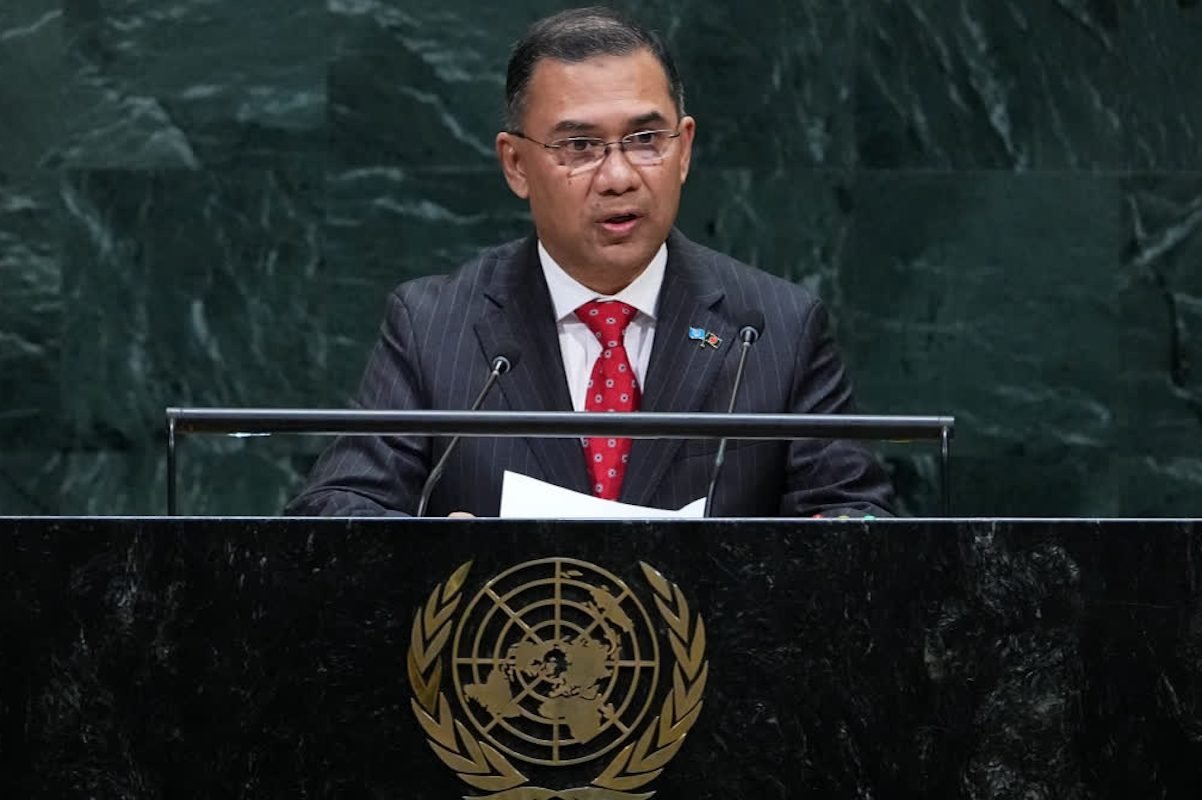
When Bangladeshi Prime Minister Tarique Rahman addressed the United Nations General Assembly for the first time on Thursday (September 24), he became the third member of his immediate family to speak from the UN podium.
His father, President Ziaur Rahman, addressed the General Assembly in 1980, speaking on self-reliance and regional cooperation. His mother, Khaleda Zia, addressed it as prime minister in 1993, with democracy and development among her themes.
“Standing before the United Nations General Assembly, I feel somewhat nostalgic,” Tarique told delegates. After recalling both parents, he added: “In the same spirit, I stand here today to speak for the interests of my country and its people, and with the hope of a peaceful world community.”
Political families spanning generations at the UN are not unprecedented. George H. W. Bush addressed the General Assembly as US president and his son George W. Bush later did the same. Pakistan’s Bhutto family has also been represented across generations in UN diplomacy.
The Rahman [and Zia] case is more unusual because it involves a father, mother and son who each served as national leader and addressed the General Assembly. The three appearances also came at different points in Bangladesh’s political history.
Zia spoke less than a decade after independence. Khaleda addressed the UN following the restoration of parliamentary democracy. Tarique arrived after the 2024 uprising, the interim administration that followed Sheikh Hasina’s fall, and the February 2026 election that returned the BNP to government.
His first UNGA speech was therefore as much an account of Bangladesh’s latest political transition as it was a statement of foreign policy.
Democracy at home, firmer positions abroad
Tarique presented Bangladesh as a country returning to electoral democracy after a prolonged period of authoritarian rule.
He paid tribute to those killed and injured in the July-August 2024 uprising and described the previous period as more than “one and a half decades” of “fascist rule and exploitation.”
That description reflects Tarique and his government’s characterization of Hasina’s rule. His argument at the UN was that the February 12 election had restored political authority to voters. “We believe that the people are the source of all our political power,” he said.
Another line set out his broader argument on governance: “A state can never become strong by keeping its citizens powerless.”
Tarique linked political participation with what he called the “democratization of the economy” — distributing the gains of growth more widely, creating employment, expanding education, supporting women and young entrepreneurs and strengthening social protection.
He also acknowledged that the transition remains incomplete, citing democracy, human rights, good governance, accountability and political stability among the areas requiring further work.
His positions on several international issues were more explicit.
Tarique criticized the diversion of development resources into military spending, supported “complete and general disarmament” and nuclear non-proliferation, and reaffirmed Bangladesh’s support for Palestinian self-determination and an independent Palestinian state.
The Rohingya crisis received particular emphasis. Bangladesh is hosting more than 1.2 million forcibly displaced Rohingyas frm Myanmar, Tarique told the General Assembly.
“The only solution to this problem is the safe return of the displaced Rohingya population to their homeland, Myanmar,” he said.
At a separate high-level event co-convened by Bangladesh and The Gambia, Tarique proposed five measures: a credible roadmap for repatriation, an end to violence against civilians in Myanmar, predictable humanitarian financing, justice and accountability, and stronger cooperation against trafficking, narcotics and illegal arms.
“Humanitarian generosity cannot become an excuse for political inaction,” he said.
The formulation sharpened Bangladesh’s existing position. Dhaka’s argument is that financing refugee camps cannot substitute for addressing the conditions in Myanmar that prevent Rohingya repatriation.
Climate change was another major theme. At a separate high-level meeting, Tarique called for emissions reductions consistent with the 1.5C target, predictable climate financing, greater access to technology, faster deployment of renewable energy and implementation of the Loss and Damage Fund.
Bangladesh contributes less than 0.5% of global greenhouse-gas emissions but is highly exposed to sea-level rise, cyclones, flooding and other climate impacts.
His argument was that countries with relatively small historical contributions to global warming should not bear a disproportionate share of adaptation costs.
Diplomacy beyond the UN hall
Tarique’s bilateral meetings also signaled his government’s foreign-policy priorities.
He met Turkish President Recep Tayyip Erdoğan and Pakistani Prime Minister Shehbaz Sharif. The meeting with Sharif covered bilateral relations as well as regional and international issues. He also met Iranian President Masoud Pezeshkian, an engagement that came amid heightened tensions in the Middle East.
For Bangladesh, the regional instability has direct economic consequences. The country depends heavily on imported energy, while shipping through the Gulf and the Strait of Hormuz affects supply and costs. Millions of Bangladeshis also work across the Middle East and constitute a major source of remittances.
Bangladeshi officials said Tarique discussed stranded ships, energy security, expatriate workers and remittance flows with Pezeshkian and called for a diplomatic resolution of the conflict.
The Iranian meeting also showed Dhaka’s attempt to maintain engagement across competing geopolitical relationships. Bangladesh has been strengthening economic ties with Washington while retaining interests that require engagement with Tehran and other regional capitals.
Tarique and his wife, Zubaida Rahman, attended a dinner hosted by US President Donald Trump and First Lady Melania Trump for visiting world leaders. Their attendance was confirmed, although details of any substantive exchanges with Trump have not been publicly released.
The visit also produced a significant commercial agreement.
On the UNGA sidelines, Biman Bangladesh Airlines signed a supplementary agreement to acquire 11 additional Boeing aircraft — five 787-10 Dreamliners and six 737-8s. The agreement takes Biman’s Boeing acquisition program announced this year to 25 aircraft.
US Commerce Secretary Howard Lutnick and Deputy Secretary of State Christopher Landau attended the signing, giving the commercial deal a clear diplomatic dimension as Dhaka seeks closer economic ties with Washington.
Tarique’s other engagements covered development financing, climate action, Rohingya repatriation, sea-level rise and maternal and newborn health.
Taken together, the speeches and meetings outlined the foreign-policy position his government wants to pursue: restoring democratic institutions at home while maintaining relations across competing geopolitical blocs, pushing harder for Rohingya repatriation, retaining Bangladesh’s established positions on Palestine and climate justice, and using trade and investment to deepen relationships with major powers.
The UNGA visit did not establish how successfully those objectives can be implemented. It did, however, provide Tarique with his first opportunity as prime minister to set them out before an international audience.
The family connection gave the appearance an additional historical dimension. Ziaur Rahman addressed the UN 46 years ago. Khaleda Zia followed 33 years ago. Tarique has now become the third member of the family to do so.
The significance of his debut will ultimately depend less on the family precedent than on whether the policies he outlined in New York are implemented after his return to Dhaka.
Faisal Mahmud is a Dhaka-based journalist.





, he became the)