The Middle East, North Africa, and South Africa form a region of extremes: giant oilfields and gas hubs, world-leading phosphate mines and platinum deposits, some of the planet’s driest landscapes, and coastlines rich in fish
When people talk about natural resources in the Middle East and North Africa, they usually mean one thing: oil. It’s true that this region pumps out roughly 30% of the world’s oil and close to a fifth of its natural gas, thanks largely to Gulf producers such as Saudi Arabia, the United Arab Emirates, Kuwait, and Qatar. But the real picture is much more complicated—and, in many ways, more surprising.
Across the region, some countries sit on world-class mineral deposits, others have enviable coastlines teeming with fish, and many struggle with a far more basic resource problem: not enough water or fertile land. How those pieces fit together helps explain why some economies boom on exports, while others worry about food and water first, and revenue second.
Oil and Gas: The Giant That Shapes the Gulf
IThe six Gulf Cooperation Council states—Saudi Arabia, the UAE, Qatar, Kuwait, Oman, and Bahrain—collectively hold some of the largest and cheapest-to-produce oil and gas reserves on the planet. Saudi Arabia alone has an estimated 267 billion barrels of proven oil reserves, Kuwait has more than 100 billion, and the UAE has close to 100 billion. At current production rates, those reserves are expected to last many decades.
This abundance has clear economic effects. Gulf governments fund a large share of their budgets from oil and gas revenues. Those earnings pay for everything from public-sector salaries to infrastructure, schools, and generous social benefits. When oil prices rise, Gulf fiscal surpluses swell; when prices fall, budgets tighten, and diversification talk returns to the table.
But even within the Gulf, there are contrasts. Bahrain has very modest oil reserves compared with its neighbors and produces only a small fraction of the barrels Saudi Arabia does. Oman has less oil than the big Gulf exporters, but more gas and minerals, and it has invested in logistics and industry. The smaller resource base has pushed both countries to lean harder into non-oil sectors such as finance, logistics, and tourism.
Outside the Gulf, Algeria, Libya, and Egypt are the heavyweights of North African oil and gas. Algeria is Africa’s largest natural gas producer and a major exporter to Europe; Libya’s oil reserves are among the biggest in Africa; Egypt has turned newly discovered offshore gas fields into a growing export business. In all three, hydrocarbons have shaped politics, foreign policy, and economic fortunes—and created vulnerability to price swings and domestic unrest affecting output.
Israel, in contrast, illustrates a different kind of energy story. It barely produces any oil, but recent offshore gas discoveries, such as the Tamar and Leviathan fields, have transformed it from a gas importer into a regional supplier. Israeli gas now helps power its own economy and is exported via pipelines and liquefied natural gas deals that link it to neighbors such as Egypt and Jordan. For a small country without major oil, that shift reduces energy dependence and creates a new export stream.
Water and Land: The Quiet Crisis Beneath the Sand
If oil is the headline resource, water is the quiet crisis. The Middle East and North Africa region has about 6% of the world’s population but less than 2% of its renewable water supply. It is the world’s driest region, with 12 of the world’s most water-scarce countries—including Algeria, Bahrain, Kuwait, Jordan, Libya, Oman, Qatar, Saudi Arabia, Tunisia, the United Arab Emirates, and Yemen.
On average, people in the region have just over 1,100 cubic meters of renewable water per person per year, compared with a global average of roughly 7,000 to 8,500 cubic meters. That figure is projected to drop further as populations grow and demand rises. In Jordan, per capita renewable water availability is only about 60 cubic meters per year—far below the 500 cubic meters threshold often used to define absolute water scarcity.
This scarcity has direct economic consequences. Agriculture, which in many countries uses more than 80% of available water, becomes harder to sustain. In places like Morocco, Syria, and Yemen, farming consumes nearly all accessible water resources. Governments respond by investing heavily in dams, desalination plants, and water-saving technologies, and by importing more food.
The contrast is clear when comparing resource maps. Saudi Arabia may look rich in oil, but it has very little arable land and almost no renewable freshwater. Jordan depends on a handful of overdrawn aquifers and the shrinking Jordan River. Israel, too, is water-stressed, but it has invested in large desalination plants and advanced irrigation, turning water scarcity into a driver of technology and policy innovation.
North Africa has more surface water than the Gulf, especially in the Nile and some river systems in Morocco and Algeria, but large stretches of land are still arid or semi-arid. The region is overwhelmingly desert—about 84% of its land—which limits how much cropland can expand. Between 2003 and 2018, cropland in the wider Middle East and North Africa shrank by 2.4% while the population grew by about 35%, increasing pressure on land and water. The population is forecast to increase by an additional 40% by 2050, according to the World Bank.
Minerals: The Less Visible Treasure
Oil and gas may dominate headlines, but minerals quietly underpin both local economies and global supply chains.
Morocco is a striking example. Beneath its soil lie roughly 50 billion metric tons of phosphate rock, about 70% of the world’s known reserves. Phosphate is an essential fertilizer ingredient, which means Morocco’s deposits are indirectly tied to global food production. A state-owned company, OCP Group, has turned this resource into a massive export industry, making Morocco a key player in global fertilizer markets and a magnet for investment in chemical processing.
South Africa, which sits just beyond the traditional Middle East and North Africa boundary, is another mineral superpower. Its Bushveld Complex holds about 75% of the world’s platinum-group metals—key ingredients for catalytic converters, hydrogen fuel cells, and various high-tech applications. US Geological Survey data indicate that South Africa accounts for the majority of global platinum-group metal reserves and a large share of annual production. It also has enormous manganese resources—primarily a steel-making metal—with estimates suggesting roughly 70% of the world’s manganese resources are located there.
These minerals give South Africa an outsized role in global mining and metal markets, even though it doesn’t have the oil wealth of Gulf states. Mining contributes significantly to South Africa’s GDP and export earnings, shaping its foreign trade and industrial base.
Elsewhere in North Africa and the wider Middle East, mineral resources are more modest but still important. Algeria and Tunisia have various metal and nonmetal deposits, though not on South Africa’s scale. Jordan, for instance, has phosphates and potash that feed into fertilizer exports and the chemical industry more than they do into raw material exports alone.
Fisheries and Coastlines: An Overlooked Source of Wealth
The Middle East and North Africa may look like a stretch of desert on a map, but along its coasts the sea tells a different story. In several places, the waters teem with fish, turning long shorelines into a valuable, if often overlooked, natural resource.
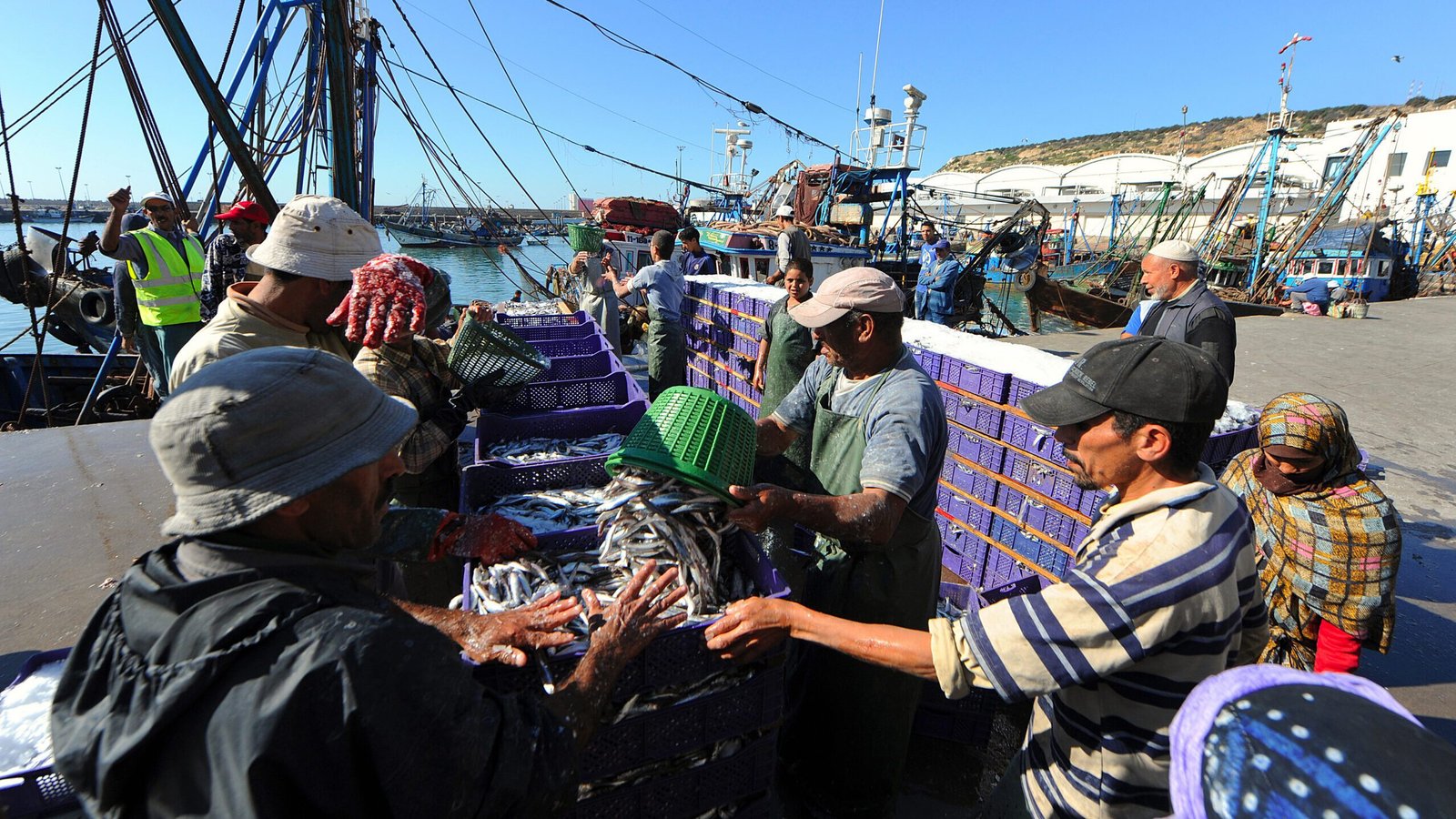
Morocco, with its long Atlantic and Mediterranean coastline, has built a sizable fishing industry. Recent analyses by the Food and Agriculture Organization and academic sources show that Morocco produces around 1.4 million tons of seafood annually and ranks as Africa’s top fish producer and leading fish exporter by value. Sardines alone make up well over half of the capture production. This steady flow of fish supports tens of thousands of jobs, from fishing crews to processing plants, and earns foreign currency, diversifying Morocco’s export base beyond phosphates and agriculture.
Other North African states, including Egypt, Algeria, and Tunisia, also benefit from fisheries, though not on Morocco’s scale. Egypt’s Nile-based aquaculture and Mediterranean fisheries contribute to domestic food supplies and rural employment, even as the country struggles with water scarcity and pollution.
In the Eastern Mediterranean, fisheries are smaller and more pressured. Coastal countries such as Lebanon and Syria have access to maritime resources, but overfishing, pollution and, in Syria’s case, war have limited their potential. Here, fisheries play more of a role in local food and livelihoods than as a major export engine.
When Resources Don’t Guarantee Prosperity
One of the most surprising lessons from looking at this resource map is that abundance does not automatically translate into broad-based prosperity—and scarcity does not doom a country to poverty.
Resource-rich economies such as Libya and Algeria show how political instability, conflict, or governance problems can blunt the benefits of oil and gas wealth. Production disruptions, uneven revenue distribution, and weak institutions can leave citizens feeling little of the theoretical riches beneath their feet.
On the flip side, countries with fewer traditional resources have learned to specialize. Israel and Jordan, both short on oil and water, have invested in technology sectors, services and, in Israel’s case, high-tech agriculture and desalination. Gulf states with oil wealth but limited land have poured money into transport hubs, tourism, finance, and renewable energy projects to prepare for a future in which fossil fuels may play a smaller role.
Across the whole region, water and land constraints force hard choices. Governments decide how much scarce water to allocate to farmers versus cities, how much food to produce domestically versus import, and how to manage environmental risks such as salinization and land degradation. Those decisions, more than the size of an oilfield or mineral deposit, shape the daily lives of most citizens.
A Region of Extremes
Put together, the Middle East, North Africa, and South Africa form a region of extremes: giant oilfields and gas hubs, world-leading phosphate mines and platinum deposits, some of the planet’s driest landscapes, and coastlines rich in fish. The mix of abundance and scarcity is what makes the region’s resource picture so striking.
Oil and gas revenues in the Gulf and North Africa power budgets and exports. Phosphates in Morocco and minerals in South Africa tie the region into global food and clean-energy supply chains. Water and arable land shortages constrain agriculture and push countries to innovate or import. Fisheries provide jobs and food where geography is favorable.
The map of natural resources under and around these countries is not just a backdrop—it’s one of the main reasons their economies look the way they do, and why their futures will be shaped as much by invisible aquifers and mineral seams as by the oil wells that have long dominated the headlines.