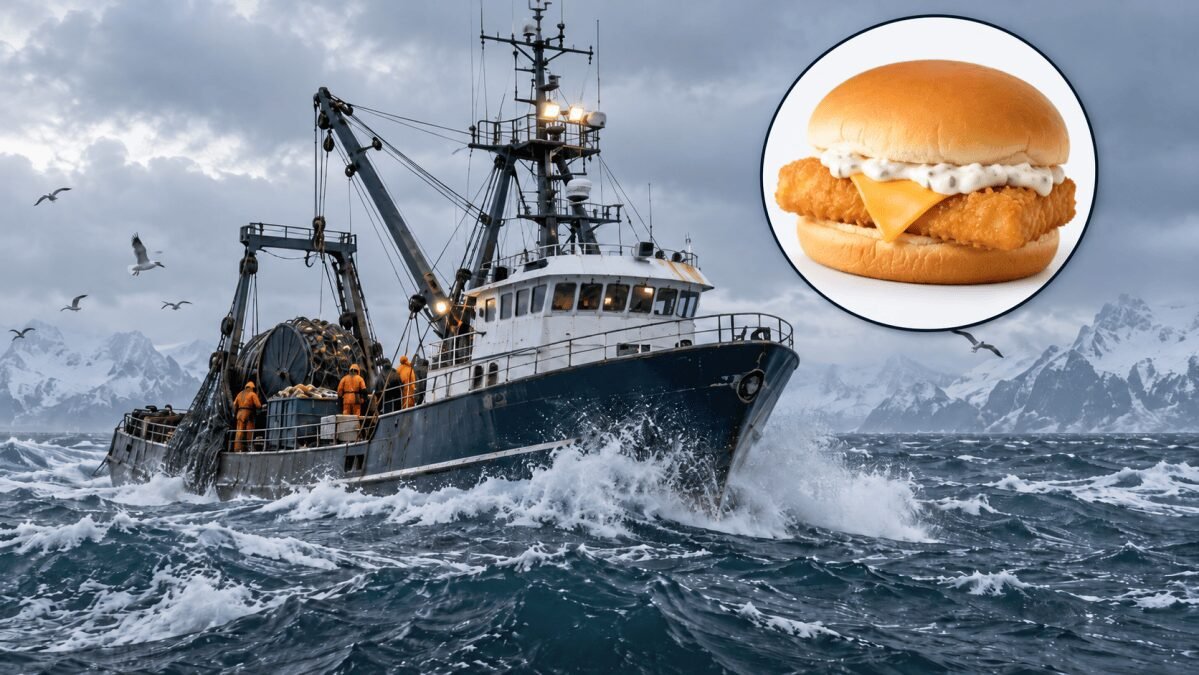
The fishing industry responsible for supplying McDonald’s famous Filet-O-Fish sandwiches is facing growing criticism over its impact on Alaska’s salmon populations, as Native communities struggle to preserve a centuries-old way of life.
Every Filet-O-Fish sold in the United States contains wild-caught Alaska pollock, a whitefish harvested in enormous quantities from the Bering Sea. But the massive nets used to catch pollock also trap salmon and other marine animals, raising concerns about an industry that supplies seafood to millions of Americans.
According to an Associated Press investigation, Bering Sea pollock operations have accidentally caught an annual average of approximately 18,000 Chinook salmon and 288,000 other salmon, primarily chum, over the past decade.
The unintended catch, known as bycatch, represents a relatively small percentage of the industry’s total haul. However, the numbers have become increasingly controversial as salmon populations decline across western Alaska.
For Alaska Native families along the Yukon River, the consequences extend far beyond fishing.
Salmon has provided food, income and cultural traditions for generations. Families have historically spent their summers catching fish, preparing them for smoking and passing those skills down to their children.
Now, severe fishing restrictions have left many communities unable to continue those traditions.
In 2024, American and Canadian authorities agreed to suspend the harvest of Yukon River Chinook salmon for seven years to help struggling populations recover. Similar restrictions have affected chum salmon and fishing communities along the Kuskokwim River.
In the remote Alaska village of Rampart, the changes have been particularly painful.
Brooke Woods, a Koyukon Alaska Native and commissioner for the Yukon River Inter-Tribal Fish Commission, told the Associated Press that her community has lost an important connection between generations.
“We have this big void in our lives right now,” Woods said.
Her 3-year-old son has never experienced setting a salmon net alongside his parents, something previous generations learned from an early age.
Her mother, Janet Woods, questioned why local families face strict fishing limits while large commercial vessels continue operating offshore.
“Why are we the only ones that have to take the burden?” she asked.
The restrictions also create practical hardships. Rampart has no grocery store, and residents must travel hours to reach larger communities for supplies. Traditionally, salmon helped families fill their freezers and reduce their dependence on expensive store-bought food.
Meanwhile, Alaska pollock remains one of the world’s largest commercial fisheries, producing more than 2 billion pounds of fish annually, according to the National Oceanic and Atmospheric Administration.
McDonald’s maintains that its U.S. Filet-O-Fish sandwiches contain pollock from sustainably managed fisheries certified by the Marine Stewardship Council.
Fishing companies also point to extensive safeguards designed to prevent salmon from becoming trapped in their nets.
These include specialized escape devices, independent monitoring, coordination between fishing vessels and temporary closures of areas where salmon are frequently encountered.
During one four-day fishing trip documented by the Associated Press, the crew of the F/V Progress accidentally caught approximately 210 chum salmon.
Captain Maverick Blake said avoiding salmon was an important part of the operation. His vessel burned nearly 3,000 gallons of fuel while traveling to different fishing grounds in an effort to reduce accidental catches.
Industry representatives argue that these efforts demonstrate a commitment to responsible fishing.
However, scientists say the broader salmon crisis is complicated.
Research points to warming ocean temperatures and changing marine conditions as major contributors to the collapse of several western Alaska salmon populations. Federal fisheries officials have also cautioned that eliminating trawl bycatch alone would not reverse the declines.
A 2025 NOAA study examined how changing ocean conditions influence the overlap between salmon and pollock, potentially increasing the likelihood that both species encounter commercial fishing nets.
Genetic testing has also shown that many salmon accidentally caught in the Bering Sea originate outside western Alaska, including fish from other parts of the North Pacific.
Nevertheless, some of the salmon caught belong to the struggling populations that Native communities are being prohibited from harvesting.
NOAA reported that approximately 47% of Chinook salmon caught as bycatch in 2023 originated from western Alaska river systems. The agency also estimated that, since 2011, Chinook salmon lost to pollock fishing represented an annual average equivalent to approximately 1.9% of western Alaska Chinook returns.
Although those figures suggest that bycatch is not the principal cause of the salmon crisis, critics argue that reducing preventable losses remains important when populations are already dangerously low.
The controversy has also become a political issue ahead of Alaska’s November elections, with candidates facing pressure to address industrial trawling and its effects on fishing communities.
Commercial fishermen, charter operators and Alaska Native leaders have raised concerns about whether existing regulations adequately balance the economic benefits of the pollock industry against the need to protect other fisheries.
Federal regulators have already established salmon bycatch limits and avoidance programs, but the debate over whether stronger restrictions are necessary continues.
For McDonald’s customers, the controversy raises questions about what sustainable seafood certification means and whether existing protections go far enough.
For families living along Alaska’s rivers, the stakes are much more personal. The longer salmon runs remain depleted, the greater the risk that younger generations will grow up without learning traditions that have connected their communities to the rivers for centuries.