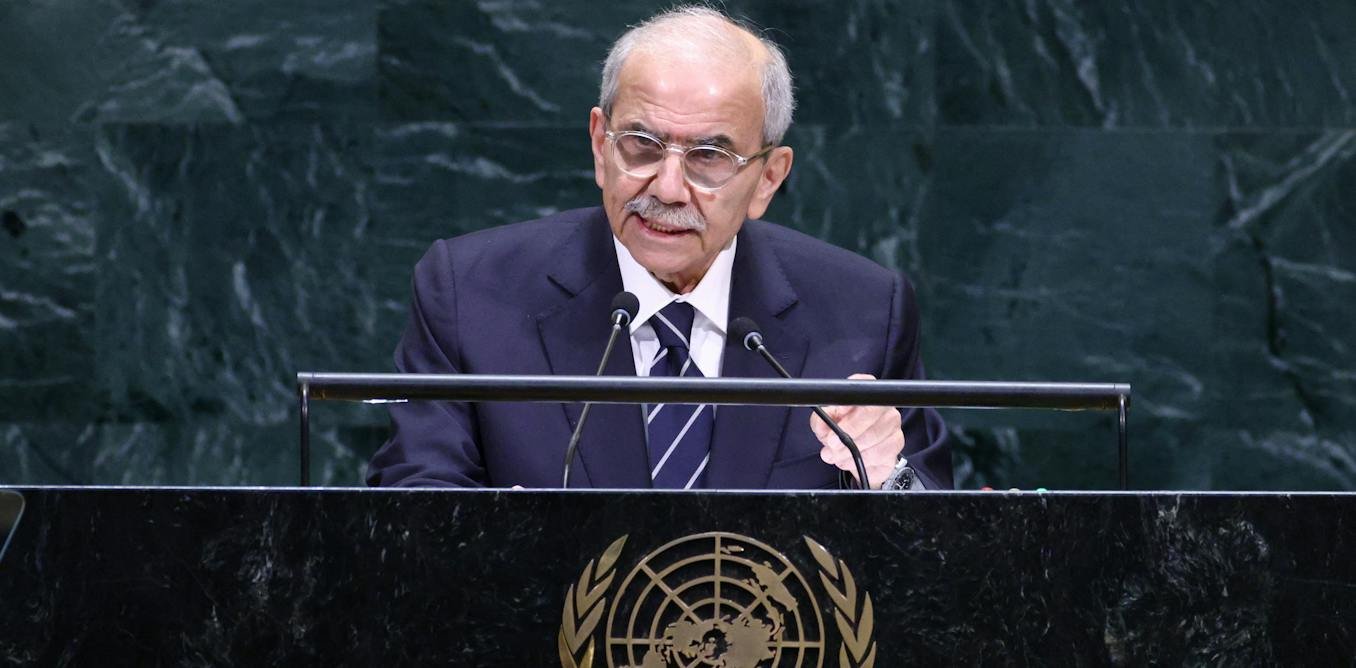
Decisions of war and peace, he continued, belong solely to the Lebanese state. Salam went on to call for a consolidated ceasefire between Israel and Hezbollah, the Shiite political party with a military arsenal, along with the withdrawal of Israeli troops and the implementation of U.N. Resolution 1701, which seeks to establish a weapons-free zone in Lebanon’s south.
The speech was meant to signal to the international community that the government is working to reassert state authority. But back home, many Lebanese saw a large gap between the lofty rhetoric of state authority and the realities on the ground.
Over the past two years, violence has radically transformed the villages and landscapes of Lebanon’s south. Even before then, many Lebanese felt a chasm between the people and the country’s leadership: a perceived failure of the state to act on various issues, from the 2020 Beirut port explosion to the collapse of the country’s currency and financial sector and the fragile security situation. Now, to many in the country, Lebanon has been dragged into unbalanced negotiations with Israel from a position of weakness.
As a scholar who focuses on the dynamics of Lebanon’s politics, I fear that the crises that have befallen Lebanon have placed greater strain on Lebanon’s already fragile power-sharing system, which depends on coexistence among 18 officially recognized sectarian communities. Now more than 80 years old, the arrangement was once held up as a model for countries around the world that are split along ethnoreligious lines.
Lebanon’s power-sharing formula
At its core, Lebanon’s political system rests on a formula in which communities divide political authority among themselves.
Its roots reach back to Ottoman rule, but Lebanese elites reaffirmed it in its modern form twice: in 1943, as the country emerged from the French mandate, and in 1989, with the Taif Agreement that ended the Lebanese civil war.
Under its provisions, the agreement allows for the three main political executive positions to be shared among the three largest groups, with a Maronite Christian president, a Shiite speaker of parliament and a Sunni prime minister. In the parliament, seats are divided equally among Lebanon’s diverse Muslim and Christian denominations; civil service appointments are also structured around sectarian quotas.
For analysts of conflict resolution in deeply divided societies, Lebanon is one of the key cases that inspired the theory of power-sharing developed in the 1960s by political scientists such as the Dutch American Arend Lijphart.
The theory has since become a major framework for understanding conflict resolution in societies divided along ethnonational and sectarian lines. It has been applied in Northern Ireland, Italian autonomous province South Tyrol, Bosnia-Herzegovina, Iraq and Burundi. It has also been proposed for the post-civil war transition in Syria.
At its core, the model rests on what I call “dual avoidance.” This lets warring parties avoid partitioning the country while allowing communities to avoid forced assimilation. They can, for instance, retain control over their own languages, traditions and educational and religious institutions. One scholar equates it to “living apart in the same room.”
Power-sharing risks
In Lebanon, this arrangement has enabled a fragile coexistence that has been tested many times, with the Israel-Hezbollah war that began Oct. 8, 2023, representing the latest.
That war, now intertwined with the broader regional confrontation involving Iran and the United States, has taken a heavy toll on the authority of the Lebanese government. It has exposed the state’s structural vulnerabilities, while reopening debates about the performance of Lebanon’s sectarian political system in managing domestic and external challenges.
Three major risks in particular look set to shape the future of power-sharing in the country.
1. The risk of disarmament
The question of Hezbollah’s military arsenal has been a perennial challenge for Lebanese state formation.
In 2004, U.N. Security Resolution 1559 called for the disarmament of all nonstate groups in the country, yet Hezbollah has consistently refused to give up its arms, citing various reasons including what it views as ongoing Israeli threats. Yet that disarmament was a stipulation of the June 2026 trilateral framework between Lebanon and Israel that was meant to pave the way for future bilateral relations.
The attempted disarmament has sparked a vociferous debate, not only about Hezbollah’s arsenal but about the terms on which Lebanon is negotiating disarmament with Israel.
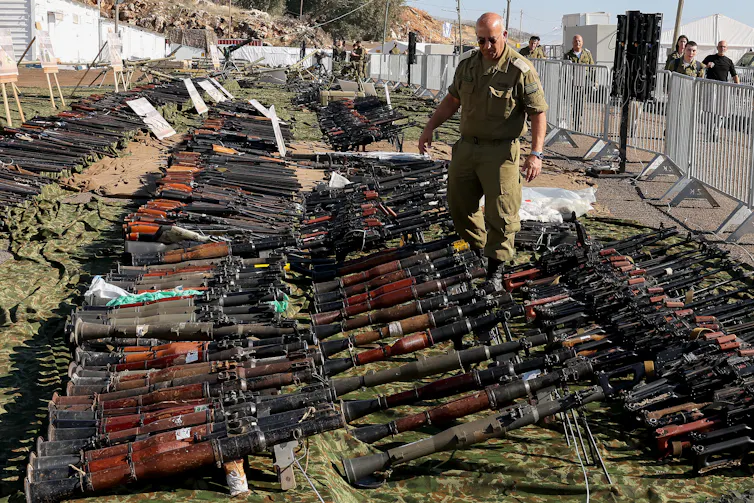
Many fear that Lebanon is bargaining from a position of extreme weakness and that such imbalance will yield only a weaker state, stripped of sovereign decision-making. Here, conflict research offers a cautious reminder: Negotiations conducted under asymmetry tend not to address root causes. Instead, they may breed frustration that lays the groundwork for renewed conflict.
The negotiations between Lebanon and Israel are deadlocked. Hezbollah insists on a full Israeli withdrawal, while Israel conditions its withdrawal on Hezbollah’s disarmament and other security guarantees.
At the same time, many experts question whether the Lebanese army would be able to redeploy effectively to southern Lebanon and consolidate security in such a deeply polarized environment. These concerns come at a time when the U.N. peacekeeping mission in the country, UNIFIL, is drawing down.
While some view the current moment as an opportunity to reduce Hezbollah’s influence over Lebanese politics, there are also broad concerns that efforts to disarm Hezbollah under pressure could revive long-standing perceptions of marginalization within the Shiite community and unsettle the state’s already fragile political equilibrium.
2. The risk of transactional politics
The strength of the Lebanese state is also undermined by the increasing prominence of a transactional vision of Lebanon’s political future by political elites and international mediators, privileging quick fixes over substantive reforms.
One example is the potential bargaining over the sectarian quota system. An idea being floated as a concession to Hezbollah’s disarming is increasing the decision-making role that the Shiite community would play in Lebanon’s power-sharing system. Others have suggested that securing the buy-in of the Shiite community would require a sticks-and-carrots approach, including financial packages to reconstruct southern Lebanon.
These ideas conflate historical security dilemmas posed by Israeli occupation and Hezbollah armament and the intractable Israeli-Palestinian conflict, which has had various spillovers in Lebanon, with adjustments to political formulas or the reconstruction of aid packages.
They also risk reducing disarmament to a matter of bargaining over shares of political power. But they do little to address the underlying drivers of mistrust and the legacies of inequalities in Lebanon.
3. The risk of social breakdown
Finally, Lebanon’s power-sharing system is increasingly buffeted by the breakdown of social cohesion. Massive internal displacement as families have fled areas under Israeli attack have tested the limits of intercommunal coexistence.
Lebanon, which spent years scrambling to formulate policies for refugees displaced by the Syrian civil war that started in 2011, now finds itself contending with a situation that since 2023 has seen more than a million people displaced, mainly from the Shiite-dominated south.
This internal displacement raises profound questions about people’s readiness to share divided spaces in times of crisis.
Many households took displaced families into their homes, and communities set up spontaneous reception centers. Yet, in some areas, displaced people from the south came to be seen as a liability, and neighborhoods came up with their own informal security arrangements to monitor the “coming and going” of so-called “outsiders.”

Looking ahead
The Taif Agreement turned 37 on Nov. 4, 2026. But can the power-sharing model withstand the strain now bearing down on it, or is Lebanon approaching a reckoning with a formula that can be traced back more than 80 years?
From my perspective, the challenges facing the Lebanese state are immense. They span security, the rebuilding of sovereign decision-making and the restoration of state institutions and infrastructure. They also require navigating a ruthless regional environment amid external pressure.
Yet I believe these challenges are not insurmountable. They can be addressed if the state does not lose sight of the original impetus that brought Lebanon’s communities together: the desire to craft politics through coexistence.
Source: Iwpost.com