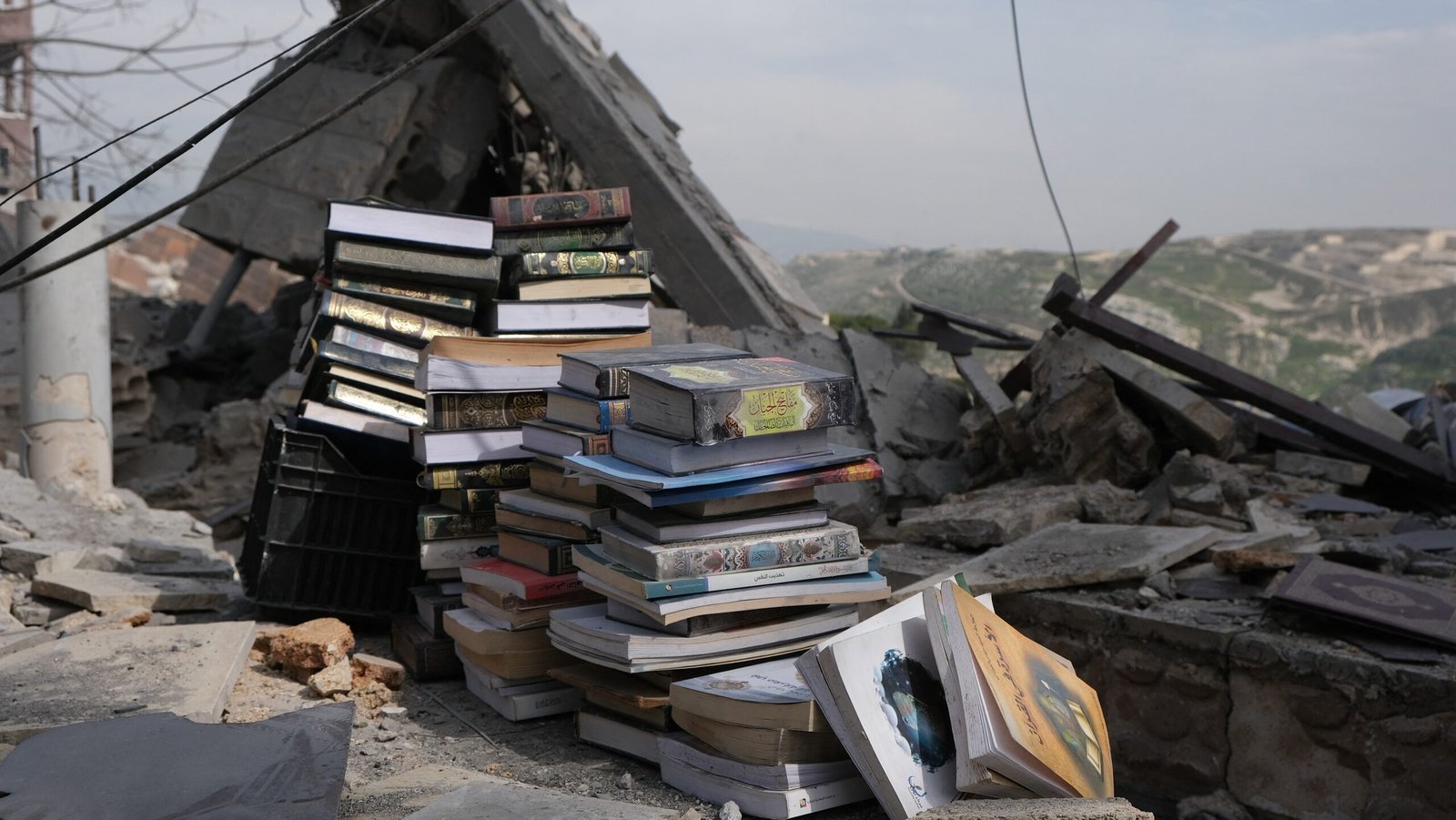
Hundreds of libraries, archives, and collections have been affected by the Israeli military campaign, but the cultural sector is fighting back with public and private initiatives to preserve the memory of its people
During Lebanon’s most uncertain days, many Lebanese turned to reading. While bombs were falling and families were fleeing their homes, books offered a refuge. But books and the places that housed them were also caught in the destruction.
Libraries, schools, universities, publishing houses, archives, places of worship, and cultural institutions have been damaged or disrupted during the fighting. Historic sites have also been affected, leaving books, manuscripts, archives, and other pieces of Lebanon’s cultural record at risk.
The latest war in Lebanon erupted on March 2, two days after the United States and Israel launched attacks on Iran, when Hezbollah fired rockets and drones toward Israel in support of Tehran. Israel responded with airstrikes and later expanded its ground operations in southern Lebanon.
According to Lebanon’s Health Ministry, 4,354 people had been killed, and 12,325 wounded in Israeli attacks between March 2 and Sept. 2. Large areas of southern Lebanon and parts of the Bekaa Valley and Beirut’s southern suburbs suffered extensive damage.
A US-brokered ceasefire agreed in June sharply reduced the large-scale fighting but did not end the violence. Israeli strikes and demolitions have continued in southern Lebanon, while Hezbollah has also carried out attacks. The relative reduction in fighting has nevertheless allowed cultural workers to begin assessing some of what was lost.
“Until now there are no definitive national figures on the number of libraries destroyed,” Wissam Istambouli, a cultural activist working to preserve libraries and cultural heritage in Lebanon, told The Media Line.
His work, along with that of librarians and other cultural organizations, points to extensive damage. Some libraries have lost their buildings or entire collections. Others remain standing but have books, archives and other materials that need to be recovered or restored.
UNESCO has confirmed damage to cultural sites in Lebanon, including Tyre, Beaufort Castle and Chama’ Citadel, and has worked with Lebanese authorities on emergency protection measures. International humanitarian law affords special protection to cultural property, although determining whether damage to a particular site constitutes a violation depends on the circumstances of the attack and the use of the site.
The “One Million Books for Lebanon” campaign is trying to put books back on damaged shelves. Launched by Taleed, the National Network for the Protection of Libraries, Archives and Cultural Heritage in Lebanon, the initiative is collecting books for libraries damaged or destroyed during the war.
Much of the reported library damage is concentrated in southern Lebanon, the Bekaa Valley and Beirut.
Samia works at a bookstore in one of the affected areas and has not yet returned to full-time work. During the war, she turned to historical novels to transport herself to another time and place and momentarily escape the violence that displaced her and her family.
Books were not merely a distraction, but a form of therapy, of healing
“Books were not merely a distraction, but a form of therapy, of healing,” she told The Media Line.
“War not only destroys buildings and kills people, but it also destroys the places where societies preserve their memory,” Istambouli said. “When a library disappears, we lose a part of the history of a person and a family and, in many cases, of an entire community.”
Alongside other specialists in Lebanon’s cultural sector, Istambouli is now documenting damage and trying to determine what can still be restored or recovered.
If we rebuild the houses after the war, but we don’t rebuild the libraries, what society will we have rebuilt?
“If we rebuild the houses after the war, but we don’t rebuild the libraries, what society will we have rebuilt?” he asked.
Writers, poets, researchers, artists, editors, librarians, archivists, academics and other cultural workers have joined calls to protect and restore Lebanon’s cultural heritage.
Istambouli described that effort as being made “in defense of Lebanese cultural heritage and human memory threatened by Israeli aggression against Lebanon.”
He goes further, arguing that some of the destruction should be understood as an assault on memory itself.
“Israeli destruction seeks to turn the place into a void, whereas we want to do the exact opposite: refill the space with knowledge,” Istambouli said. “The aggressor works to erase Lebanese memory, just as it does in Palestinian Gaza.”
Israel rejects claims that its military campaign is directed at Lebanese culture as such. The Israeli military says its operations are aimed at Hezbollah personnel, weapons and military infrastructure and accuses the group of embedding military facilities in civilian communities and, in some cases, near historic sites. Israel has said it takes precautions to reduce civilian harm and considers cultural sensitivities when planning operations.
Lebanese officials and cultural workers dispute Israeli claims concerning some damaged sites and say the scale of destruction has endangered cultural heritage regardless of the intended targets.
For Istambouli, rebuilding libraries is a form of what he calls “cultural resistance,” intended to “prevent a society from losing the tools it needs to remember and tell its own story.”
He reflected on the importance of preserving current and past publications for future generations.
When a manuscript survives, future generations can learn about something that might otherwise have vanished forever
“When a manuscript survives, future generations can learn about something that might otherwise have vanished forever.”
During the war, some Lebanese also came to see reading itself as a form of resistance.
“To us, books are innocent, but to our enemy, literature is a weapon,” Samia said. “The fact that we are educated and open to other cultures and languages is intimidating” to Israel, and “that is why we strike back with our own weapon: reading and books,” she added.
She recalled Hezbollah members who had attended the bookstore’s book clubs and cultural events and described them as “highly educated people.”
One of the public libraries destroyed was in Taybeh, a village in southern Lebanon less than 4 kilometers from the Israeli border. Lebanese Culture Minister Ghassan Salamé said he had been preparing to inaugurate the newly restored library only days after the latest war began.
The Bint Jbeil public library was also destroyed. UNESCO has since been working with Lebanon’s Culture Ministry on the broader rehabilitation of the country’s public-library network.
“Other libraries have also been destroyed. I promise that as long as I am here, I will never stop trying to rebuild them,” Salamé said.
Lebanon’s Culture Ministry has announced a three-year program intended to rehabilitate and modernize 57 public libraries, including rebuilding those destroyed in the fighting and strengthening libraries in communities that currently lack adequate services.
For the people collecting books and surveying damaged shelves, the task is about more than replacing paper and bindings. They are trying to preserve the records through which communities remember who lived there, what they read, and how they understood themselves before the war.