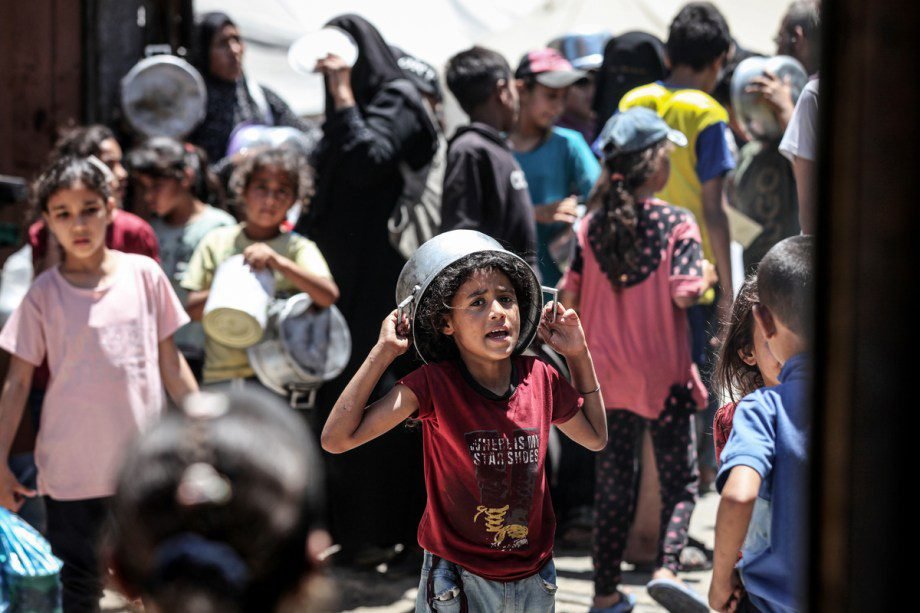
The international community prefers not to address the fact that violence poses a permanent threat to food security and, as a result, to any humanitarian paradigm. On Monday, the World Food Program (WFP) announced that 500,000 Palestinians in Gaza will be left without food support due to funding shortages. For 2026, the WPF received less than half its funding and requires $450 million “to maintain critical operations in the occupied Palestinian territory over the next six months.”
WFP’s announcement broke down the consequences of its funding shortage. Out of 1.6 million Palestinians in Gaza, 1.1 million remain eligible for WFP’s services. Food rations have been but down by half. Hot meals have been reduced from 250,000 to 150,000, while Palestinians living in the vicinities of the Yellow Line can only receive one hot meal on alternate days. The WFP also reduced cash assistance to 75,000 families. Bakeries are, until now, still supported, however the aid only covers one third of the population reached by the bakeries. Unemployment in Gaza is over 80 per cent, and 1.4 million Palestinians are classified as experiencing acute food insecurity.
Meanwhile, for the fifth consecutive year, Israeli arms sales broke another record – from $14.8 billion in 2024 to $19.2 billion in 2025. This means that during the genocide in Gaza, when government were begrudgingly fulfilling their rhetorical duty calling for humanitarian pauses and deploring civilian deaths, arms sales were contributing to the genocide and, as a result food insecurity.
Governments have billions to spend on weapons while $450 million to maintain the WFP’s critical operations are hard to come by.
READ: UN: 950,000 displaced people in Gaza face flood risks this winter
Governments also support humanitarian paradigms, albeit only as a veneer against their complicity in fomenting violence. However, even that veneer can no longer support its own narrative, as the consequences of Israel’s internationally supported genocide in Gaza is further illustrating that humanitarian aid was never designed to be permanent. The budget allocated to humanitarian aid was never on a par with that allocated for war. With that discrepancy, it is likely that a state of permanent colonial violence in Gaza is fast becoming normalised to the point that the lack of humanitarian aid will go the same way.
Just as forced displacement no longer elicits anything but statistical data, so will humanitarian aid follow the same trajectory. Funding deficits are already normalised, and so will food insecurity and starvation.
Calling upon Israel to assume its responsibilities as an occupying power never worked. The humanitarian paradigm failed since its inception. The weakest calls from the international community are for Israel to exercise restraint, while the loudest silence encouraged genocide. It is only here that the international community’s warped logic shines through – it will not contradict its own complicity in genocide by investing more in the humanitarian paradigm. On the contrary, Gaza remains testimony to genocide and the international community’s commitment to it. If Israel and the international community do not carry the humanitarian burden because it contradicts their complicity in genocide, Palestinians then face permanent food insecurity. As things stand, all roads lead to genocide in Gaza, and Israel has already completed the groundwork with the international community’s aid.
BLOG: Olive theft is just one component of Israel’s colonial structure
The views expressed in this article belong to the author and do not necessarily reflect the editorial policy of Middle East Monitor.