On Tuesday, a US jury convicted one of China’s key telecommunications and AI giants, Huawei Technologies, of stealing trade secrets from US tech firms and evading sanctions against Iran.
Although the longrunning charges stem back to 2018, the verdict coming now threatens to inflame US-China tensions at a sensitive time, just as Donald Trump prepares to increase tariffs on China. In a press release, however, the US Department of Justice celebrated the outcome as critical to protecting the US financial system, the global telecommunications industry, and US national security.
The jury convicted Huawei of charges including bank fraud, conspiracy to defraud the US, money laundering conspiracy, and “substantive” violations of the International Emergency Economic Powers Act.
Among crimes, Huawei was found guilty of “repeatedly” lying to banks about its business in Iran. Huawei also frequently lied to the US government that “it did not assist Iran’s government, military, or intelligence community,” the DOJ said. In reality, the DOJ proved at trial that Huawei was conducting business in Iran under the name “Skycom” to evade sanctions, while providing Iran with “turnkey services with respect to an Internet backbone and broader accessibility for mobile networks.” Further, Huawei helped the Iranian regime “monitor and censor its users’ access to the Internet” and provided surveillance cameras to monitor protests, the DOJ said. In a statement, the acting principal deputy assistant attorney general for national security, M. Scott Proctor, said Huawei “empowered our enemies” and “harmed our national security.”
Huawei stole US trade secrets
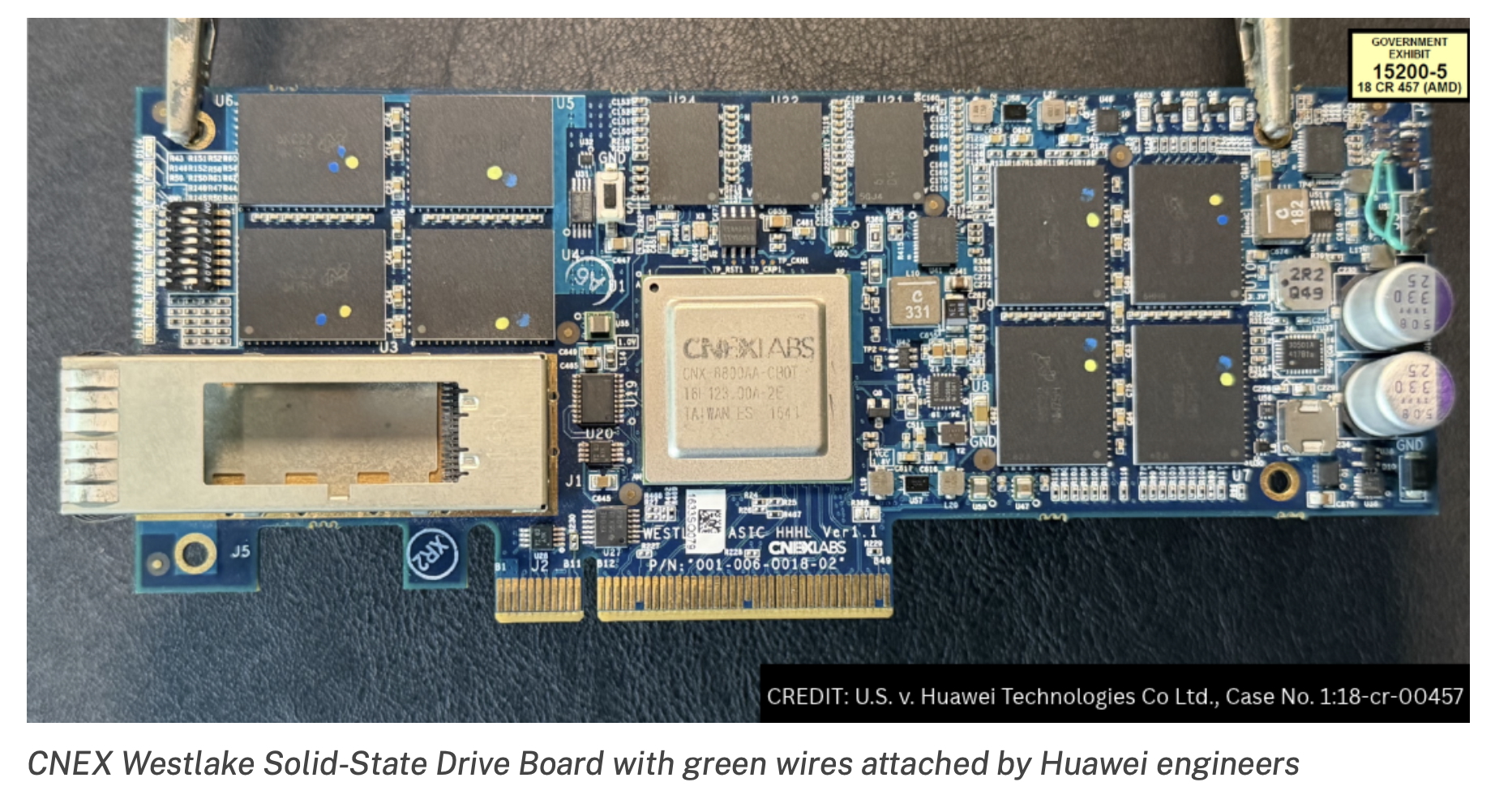
As the DOJ successfully argued, Huawei lied about its Iranian business specifically so that it could continue obtaining billions in US dollars by participating in a global marketplace that gave it necessary access to steal US tech. Among companies targeted, US Attorney for the Eastern District of New York Joseph Nocella Jr. said that Huawei blatantly stole from T-Mobile and Cisco, as well as a semiconductor storage company called CNEX and an antenna manufacturer called Quintel.
“The misappropriated intellectual property included trade secret information and copyrighted works, such as source code and user manuals for Internet routers, antenna technology, and robot testing technology,” the DOJ said.
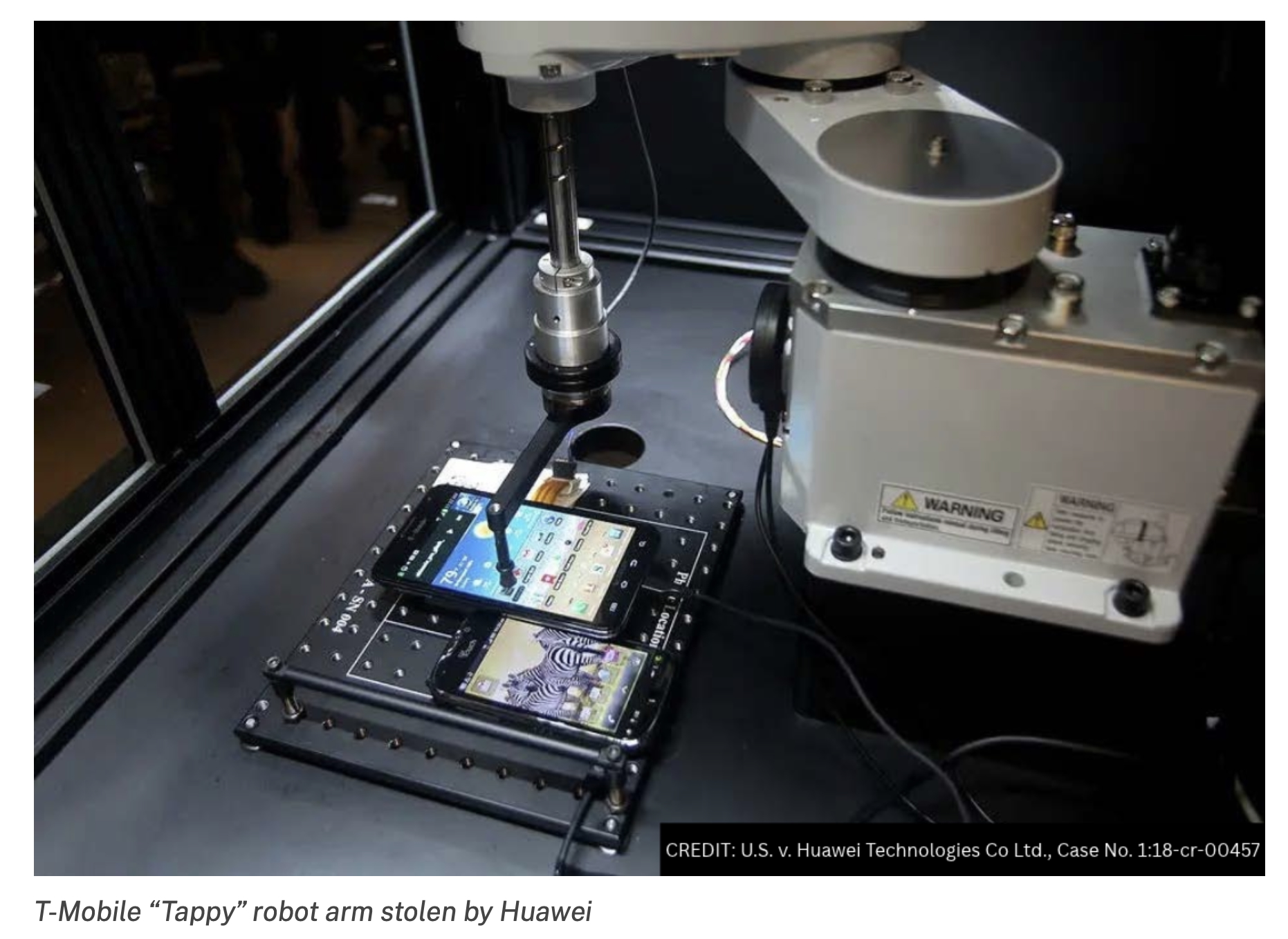
One of the stolen ideas was the design of a T-Mobile robot called “Tappy,” which helped the US firm “assess the responsiveness of touch screens by mimicking a human touch,” the DOJ said. To copy the design, Huawei signed a non-disclosure agreement, then sent photos and technical details back to China. Even bolder, when that intel was deemed insufficient, “a Huawei employee stole a part of the robot in his backpack and carried it out of T-Mobile’s controlled laboratory,” the DOJ said.
Huawei’s tactics weren’t always sophisticated, but they were effective, the DOJ said, building into “a long-running conspiracy to steal intellectual property of US companies.” At trade shows and tours of rivals’ facilities, Huawei employees would pretend to “get lost,” the DOJ said, so they could wander into restricted areas and take photos of hardware, The New York Times reported.
Huawei engineers would also sometimes hide their activity by spelling words backwards. For example, Huawei was able to copy the source code used on Cisco routers—which the DOJ said was “identified as the ‘crown jewel’ of Cisco technology”—by taking notes in which they spelled Cisco as “ocsic.” Another time, the DOJ noted that a Huawei employee was caught “photographing proprietary Fujitsu equipment” while wearing a badge that falsely identified him as an employee of “Weihua.”
During the trial, Meredith Arfa, a federal prosecutor, noted that Huawei employees were sometimes paid bonuses for their crimes, since the theft was so integral to Huawei’s business model, NYT reported.
Roman Rozhavsky, the assistant director of the FBI’s Counterintelligence and Espionage Division, said that Huawei spent years expanding its international enterprise “through theft of trade secrets, fraud, and other criminal conduct at the expense of US companies and the rule of law.”
Huawei will appeal; China lashes out
Huawei has been banned from selling its tech in the US since 2019, so NYT noted that the guilty verdict is unlikely to rattle the company’s finances much. However, the financial penalties stemming from the verdict could be steep, as the DOJ explained that they include “criminal fines, forfeiture, and restitution.”
Sentencing is scheduled for September 14.
Huawei continues to deny any wrongdoing and rejects US claims that the Chinese Communist Party directed the thefts. NYT noted that Huawei’s investors have argued that the US fight is politically motivated and seeks to hobble “a Chinese initiative to build 5G networks around the world.”
Outside the courthouse following the verdict, Brian Heberlig, a lawyer for Huawei, told reporters that it’s significant that the jury did not convict Huawei of racketeering charges or conspiracy to obstruct justice. According to Heberlig, the examples of US technology theft merely represented “isolated misconduct by company employees,” which inevitably happens in a company so large, with “hundreds of thousands of people.”
Heberlig confirmed that Huawei planned to appeal and considered the jury’s opposition to racketeering charges to be a “profound rejection of the United States’ narratives about what Huawei is.”
“The allegations that the government made in this case overreached and simply weren’t consistent with the successful, innovative and hard-working company that we came to know and deeply respect in this trial,” Heberlig said.
After the verdict, China “lashed out” at the US, AFP reported. According to Chinese foreign ministry spokesperson Guo Jiakun, the US is trying to use the ruling to “suppress” Huawei.
China “firmly opposes the US suppressing and containing Chinese enterprises and firmly supports Chinese enterprises in safeguarding their legitimate rights and interests,” Guo said.
However, the FBI’s Rozhavsky suggested that even China, which frequently negotiates with Trump as the trade rivals continually clash, can’t spare Huawei from substantial penalties.
“This case serves as a stark reminder that the Chinese government continues to pose a serious threat to our economic and national security, but today’s guilty verdict proves the FBI and our partners will aggressively investigate, expose, and hold accountable those who target our nation,” Rozhavsky said. “No company is too big, too powerful, or too well connected to exploit the US and its citizens and expect to escape American justice.”
Source: Iwpost.com