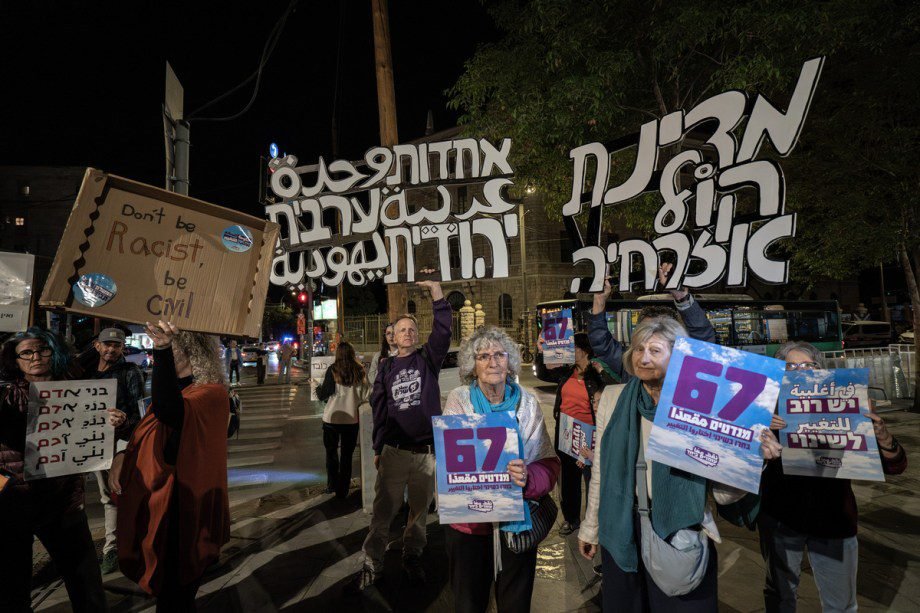
The numbers make the Arab factor impossible to ignore. Arab political parties, represented through the Joint List and Ra’am, command 19 seats in the 120-member Knesset. Gadi Eisenkot’s anti-Netanyahu bloc, meanwhile, has 48 seats, insufficient for a parliamentary majority. Arab parliamentary support could therefore prove decisive in preventing Netanyahu’s return to power. Yet the hesitation surrounding their participation exposes a contradiction: while sections of the centre recognise the importance of Arab cooperation, others remain unwilling to depend on Arab representatives for governmental survival.
This resistance is not merely a disagreement over coalition arithmetic. It reflects a deeper political culture in which Arab participation is frequently treated as a threat to the character and identity of the Israeli state.
The uncomfortable question is whether Israel can legitimately call itself a democracy when the votes of a sizeable minority are welcomed at election time but their representatives are treated as unacceptable when they seek to exercise political power. Can democracy be reduced to the right to cast a ballot while denying a substantial section of the electorate a meaningful opportunity to influence the government?
This is the distinction between electoral democracy and substantive democracy. Political scientist Robert Dahl argued that democracy requires effective participation, voting equality and genuine opportunities for citizens to influence political decisions. Elections are indispensable, but they are not the entirety of democracy. If Arab citizens can elect representatives only to discover that those representatives are considered illegitimate partners in government, democracy risks becoming an electoral ritual stripped of much of its substance.
There is also the danger of what political theory describes as the tyranny of the majority. A parliamentary majority has the democratic right to govern, but that right cannot become a licence to make minority communities permanently irrelevant.
Democracy rests not simply on numerical supremacy but on minority rights, equal citizenship and the recognition that political legitimacy cannot be monopolised by one ethnic or religious community.
The experience of Ra’am’s participation in the Bennett-Lapid government in 2021–2022 demonstrated that Arab parties can negotiate concrete improvements in housing, infrastructure, municipal services and social investment. It was an imperfect experiment, but it challenged the assumption that Arab political representation must remain outside the corridors of power. Political cooperation does not require complete ideological agreement. Parties can negotiate common programmes and pursue the immediate interests of their constituencies without abandoning their wider convictions.
The theoretical work of Arend Lijphart on consociational democracy is particularly relevant. Lijphart argued that deeply divided societies require mechanisms of accommodation, negotiation and power-sharing if they are to avoid permanent political domination by one community. Israel may not be ready for formal power-sharing, but the principle of inclusion deserves serious consideration. Arab participation should not be viewed as a concession by Jewish political leaders. It is a legitimate expression of representative democracy.
The political trajectory of Avigdor Lieberman and his Yisrael Beiteinu (Israel Our Home) party illustrates how this exclusionary approach extends beyond the religious and explicitly Kahanist far right. A secular nationalist, Lieberman built much of his political identity around the proposition that citizenship must be accompanied by loyalty to Israel as a Jewish state. His 2009 electoral slogan, “No Loyalty, No Citizenship”, targeted Palestinian citizens and accompanied proposals for loyalty oaths and territorial exchanges that would place Arab-populated areas outside Israel. These positions raised fundamental questions about whether citizenship and political rights could be made conditional upon acceptance of a prescribed national identity. The contemporary significance is unmistakable. Although Lieberman has joined Eisenkot’s opposition effort, he has ruled out a minority government dependent on Arab parliamentary support. His party’s agreement with Eisenkot in November 2026 does not remove this contradiction. It demonstrates how the exclusion of Arab political participation can become a red line even within a bloc seeking to replace Netanyahu. The problem, therefore, cannot be attributed exclusively to Netanyahu or the religious far right. It has deeper roots in secular nationalist politics as well.
The challenges confronting Arab communities in Israel are substantial. Organised crime and violence, housing shortages, discriminatory land policies, house demolitions and unequal public investment have created profound marginalisation.
Since October 7, 2023, the atmosphere has become even more hostile, with Arab citizens facing suspicion, intimidation and accusations of disloyalty. The normalisation of anti-Arab rhetoric and the growing influence of far-right and Kahanist politics have further narrowed the space for coexistence. Racism is no longer confined to the political fringes; it has acquired influence within the mainstream political establishment.
This brings us to the politics of recognition. Recognition means more than acknowledging another community’s existence or granting it formal legal status. It requires recognising equal dignity, political agency, historical experience and the right to shape the common future. Hannah Arendt’s idea of the “right to have rights”, developed in the context of statelessness and political exclusion, offers a useful philosophical lens. Rights become meaningful not merely because they are written into law, but because people are recognised as members of a political community whose voices deserve consideration. Arab citizens possess formal citizenship. But can citizenship be considered complete when their political legitimacy is repeatedly questioned?
The contradiction becomes more pronounced through the lens of ethnonationalism. When a state defines its political identity primarily through the national character of its majority, the democratic equality of minority citizens can become subordinate to the preservation of that identity. This is the tension Israel must confront between its claim to be both Jewish and democratic. The two descriptions cannot be reconciled through constitutional declarations alone. They must be reconciled through the lived experience of equal citizenship. If citizenship is formally available to all but political belonging is effectively reserved for one national community, democracy becomes conditional.
Jürgen Habermas’s idea of constitutional patriotism offers a different possibility. A democratic society need not demand that all citizens share the same ethnicity, religion, historical memories or national aspirations. Its cohesion can rest on a common commitment to constitutional principles, equality, human dignity and democratic institutions. Jewish and Arab citizens need not agree on every aspect of their history or politics to recognise one another as equal participants in a shared civic future.
There is, however, a further contradiction. Arab citizens of Israel are not simply a minority defined by language, religion or ethnicity. They are Palestinians by historical and national identity, many belonging to families whose roots in the land predate the establishment of Israel. Their demand for equality is also a demand for recognition of historical memory, collective identity and the right to retain a distinct national consciousness.
Expecting them to leave their Palestinian identity outside the political arena as the price of acceptance makes equality conditional upon cultural and political surrender. Genuine citizenship must accommodate difference, not erase it.
This is where Israel’s democratic debate intersects with its unresolved Palestinian question. It cannot indefinitely compartmentalise the treatment of Palestinian citizens within Israel from the occupation and denial of Palestinian self-determination beyond its recognised borders. The situations are not identical, but they are connected by a political imagination that too often regards Palestinian identity as a problem to be managed rather than a people whose rights and aspirations must be recognised. The promise of equality at home remains compromised by the denial of rights elsewhere.
Arab political leadership also faces an important choice. Should it seek influence through direct participation in government, or provide parliamentary support to an anti-Netanyahu coalition without formally joining it? The Joint List’s willingness to explore a blocking arrangement reflects this dilemma. Arab representatives must balance the immediate interests of their constituents against the larger question of political equality. There are ideological differences among Arab parties, just as there are disagreements within Jewish political formations. Their positions on Zionism, the occupation, Palestinian statehood and Israeli security policies are not identical. But disagreement cannot become a permanent justification for denying representation. Democracy is not a privilege reserved for those who subscribe to the ideology of the governing majority.
The Arab factor could therefore become much more consequential than a bargaining instrument in coalition formation. It could compel Israeli politics to confront the meaning of citizenship, equality and shared responsibility. It could also open a conversation about the relationship between Israel’s Arab citizens and the wider Palestinian struggle, rather than pretending that the two realities can be permanently separated.
This requires courage from both sides. Arab political leaders must negotiate without surrendering their principles. Jewish political leaders must abandon the distinction between acceptable and unacceptable citizens based on ethnicity or political identity. An emerging government must understand that ending Netanyahu’s tenure is not synonymous with ending the political conditions that made his brand of nationalism possible. Reversing judicial reforms, establishing an official commission of inquiry into the failures surrounding October 7 and rebuilding democratic institutions are important objectives. But a government that leaves structural discrimination and the political exclusion of Arab citizens untouched will have changed its leadership without transforming its democracy.
There is, finally, a larger moral question. Can Israel recognise that a common humanity is not a concession made by one community to another, but the starting point of a genuinely democratic society? Arab citizens should not have to prove their right to belong every time a government is formed. Their equality must be recognised as a democratic principle, not negotiated as a political favour.
The real test of Israeli democracy is not whether the Jewish majority is willing to tolerate an Arab minority, but whether it recognises that this minority has an equal right to shape the country’s future. The 19 Arab seats in the Knesset are not merely numbers to be counted when coalition arithmetic becomes difficult. They represent citizens whose political voices deserve the same legitimacy as those of every other constituency.
Israel’s opportunity is to move from a democracy that merely tolerates minority participation to one that recognises minority equality as indispensable to its legitimacy.
Whether its political leadership has the courage to make that transition will determine far more than who occupies the prime minister’s office. It will help determine what kind of society Israel chooses to become.
The views expressed in this article belong to the author and do not necessarily reflect the editorial policy of Middle East Monitor.
Source: Iwpost.com