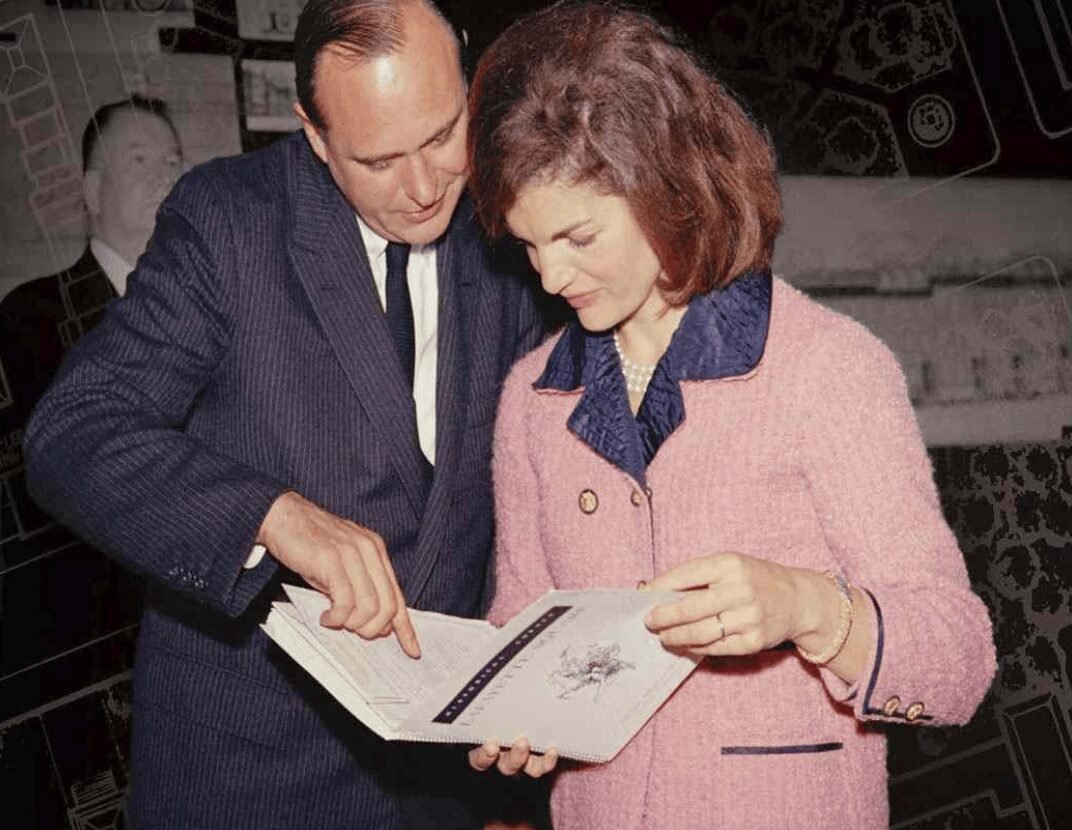
Jackie Kennedy’s carefully guarded private life is back in the spotlight after a revealing memoir exposed intimate details of her secret romance with the very man hired to design her assassinated husband’s grave, including daring Hawaiian adventures, discussions of marriage and a love that reportedly survived decades of separation.
Architect John Carl “Jack” Warnecke, who died in 2010 at age 91, left behind an unpublished account of his relationship with the former first lady. Now, his daughter is bringing that story to the public in Camelot’s Architect, a memoir offering new details about a romance that began in the shadow of one of America’s greatest tragedies.
Warnecke first entered the Kennedy family’s inner circle while working on the preservation of historic Lafayette Square near the White House. Following President John F. Kennedy’s assassination in November 1963, Jackie personally selected him to design her husband’s permanent gravesite at Arlington National Cemetery. Their professional relationship gradually became something far more personal as the grieving widow found comfort in the charismatic, 6-foot-3 architect.
According to Warnecke’s recollections, their feelings finally came to the surface during a 1964 weekend at Jackie’s family estate in Rhode Island. What followed was an intensely private romance that lasted roughly two years, with the couple eventually discussing marriage. Warnecke became close enough to Jackie that their families even celebrated Thanksgiving together.
But some of the memoir’s most surprising revelations concern a 1966 getaway to Hawaii, where Jackie reportedly enjoyed a freedom she rarely experienced under the relentless scrutiny of the American public.
Warnecke recalled arriving at her rented beachfront home and discovering the former first lady sunbathing without clothing, apparently unaware that anyone was approaching. On another occasion, he claimed she surprised him by climbing unclothed into the back seat of his convertible before they set off on a moonlit drive along the coast.
The architect described the encounters as playful expressions of a relationship that allowed Jackie to briefly escape the expectations surrounding her famous name. During one unforgettable evening, he recalled her declaring, “I’m all yours. All of me.”
Yet their seemingly idyllic romance was already facing serious trouble. By late 1966, Warnecke discovered he was approximately $1 million in debt, the result of business difficulties he said were compounded by his extensive work on Kennedy’s memorial. The financial crisis shattered his confidence that he could provide Jackie and her children with the privacy and protection they needed.
Although he hoped they might eventually marry, their relationship never recovered. Following Robert F. Kennedy’s assassination in June 1968, Jackie grew increasingly concerned about her family’s safety. Four months later, she stunned the world by marrying Greek shipping billionaire Aristotle Onassis, whose extraordinary wealth offered a level of security Warnecke could not match.
Warnecke later claimed Jackie privately regretted that decision. During a reunion in Paris, he recalled her expressing deep unhappiness with her second marriage and describing it as the greatest mistake of her life. That account reflects his personal recollection rather than an independently verified statement from Jackie.
Despite their separate lives, the former lovers never entirely lost touch. After Onassis died in 1975, they renewed their friendship, occasionally spending hours together discussing their relationships and sharing personal advice. Although Warnecke insisted their physical romance had ended, he believed an emotional connection remained.
That bond resurfaced in February 1994, when Warnecke learned Jackie had been diagnosed with cancer. With Valentine’s Day approaching, he wrote her a deeply personal letter reflecting on the relationship they had lost and the life they might have shared.
He acknowledged that circumstances had separated them but confessed that, in his heart, their romance had never truly ended. Drawing inspiration from the romantic movie Sleepless in Seattle, he even imagined someday reuniting with her atop the Empire State Building.
According to his memoir, Jackie telephoned him the following morning and thanked him for the unexpected Valentine’s message. She reportedly agreed that their love had never been destroyed by the years or the events that separated them, telling him, “Nothing had ever changed it.”
Just three months later, on May 19, 1994, Jackie died at age 64. She was buried beside President Kennedy at Arlington National Cemetery, returning to the memorial Warnecke had designed decades earlier.
Watching the funeral coverage from California, Warnecke found himself confronting the final chapter of their extraordinary relationship. He later recalled taking a worn fur blanket Jackie had given him for Christmas in 1965 to the Russian River, where he released it into the water as a private farewell.
For the architect who had helped preserve the legacy of Camelot, Jackie’s death marked the end of a deeply personal chapter in his own life. He eventually returned to Arlington to visit her grave, reflecting on the remarkable circumstances that had brought them together and the feelings he believed had never disappeared.
Warnecke’s daughter, Margo Warnecke Merck, helped fulfill her father’s wish to publish his story. The memoir, Camelot’s Architect: The Untold Story of Jackie Kennedy, Lafayette Square, and a Secret Romance, is scheduled for release November 10, offering a rare glimpse into the woman behind one of America’s most enduring public images. People.com+3
Source: Iwpost.com