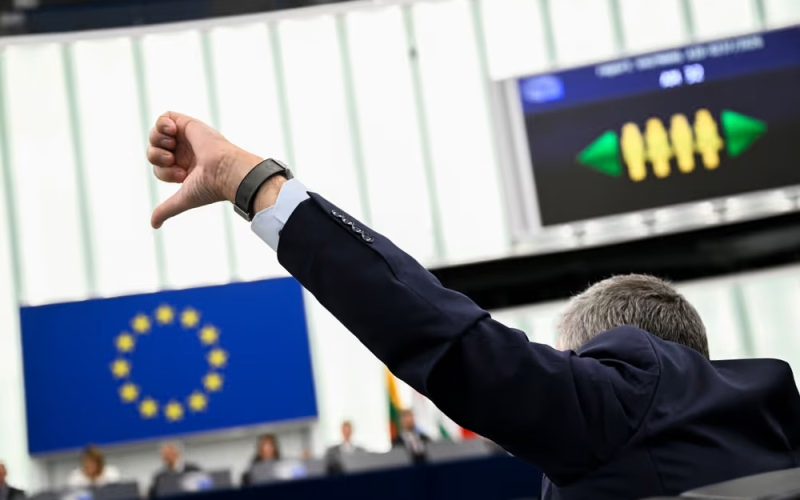
The European Parliament on Thursday adopted three resolutions condemning human rights violations in Iran, Georgia and Azerbaijan, calling for broader sanctions on Iran and targeted measures against officials in the other two countries.
Iran
Members of the European Parliament said Iran has the highest rate of executions per capita in the world and denounced what they described as an unprecedented scale of violence by authorities against civilians since January 2026.
The lawmakers pointed to intensified attacks on human rights activists and journalists. They also cited sham prosecutions of protesters based on confessions obtained through torture.
They called for the annulment of the politically motivated verdicts against Taraneh Rahimi, 20, and Leila Abolhasani, 43, who were sentenced to death after protests. They also cited the case of Rahimi’s sister, Romina, who received a long prison sentence.
The lawmakers said Iran must abolish the death penalty. They expressed deep concern about the rising number of women convicted, the persecution of religious and ethnic minorities, and the government’s transnational repression beyond its borders. They denounced Iran’s codification of gender discrimination and called for gender apartheid to be recognized as a crime against humanity under international law.
The lawmakers said the scope of sanctions should be broadened and the U.N.’s independent international fact-finding mission stepped up to gather evidence and identify those responsible. They also called for the Iranian government to be referred to the International Criminal Court.
The resolution passed with 541 votes in favor, 11 against and 25 abstentions.
Georgia
Parliament denounced the misuse of legislation and institutions to silence political opponents in Georgia and strongly condemned attempts by the ruling Georgian Dream party to ban opposition parties.
It called for the immediate and unconditional release of all political prisoners and peaceful protesters. Those named included Elene Khoshtaria, Mzia Amaglobeli, the 2025 Sakharov Prize laureate, Mikheil Saakashvili, Giorgi Baramidze and Nika Melia.
Lawmakers said attempts to judicially eliminate the political opposition are incompatible with democracy and that banning established parties would make progress toward EU membership impossible.
They criticized the EU and its member states for failing to act as the situation deteriorates, while reaffirming support for the European aspirations of the Georgian people. They repeated calls for targeted sanctions against those responsible for democratic backsliding, violent repression and political persecution, naming Bidzina Ivanishvili, Irakli Kobakhidze, Shalva Papuashvili and Kakha Kaladze.
The resolution passed with 445 votes in favor, 37 against and 97 abstentions.
Azerbaijan
Lawmakers said any future partnership agreement between the EU and Azerbaijan must depend on tangible human rights improvements, including the release of political prisoners.
They welcomed Dr. Gubad Ibadoghlu’s recent arrival in Europe for urgent medical treatment and called for all prosecutions against him to be dropped.
They strongly condemned the detention of Ali Karimli, president of the Azerbaijani People’s Front, and of Anar Mammadli and his co-accused, journalist Anar Abdullayev. They demanded their immediate and unconditional release and denounced their detention conditions and serious allegations of ill-treatment.
Lawmakers also criticized the misuse of criminal and national security laws to silence nongovernmental organizations and the media, and condemned transnational repression against opponents abroad. They urged the European Commission to step up support for civil society and independent media in the country and in exile.
They called on the EU’s high representative to prepare targeted measures under the EU Global Sanctions Regime and to ensure diplomatic engagement upholds democratic values.
The resolution passed with 492 votes in favour, 23 against and 60 abstentions.