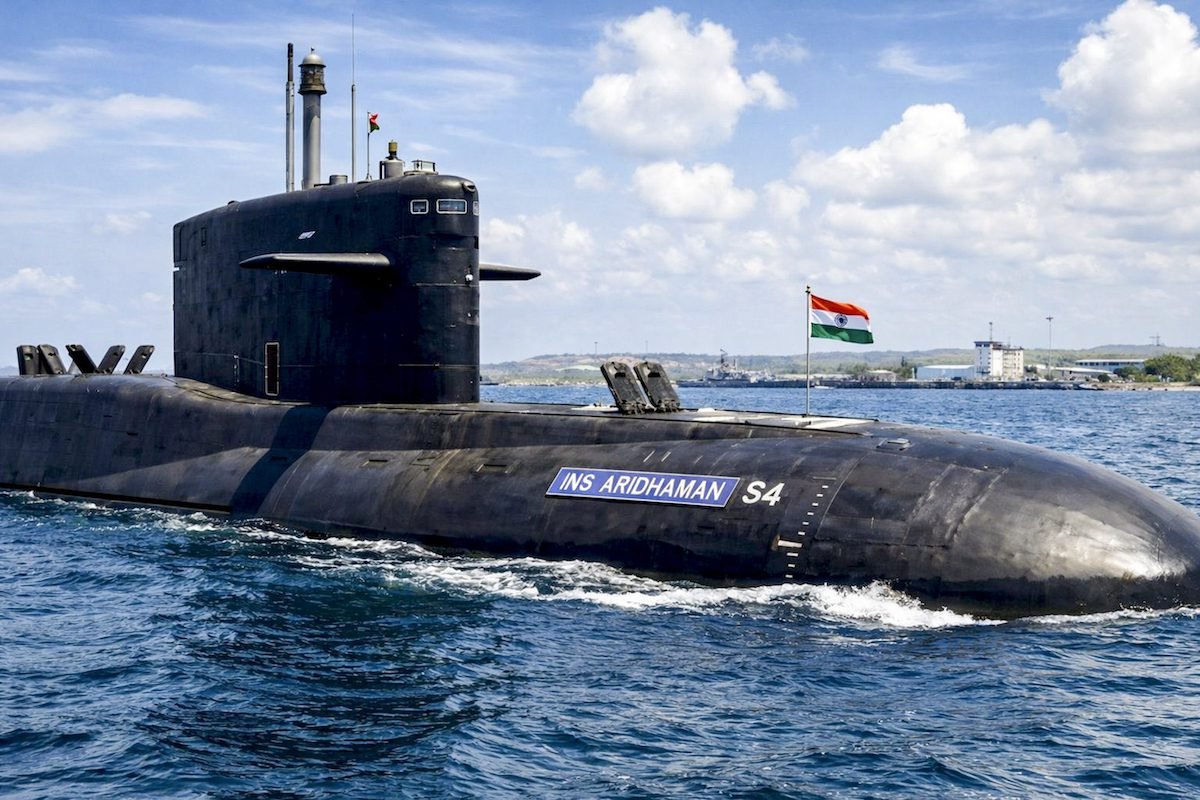

The induction of INS Aridhaman, a nuclear-powered ballistic missile submarine (SSBN), marks a strategic shift in India’s undersea deterrence posture in the Indo-Pacific. This is not just another warship entering theIndianNavy’s order of battle. It signifies that India’s sea-based nuclear deterrent is beginning to acquire real and credible heft.
INS Arihant and INS Arighat were commissioned in 2016 and 2024, respectively. With INS Aridhaman now commissioned, India’s SSBN force has moved beyond demonstration to an institutionalized nuclear deterrence posture with meaningful implications for the balance of power across the Indo-Pacific.
The underlying philosophy of India’s nuclear doctrine has always been rooted in restraint. India’s “No First Use” — NFU — policy is a commitment not to strike first, but to assure retaliation after any nuclear attack. Survivability is therefore the backbone of India’s deterrence posture.
Ballistic missile submarines, or SSBNs, are among the most important legs of India’s nuclear triad and are best suited to advance its NFU objectives. Any SSBN at sea is far more difficult to detect, track and destroy than land-based missiles or aircraft-delivered weapons.
This makes sea-based nuclear forces the most resilient pillar of India’s deterrent and essential to the survival of its NFU doctrine.
India’s first SSBN, INS Arihant, marked the country’s entry into the select group of nations with an indigenously designed and built SSBN capability. INS Arighat, its second, demonstrated India was moving beyond a single-boat posture. INS Aridhaman, now its third, has further strengthened that progression.
This shift reflects a broader change in the Indian Navy’s role under Prime Minister Narendra Modi. Over the past decade, maritime power has moved steadily into India’s national-security mainstream.
The commissioning of three SSBNs is especially noteworthy because it brings the Navy into the heart of India’s nuclear deterrence. The Navy is no longer only a sea-control force or an instrument of maritime diplomacy in the Indian Ocean — it is now one of the principal custodians of India’s most survivable nuclear capability.
This represents a fundamental shift in India’s naval posture and strategic calculus. INS Aridhaman is larger than the original Arihant-class design and is capable of carrying longer-range submarine-launched ballistic missiles, or SLBMs, including the K-4.
This allows Indian SSBNs to conduct deterrence patrols in better-protected waters far from adversaries while retaining the ability to strike them — directly supporting the core logic and credibility of India’s sea-based nuclear deterrent. A submarine that can remain concealed while delivering a credible retaliatory strike is far more valuable.
As China increases its activity in the Indian Ocean, with more frequent naval deployments, expanded port access and a steady People’s Liberation Army Navy presence, the need for a credible Indian undersea response only grows more acute. INS Aridhaman strengthens that response not because it can be seen, but because it cannot.
Its real value lies in augmenting India’s force of submarines that can survive, stay hidden and deliver a nuclear strike if needed. This is a different kind of strategic advantage — not about controlling the seas or matching China ship for ship, but about ensuring no adversary can be certain of eliminating India’s nuclear forces in a first strike.
A force capable of absorbing a first strike and retaliating makes deterrence credible, and that credibility is the foundation of stable deterrence in the Indo-Pacific.
INS Aridhaman takes India one step closer to a genuinely sustainable sea-based deterrent. A continuous at-sea deterrent requires a pool of submarines since no single boat can patrol while simultaneously undergoing maintenance, refit and crew training.
India’s third SSBN is a meaningful step toward that goal, reducing stress on individual boats, increasing overall availability and giving planners greater flexibility to schedule long-term deterrence patrols. It also signals that India’s SSBN program is no longer a one-time technological achievement but a durable feature of national power.
INS Aridhaman significantly advances India’s China-deterrence capability in an increasingly militarized Indo-Pacific, moving the Indian Navy to the center of national security strategy — not as a conventional sea-control force, but as the premier custodian of India’s sea-based nuclear deterrent.
In the Indo-Pacific, the most consequential shifts in power are often the least visible. INS Aridhaman is one of them.
Siddharth Singh is a senior research fellow at the India Foundation







, marks a strategic shift in India's undersea deterrence posture in)