Indonesia is buying the weapons of a modern military at a pace rarely seen in its recent history.
Rafale fighter jets are entering service, and the country has contracted for 48 KAAN fighters from Turkey. The navy has taken delivery of two Italian PPA warships and commissioned a former Italian aircraft carrier, the Giuseppe Garibaldi, as the KRI Sriwijaya.
Two Scorpene submarines are being built at home with French technology transfer. BrahMos cruise missiles are moving through the procurement pipeline, Turkish drones are expanding the unmanned fleet, and an A400M airlifter and new air-defense radar have arrived.
The money behind the buildup has climbed just as steeply. Indonesia’s defense spending rose from 125.8 trillion rupiah (about $7 billion at current exchange rates) in 2021 to 190.3 trillion in 2024, was projected at 245.2 trillion for 2025 and is budgeted at 337.4 trillion for 2026. The government says the money is meant for more than procurement: maintenance, infrastructure, the domestic defense industry and the wider development of the armed forces.
On paper, Indonesia is assembling the pieces of a far more capable military. But owning sophisticated weapons is different from generating sophisticated military effects. It must now knit the new platforms into a coherent force that can sense, decide, communicate, strike, maneuver and sustain operations together.
In September, the Defense Ministry and the National Defense Council effectively acknowledged the challenge by convening a forum on interoperability, network-centric warfare and C6ISR, including the standardization of communications and data links. Officials stressed that modern warfare is no longer decided by the number of platforms or the destructive power of individual weapons.
The logic of the buildup
Indonesia’s procurement drive is more than an arms-shopping spree. The Rafale gives the Air Force a modern multirole fighter with advanced sensors and long-range weapons. The A400M expands its airlift. The 48-aircraft KAAN program could give Indonesia a path into fifth-generation fighter technology and a chance for domestic industry to take part.
The naval picture is similar. The PPA ships, the KRI Brawijaya and the KRI Prabu Siliwangi, are 143-meter combatants armed with surface-to-surface and surface-to-air missiles, naval guns and torpedoes, a leap beyond many older vessels in the fleet.
The two Scorpene submarines may matter more over the long run. They are being built at PT PAL, Indonesia’s state-owned shipbuilder, with French technology transfer and training for more than 400 Indonesian engineers.
The same is true of drones. Indonesia has accelerated purchases of Turkish systems, including the ANKA-S, TB3, Akıncı and Kızılelma, a marked shift toward unmanned surveillance and strike.
According to the Singapore-based S. Rajaratnam School of International Studies, Indonesia signed just one contract for armed Chinese CH-4B drones between 2012 and 2022. Since 2023, it has contracted for several types of Turkish unmanned aircraft.
Every new platform creates a second requirement: the architecture around it. Modern military power is a system of systems. Sensors must feed command networks, which must pass targeting data to weapons quickly enough to matter.
Aircraft, ships, submarines, drones and ground units must work from a common operational picture, and all of them must be supplied, repaired and crewed. The relevant question is no longer how many weapons Indonesia has bought, but whether they can operate as one force.
The price of diversification
Diversification has given Indonesia a geopolitical advantage.
It is acquiring or developing capabilities with France, Italy, Turkey, India, the United States, South Korea and its own defense industry, which gives Jakarta more room to maneuver than reliance on a single supplier would. The approach also suits the country’s long tradition of strategic autonomy and hedging among major powers.
But diversity has a military cost. Each supplier brings its own communications architecture, software, maintenance regime, weapons interfaces, training systems and logistics. A force drawn from so many technological ecosystems can gain political independence while becoming harder to integrate in battle. Strategic diversification can breed tactical fragmentation.
Indonesia’s defense establishment seems increasingly aware of the tension. September’s forum drew the Defense Ministry, the armed forces headquarters, the three services, the digital ministry, the national research agency BRIN, the cyber agency BSSN and domestic defense companies.
The agenda covered C6ISR, network-centric warfare, communications standards and data links. Officials’ definition of interoperability was telling: it reached beyond communications to personnel, doctrine, procedures, data, networks, sensors, command-and-control systems and weapons platforms.
That is where modernization must become transformation. Take the Rafale. Its effectiveness depends not just on the aircraft but on the radar picture available to pilots, the intelligence behind each mission, the weapons built into doctrine and the ability to sustain a high rate of sorties.
During the 2026 PEGASE exercise with France, Indonesian Rafales flew alongside French Rafales and an A330 MRTT tanker, a glimpse of the value interoperability can create. The same logic applies to the BrahMos, the Scorpene, the PPA warships and unmanned aircraft: a weapon is worth far more as part of a reliable kill chain. Without one, even advanced platforms operate alone.
The Sriwijaya test
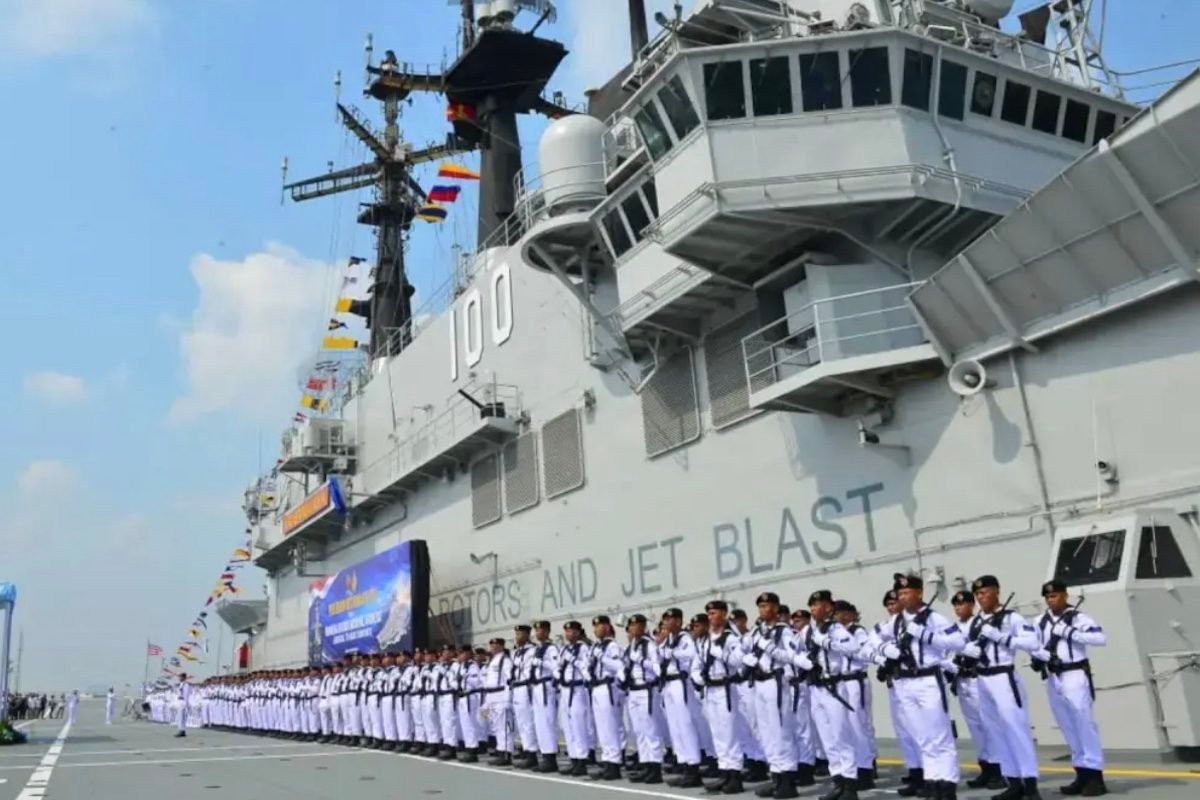
The Sriwijaya may be the clearest test of whether Indonesia can turn procurement into institutional capability. The former Italian carrier Giuseppe Garibaldi was commissioned in September as Indonesia’s first aircraft carrier.
Officials describe it chiefly as a command center for maritime operations, a platform for defense diplomacy and a vehicle for humanitarian aid. It can operate many helicopters and is expected to contribute substantially to disaster response and logistics across the archipelago.
That is a sensible starting point. Indonesia does not need to copy American or Chinese carrier doctrine to get value from a large ship that can carry aircraft. Its geography creates real needs for mobility, disaster response, maritime presence and command and control.
But the Sriwijaya also shows the gap between acquiring a platform and mastering a capability. A carrier needs trained crews, aviation specialists, deck operations, maintenance facilities, helicopters or other aircraft, escorts, replenishment ships, communications and a doctrine for sustained deployment. The hull is the visible part of a far larger operation.
The ship is better seen as a test of institutional learning than as proof that Indonesia has become a carrier power.
The questions are whether the Navy can build the procedures, human capital and logistics to keep it useful for decades; whether it can link the vessel with frigates, submarines, maritime patrol aircraft and unmanned systems; and whether PT PAL and other Indonesian companies can learn enough to maintain, and eventually modify, such complex platforms at home.
The Scorpene program may offer a more promising model. Naval Group, the French shipbuilder, says both submarines will be built and commissioned in Indonesia, with technology transfer meant to let Indonesians manage, operate and maintain them.
More than 400 Indonesian engineers are expected to be trained in submarine construction. Strategic autonomy requires more than owning a weapon. It requires enough technical, industrial and organizational knowledge to keep it effective when foreign supply chains become costly, disrupted or politically constrained.
From procurement to readiness
Indonesia has shown that it can spend more, diversify its suppliers and acquire advanced platforms. The next test is whether it can sustain them, which means measuring modernization differently.
Procurement numbers are politically visible, but operational readiness matters more strategically. The useful measures are how many aircraft are available at any given time, how many hours pilots fly, how long ships can stay deployed, how quickly damaged systems are repaired, how much ammunition is in stock, how many engineers can maintain the newest platforms and how well the services share targeting data.
The answers are rarely public, yet they determine whether a military merely owns weapons or can actually use them. There is also a fiscal question. The 337.4 trillion rupiah allocated for defense in 2026 is a major expansion, but procurement creates long-term obligations.
Every aircraft, submarine, missile system and major warship brings recurring costs for fuel, spare parts, maintenance, software, infrastructure, training and eventual upgrades. The purchase price is only the start; a weapon’s real cost is keeping it operating for its whole service life.
Indonesia must also keep local-content rules from standing in for genuine capability. Domestic assembly matters, but deeper autonomy comes from mastering design, maintenance, software, systems integration and engineering.
The recent modernization of a C-130H by Indonesian industry matters less for the aircraft itself than for what it suggests: a growing domestic ability to sustain existing forces.
The central challenge for President Prabowo Subianto’s defense policy is coming into focus. The first phase was about closing capability gaps through procurement. The second must be about integration: a force that can see, communicate, decide, strike and remain operational together.
None of this diminishes what Indonesia has accomplished. The scale of the modernization is substantial. But it changes how success should be measured: affording modern weapons is no longer the test. Indonesia is building a more sophisticated military. The harder task is to make it a coherent war-fighting system.
Ronny P Sasmita is senior international affairs analyst at Indonesia Strategic and Economic Action Institution, a Jakarta-based think tank. he holds a PhD from the University of Tokyo.