Black women candidates were crucial in digital mobilization efforts encouraging voters to support Lula during the first and second rounds of the election and were decisive in his victory. Meanwhile, a record 15 Black women will now be sworn in to Congress as federal deputies on Feb. 1, 2027, according to the government-run Agência Brasil – an increase of 67% from 2022.
As scholars who have analyzed Brazilian politics, race and gender for several decades, we have seen a significant representation shift in Brazilian politics in recent years, driven by Black women and the emergence of a Black vote in the country.
The election cycles of 2018 and 2020 saw an initial surge in Black women running for, and winning, elected offices around the country that only increased in 2026.
Black women have been at the forefront of anti-racist and feminist activism in Brazil for five decades, but their increased engagement in electoral politics is more novel. It has also shifted the political terrain in Brazil in ways that will continue to reverberate in the coming years.
An emerging voting bloc
Brazil’s last census, in 2022, found that 56% of the population was Afro-descendant when “Black” and “brown” color categories were combined. Black activists have advocated for combining these categories for decades to reflect the true size of Brazil’s Afro-descendant population, including individuals with mixed European and other ancestry.
Yet despite their majority share of the population, Black Brazilians have historically been politically underrepresented. That’s especially true of Black women, who at 28% of the total populace make up the largest demographic group in Brazil. Even after the gains in the latest election, however, Afro-descendant politicians of all genders will only make up 26.3% of Brazil’s Congress – a 2.9% decline from 2023. Despite their gains in the lower house of the Brazilian legislature, moreover, no Black women will serve come February in Brazil’s Senate.
Indeed, in the past, only a handful of Black women have served in office at the city, state or federal level. Those that have include pioneering political figures like Maria Olivia Santana – who since 2005 has served as a city councilor in Salvador and state representative for Bahia — and Benedita da Silva, a longtime congresswoman and former senator from Rio de Janeiro who on Nov. 17 announced her retirement from politics. Yet despite their lack of relative political power, da Silva, along with other Black women activists, was pivotal in shaping democracy in Brazil as the country emerged from dictatorship, and played a leading role in writing the country’s new constitution in 1988.
The blossoming of ‘Marielle’s seeds’
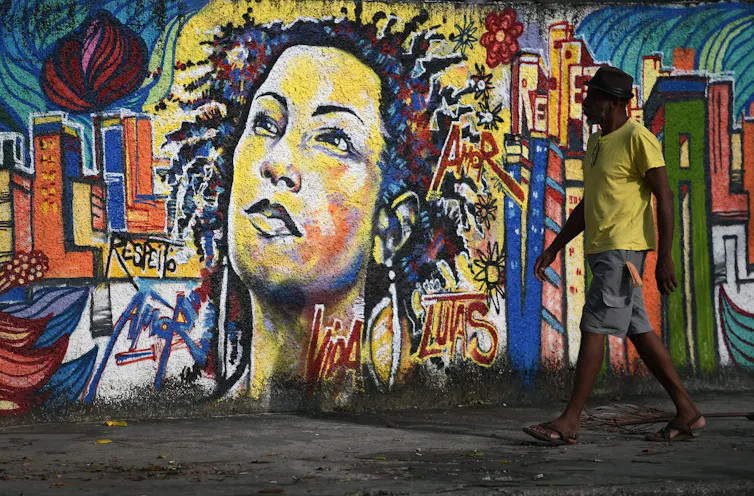
Many of the Black women who ran for office in 2026 ran as “Marielle’s seeds” – a reference to late Rio City Councilwoman Marielle Franco.
A stalwart progressive legislator and advocate for marginalized communities, Franco was assassinated on the orders of two right-wing politicians in March 2018, sparking large protests throughout Brazil and solidarity movements across the globe.
Her death also galvanized large numbers of Black women to engage in politics and run for office. During the 2026 election, the Marielle Franco Institute – established by her family in Franco’s memory – promoted the social media campaign “Vote por Marielle” to drive support for progressive politicians.
Social media campaigns have been widely credited for motivating younger voters and helping Lula overturn a first-round loss to Flávio Bolsonaro. And the role of Black voters was crucial, with the main gains that propelled Lula to victory coming from urban peripheries and “favelas” – informal settlements that are home to a higher proportion of Afro-descendant Brazilians.
The late votes to Lula in the second round could not stop a swing to the right in the federal Congress that had already been decided after the first round of voting on Oct. 5.
But even so, Black voters and social media campaigns helped vote in a cross-generation cohort of Black women, most of whom are affiliated with leftist political parties.
Among them is Vilma Reis, a leading Black feminist, anti-racist militant and soon-to-be state representative in the predominantly Black northeast state of Bahia. Reis has long challenged the dominant imagery in Brazilian politics by centering aesthetic and cultural aspects of Blackness that are frequently marginalized in Brazil – such as wearing her hair in locs and highlighting her ties to the often persecuted Afro-Brazilian religion Candomblé.
Reis will join Erika Hilton, a Black transgender woman from São Paulo, reelected to the lower chamber of Brazil’s Congress. A member of the Party of Socialism and Liberty, Hilton was elected as Brazil’s first trans member of Congress in 2022 and has since pushed a pro-LGBTQ and pro-labor agenda. In fact, Hilton’s bill to institute a 40-hour work week, passed into law in October, was viewed as a key victory for Lula leading up to the second round of the election, garnering widespread support from workers.

Another notable Black woman elected to Congress in the October vote was 21-year-old Workers’ Party candidate Ana Elisa Santos Silva from the state of Minas Gerais. Known by her first name, Ana Elisa represents a younger generation of Black women politicians. Her win was aided by social media – she had 2 million Instagram followers going into the vote, a number that swelled to 6 million after the second round of voting. She was also enlisted to help Lula’s successful social media campaign, with her own message focused on combating disinformation in social media, antiracism and defending equality.
While the three women represent different generations – Reis is 57, Hilton is 33 and Silva is 21 – all ran campaigns centered on supporting communities that have been targeted by Bolsonaro and other right-wing candidates in recent years. That found a wide audience too, with Hilton and Silva receiving the first- and second- highest number of votes of any women running for Congress this year.
Turning representation into power
In his previous three administrations, Lula advanced anti-racist policies, including establishing a federal ministry for racial equality and promoting affirmative action in federal jobs and public universities.
Given the role Black women played in securing Lula’s unprecedented fourth victory, many activists now believe the onus is on Lula’s government to respond to calls to turn greater representation into action.
Organizations such as Black Women Decide have called on Lula to appoint a Black woman to the Supreme Court – something that has not happened in the court’s 135 years.
This, combined with Black women’s increased presence in state- and federal-level offices, could usher in an unprecedented era of Black women’s power in politics.
Source: Iwpost.com