Anyone following the AI space is by now familiar with lofty claims that AI models will soon be better than humans at everything and capable of replacing vast swaths of the human workforce. In a new study from Google Research, though, a team that looked at how workers are actually using Gemini “[did] not find evidence… to support the claims that AI is about to cause massive automation and displacement of white-collar work…”
The paper, released last week, introduces the “AI & Economy ATLAS,” an Activity, Task, Landscape, and Adoption Study of 15 million anonymized AI interactions across the Gemini App, Google’s AI Mode, and the Gemini API. Their initial review of the data finds that, while AI sees some significant use across a wide variety of occupations, that use “remains shallow and overwhelmingly collaborative in nature, with end-to-end task automation limited in scope.”
“AI appears useful for a subset of tasks…”
To come to these conclusions, Google researchers used an automated classifier to sort work-based AI interactions using the Bureau of Labor Statistics’ Standard Occupational Classifications and O*NET’s more detailed database of specific work interactions. While this method required some probabilistic classification of “inherently uncertain” interactions, verification by human reviewers found it to be a reliable gauge of how Gemini prompts were being used for work.
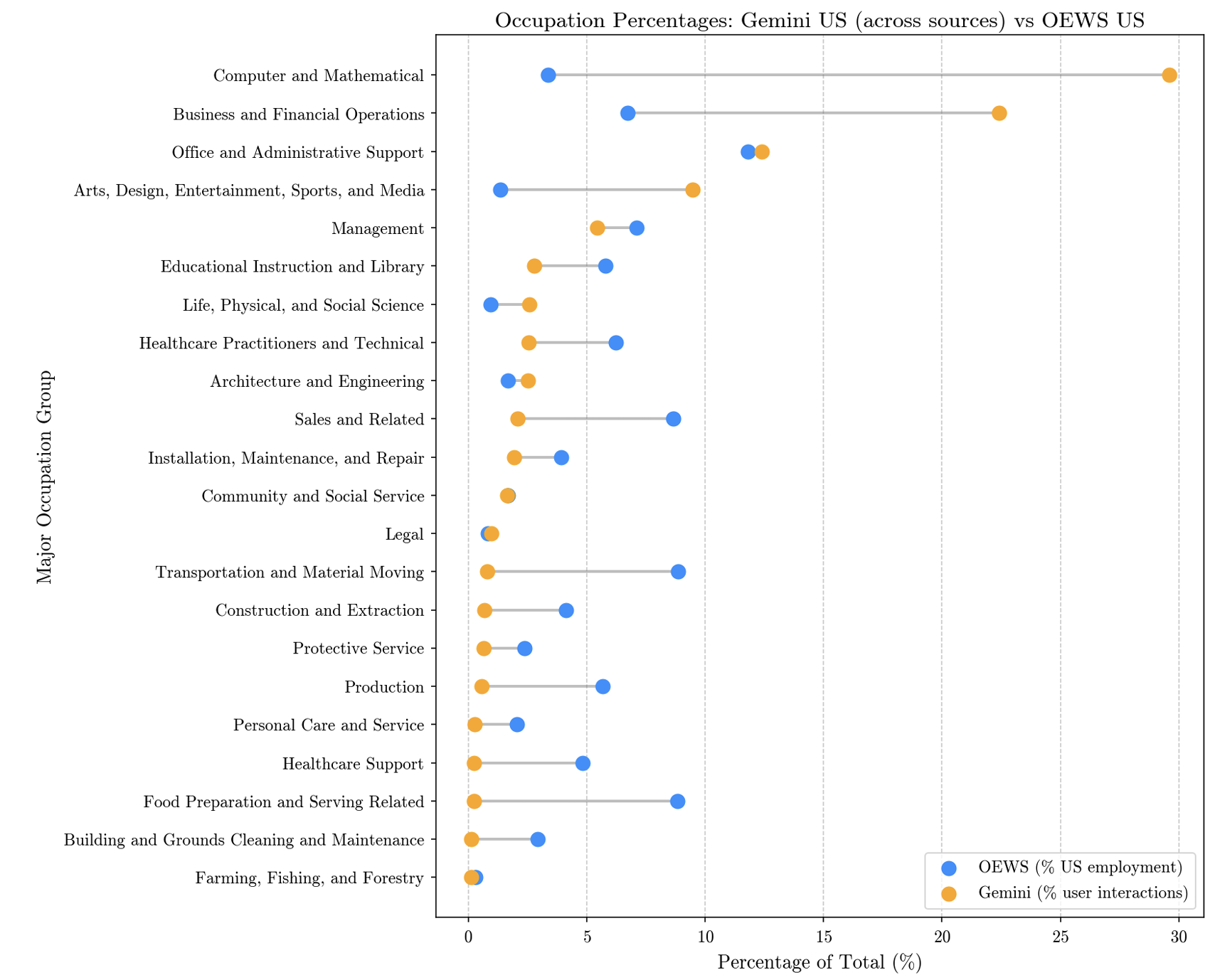
Unsurprisingly, white-collar jobs in fields like computers, finance, and arts and entertainment were some of the ones where the volume of Gemini use was overrepresented (when compared to their prevalence across the US economy). Financial/market analysts, software developers, and systems administrators were some of the relatively heaviest users of AI for job-related tasks, while salespeople, transportation workers, and food preparation/service workers were heavily underrepresented in the AI use data.
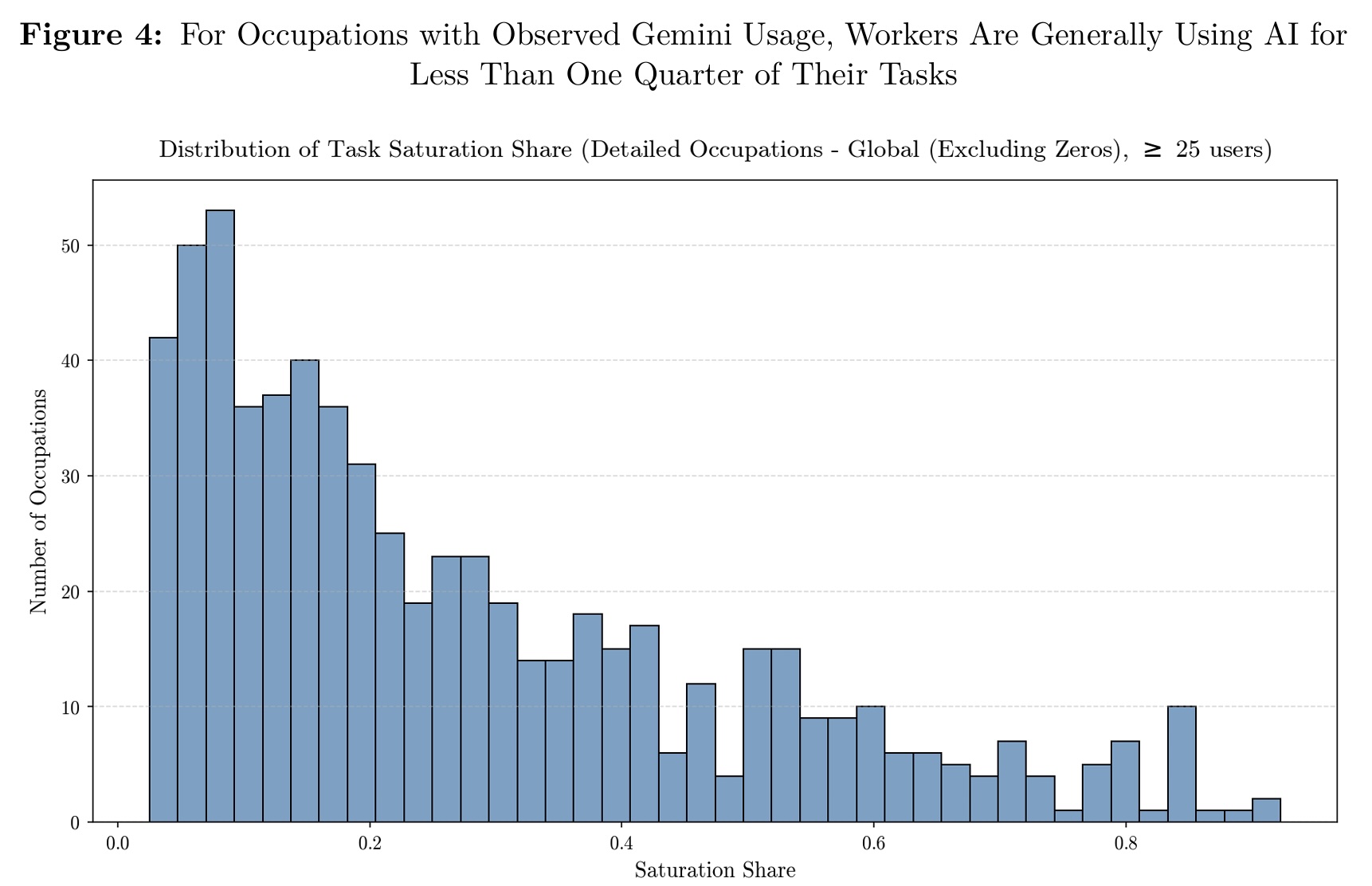
The researchers also attempted to measure how deeply AI was being integrated into various jobs, looking at how often individual, granular O*NET work tasks were attempted using Gemini. Across that entire database, the ATLAS researchers only classified 21 percent of all work-related tasks as “Gemini tasks”—those that met a minimum threshold of 25 related interactions attempted in the massive sample.
For many occupations (29%), not a single relevant work task achieved this “non-negligible” Gemini usage threshold, suggesting those jobs have been minimally impacted by the AI revolution so far. For another 30 percent of all occupations, less than one-quarter of tracked tasks saw significant related Gemini usage, suggesting humans were still the ones responsible for the vast majority of the component parts of those jobs.
In only 3 percent of occupations was Gemini being regularly consulted for at least three-quarters of that job’s relevant tasks. Jobs like software quality assurance analysts and testers, human resources specialists, and document management specialists fell into this bucket and are seemingly the most impacted by AI use in the study.
Altogether, the researchers write, these kinds of numbers suggest that “AI is currently serving primarily as a complement to existing work” and that “AI appears useful for a subset of tasks performed within occupations, but they do not currently appear to be comprehensively used for performing the work currently done by humans.” While the researchers say that this state of affairs may change “as new AI breakthroughs emerge,” it’s also possible that new workflows “will maintain a degree of complementarity between workers and AI systems.”
Give AI the low-expertise, non-routine work
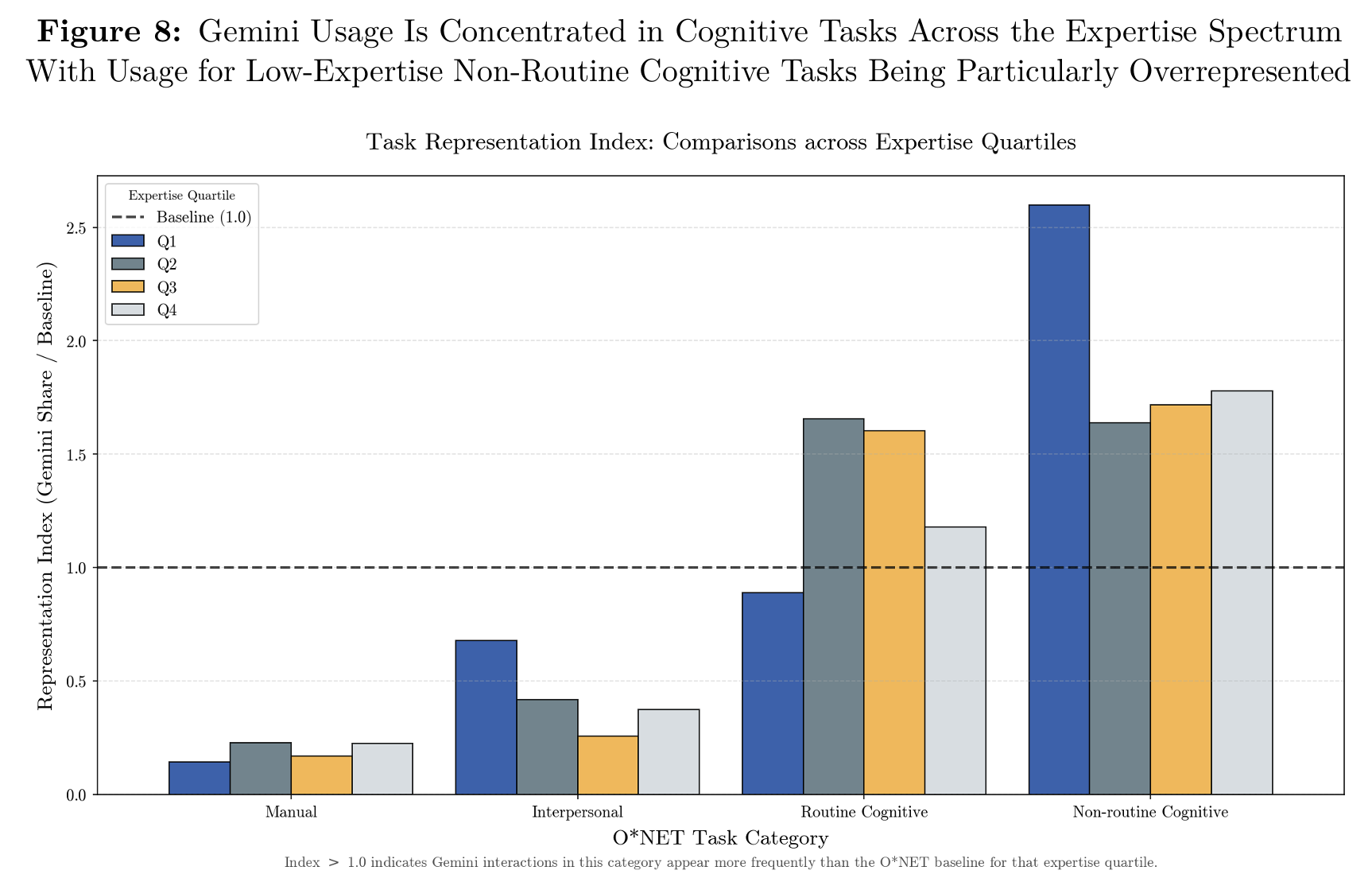
Beyond looking at high-level occupations, the Google researchers also looked at the specific kinds of work tasks that Gemini users ask the model to undertake. Cognitive tasks (i.e. those that primarily involve thinking) represented a whopping 86 percent of the Gemini interactions measured (by volume), while interpersonal and manual tasks were underrepresented in the sample compared to their workplace prevalence.
That doesn’t mean models like Gemini have been useless for more manual blue-collar jobs, though. The researchers found thousands of examples of industrial machinery mechanics using Gemini for “analyzing test results and machine error messages,” for instance, on top of tens of thousands of conversations where auto mechanics used Gemini to help with “testing vehicle components and systems, rewiring systems, and inspecting parts for wear.” These workers were much more likely than others to feed Gemini a photo for reference, rather than text.
When it comes to more cognitive work, the majority of significant Gemini tasks observed were related to either the “drafting and generation” of ideas or “information retrieval and learning.” A minority fell into a bucket related to automation of work tasks, even for the parts of these jobs that were judged to be “routine.”
Crucially, the kinds of cognitive tasks the researchers found workers offloading on AI were overwhelmingly ones that didn’t require a lot of expertise (as measured by the complexity and entropy of the words involved in their descriptions). Low-expertise tasks such as rewriting material in different languages and writing and reviewing product specifications were heavily over-represented in the Gemini sample, suggesting that humans are much less likely to use the model for the most complex parts of their jobs.
Taken as a whole, all this data suggests to the researchers that workers are not “automating themselves out of existence” with AI. Instead, employees seem to overwhelmingly be using AI to “augment their work by automating routine cognitive tasks and simultaneously collaborating with AI in their performance of non-routine cognitive work.” This could change if future models become more useful for high-expertise tasks or if AI-powered robots become better at performing manual tasks, the researchers note. Overall, though, the researchers write that the current usage patterns of Gemini for work-related tasks points to “greater returns to human skill in [the] non-routine dimensions” that still dominate most job descriptions.