Four months have passed since US forces captured Venezuela’s sitting president, Nicolás Maduro, and ousted him from power. Maduro’s vice-president, Delcy Rodríguez, quickly moved into the top job and has, under US tutelage, begun a process of reversing her country’s experiment with socialism.
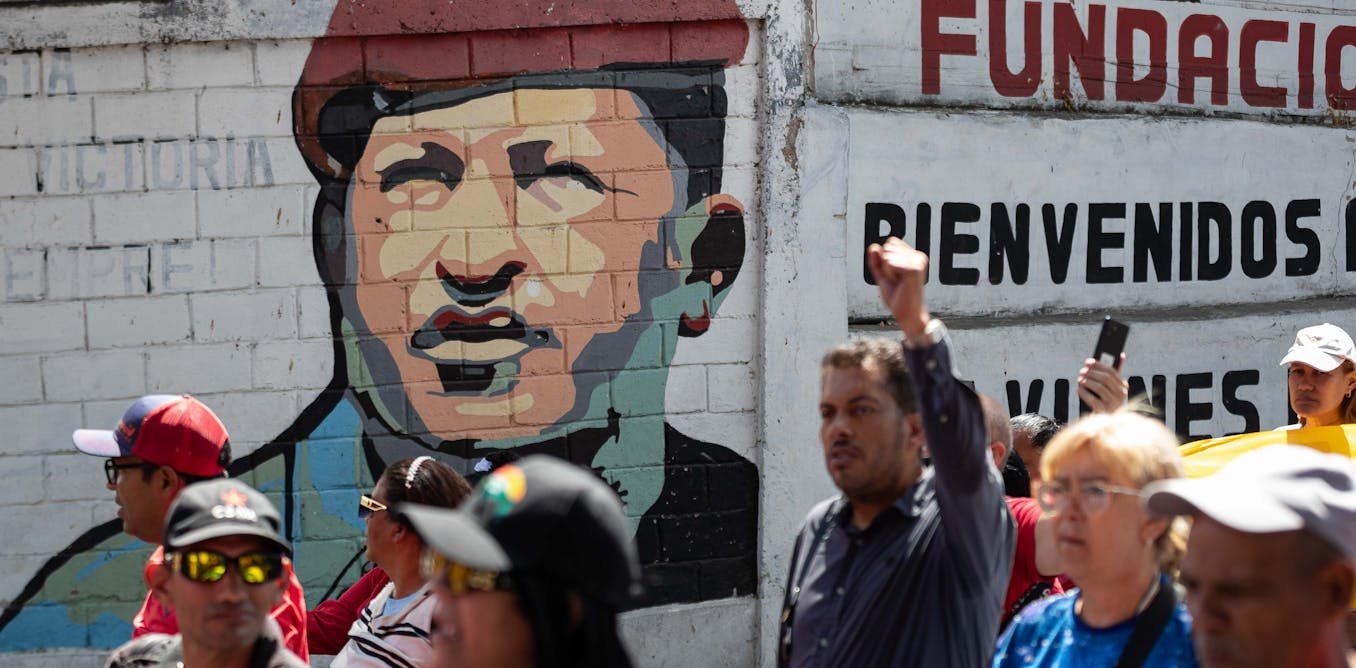
Venezuela’s pivot towards socialism began under the leadership of Hugo Chávez. After entering office in 1999, he initiated a programme of sweeping nationalisations, state-led oil wealth redistribution and increased social spending. Chávez called this process the Bolivarian revolution.
Maduro replaced Chávez as president after his death in 2013. And from there, his administration oversaw one of the most severe economic declines in modern history while simultaneously dismantling democratic checks and balances.
Ideological revision is a perilous moment for revolutionary regimes. Major policy pivots require cautious steering and, without credible and calibrated leadership, they risk overwhelming insular, authoritarian states.
The Soviet Union is perhaps the most illustrative example of this. It collapsed in 1991 under the weight of popular economic grievances mobilised under newfound freedoms of speech and assembly.
Keen to avoid a similar fate, the Chinese Communist party studied the Soviet Union’s downfall over the next decade. It concluded that the Soviet miscalculation was simultaneous economic and political opening, and has thus limited regime liberalisation to the economy.
In Venezuela, Rodríguez appears to be following China’s approach. She has maintained tight control of political conditions inside the country, while prioritising economic liberalisation.

Under the acknowledged guidance of US officials, Rodríguez has unravelled some elements of Maduro’s regime. Thirteen of 32 ministerial positions have been reshuffled in an administration that has long been dominated by military figures and interests.
However, a number of the key power brokers from the Venezuelan armed forces who maintained the Maduro regime remain in government. This includes the interior minister, Diosdado Cabello, and Vladimir Padrino López, who was dismissed from his role as defence minister in March and appointed as agriculture minister instead.
These people have moved into line behind Rodríguez. Successive US presidents have issued sanctions, bounties and arrest warrants against them, as they have against Rodríguez. Hers have now been rescinded, and other prominent Maduro loyalists will be hoping their compliance brings them the same.
The entire machinery of state and government remains in the hands of the ruling United Socialist Party of Venezuela (PSUV). This includes the national assembly, supreme court, national electoral administration, police and military. PSUV governors are in place in 23 of the country’s 24 states.
And despite demands from Venezuelan opposition figures for presidential elections, the Trump administration and Rodríguez have thus far avoided committing to a vote. Progress on granting amnesty to Maduro-era political prisoners has also slowed.
While more than 2,200 people were released from prison or had other legal restrictions withdrawn after the passing of an amnesty law in February, the release of political prisoners has reduced to a trickle. Over 400 of these people remain incarcerated, and the amnesty law has been quietly parked for revision.
Economic liberalisation
On the economic front, Rodríguez has implemented reforms at a greater pace. New laws and regulations reversing Chávez’s nationalisation drive are reopening key sectors of the economy to private investment. This includes hydrocarbons and mining.
A recently unveiled Commission for the Evaluation of Public Assets will audit state ownership in other economic areas such as agriculture, manufacturing and infrastructure. A fire sale to the private sector is expected.
The discipline and political dominance of the PSUV machine have been put to good use here, waving through favourable terms and other confidence-building measures for investors. These include providing legal guarantees in what has long been a notoriously unpredictable economic environment, as well as access to international arbitration. Whether these measures encourage investment will become clear in the months ahead.
Rodríguez has also steered Venezuela back into the International Monetary Fund (IMF), ending a suspension that began in 2019 when the organisation ceased recognising Maduro’s government. Kristalina Georgieva, the IMF’s managing director, reports having “productive” conversations with Rodríguez.

The US president, Donald Trump, has praised Rodríguez for doing a “great job”. He has said she is working well with US representatives. But there are many disruptive challenges on the horizon for Rodríguez. In the short-term, there is a very real risk of protests. Venezuela remains in a political limbo with hopes of justice and democracy currently frustrated.
The absence of demonstrations to date owes much to a lack of leadership on the ground. This is likely to change when opposition leader Maria Corina Machado, who the Maduro government barred from competing in the July 2024 presidential election, returns to the country. Machado has said she expects to be back in Venezuela before the end of 2026.
Many had expected Machado to be delivered into the vacated presidency after Maduro’s capture. But Trump declined to support her as the country’s next leader. Even after she gave Trump her Nobel Peace Prize medal in January – and despite her strong friendship with US secretary of state, Marco Rubio – Machado remains on the periphery of US decision making.
On a recent tour of Europe, avowed neoliberal Machado did not voice support for the economic changes Rodríguez has introduced. She has instead emphasised the necessity for political reform in Venezuela, while also demanding accountability and justice for the corruption and abuses of previous governments.
Another, more long-term problem relates to the type of political economy that is emerging in Venezuela. The economic changes are designed to spur investor interest in extracting the country’s hydrocarbon and mineral resources.
This will merely reestablish Venezuela’s historical dependence on commodity exploitation. Such dependence has been a fundamental factor in Venezuela’s instability since the 1970s and is something the Bolivarian revolution pledged to end.