“The Iran war weakens deterrence in Asia, undercuts confidence of US allies and partners, and makes conflict with China more likely.”
That’s become an article of faith among those opposing the US fight with Iran.
The US military – the navy in particular – is indeed smaller than it should be, and much American combat power is deployed to the Middle East. There is no deployable aircraft carrier in the Western Pacific, and the sole forward-based Marine amphibious unit, the 31st MEU, is deployed to Iran.
As troubling, the Iran war is draining war stocks – especially long-range precision missiles and air-defense ordnance. It’s unclear exactly how alarming the situation is, but it is likely that the US hasn’t got what it would like to have to fight China. The USINDOPACOM commander, Admiral Samuel Paparo, suggested as much in recent comments.
Does this present Xi Jinping with a tempting opportunity to make a move on Taiwan or against the Philippines or Japan – or all of them?
Maybe.
But Xi might have second thoughts.
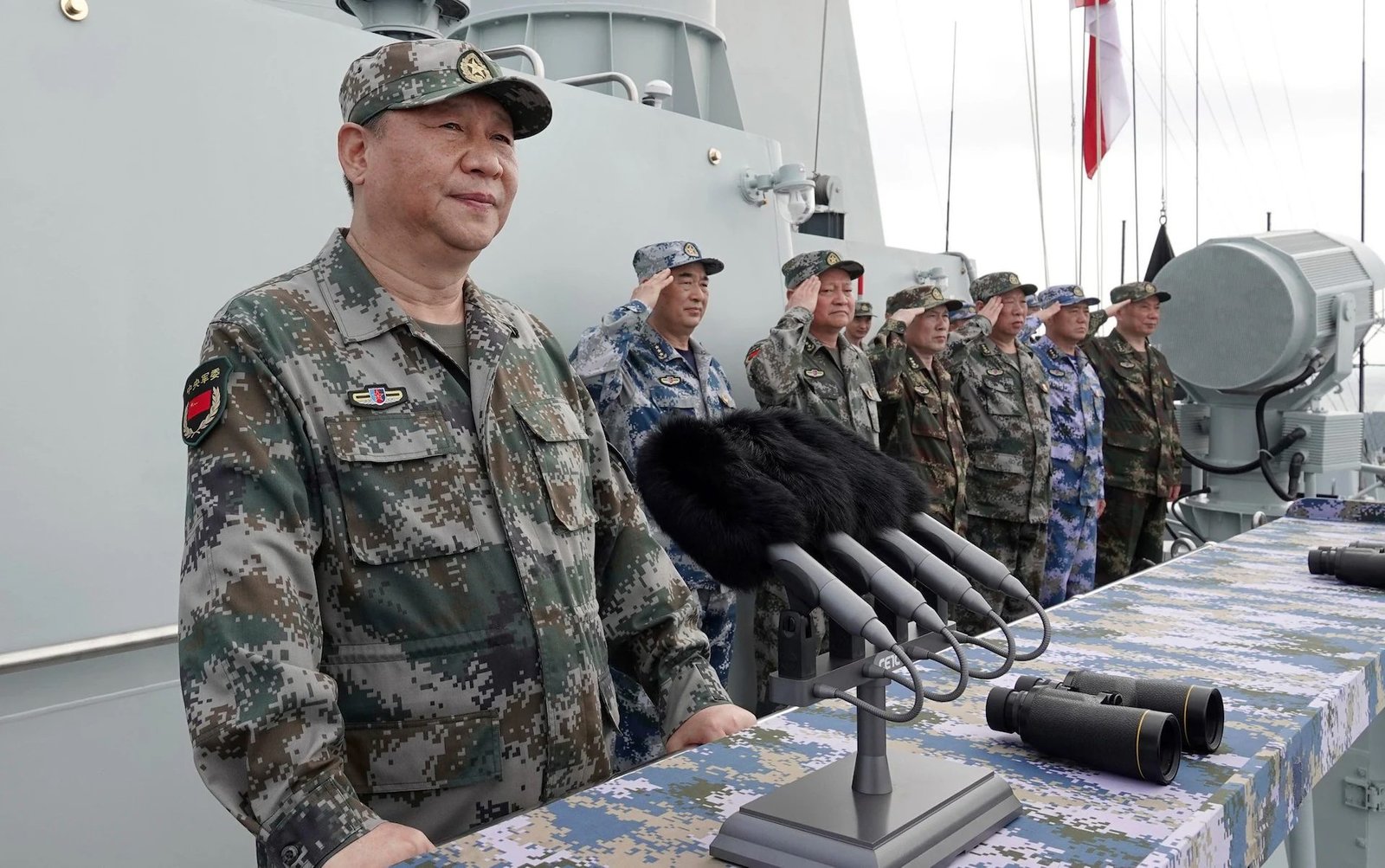
China has indeed built a powerful military – in what’s often described as the biggest, fastest military buildup since World War Two.
The US Department of War’s annual China Power Reports make for grim reading.
The People’s Liberation Army’s principal near term mission is to seize Taiwan. It has been working on the problem for at least five decades.
Its naval and air forces can surround the island.
Combined PLA sea and airborne lift can potentially move large enough forces across the Taiwan Strait.
The PLA’s huge rocket force can hammer Taiwan. It has a Fifth Column in Taiwan that can assist, and has been engaged in effective subversion and cognitive warfare against Taiwan’s population for years.
Short and confined
Xi Jinping might like his odds – especially if the fight is confined to the area around Taiwan and it ends soon – say, in a few weeks.
But taking Taiwan is no sure thing.
The US military still has considerable capability in the region – even with all that’s going on with Iran – and it can reinforce from elsewhere.
Even more, the Americans have shown they know how to fight, as seen in Venezuela and Iran – and swatting away Houthi missiles in the Red Sea. And, worse, Chinese air defenses and missiles sold to their proxies haven’t worked so well.
The PLA also hasn’t been in a real fight for 50 years.
Xi must wonder.
If the fight for Taiwan expands and becomes a global war China – by its own admission – still cannot protect its global interests.
The PLA is not ready to operate worldwide, or project power much beyond 1,000 miles from the mainland – even if its missiles can range much farther.
Beijing can expect its international trade to come to a standstill – along with energy and food imports.
Chinese companies will be starved of components and technology to build things nobody will buy anyway.
And halting exports that earn hard currency (principally US dollars) – as well as being booted from the US dollar network – would pose other huge problems.
Beijing will need to make do with its own currency, which is not freely convertible. A nice way of saying most people don’t want it.
Try buying Australian iron ore to produce the steel to build the PLA Navy – or even buying off Ivy League professors – without US dollars to pay for the purchases.
And if the attack on Taiwan isn’t a short affair, and the PLA gets bogged down, the Chinese public may not be so understanding – even after an initial surge of nationalism.
Xi has been telling Chinese citizens to get ready to ‘eat bitterness’ for years. But the 600 million people living $5 a day or less, the single child households whose sons are dead, and Xi’s many enemies may instead blame Xi for the hardship.
And starting a kinetic war just might wake up other countries to the need to better defend themselves – and cooperate with each other and the United States.
It’s already started – and that’s before a shooting war.
Xi Jinping’s aggressive behavior has gotten Japan to bolster its defenses – something successive US administrations couldn’t achieve.
The Philippines are similarly energized. The Indonesians too. Even New Zealand sounds worried about China.
And the Americans are clearer about the China threat than they were a decade ago when warnings – even by military officers – were verboten in Washington and at USINDOPACOM.
The Europeans? They can be craven but are sort of realizing that defense matters – thanks to Putin, and to Trump’s tough-love approach.
The Global South? Wait until the reports come out of the PLA gunning down Taiwanese – and also the reports of Chinese investment (and under the table payments) drying up.
Even the Russians might only make pro-Beijing statements and shed crocodile tears, leaving the Chinese and the Americans to go at it.
Chinese-funded leftist groups in America might try to help the cause. But attack Taiwan (or Japan) and US bases on Guam and in the Northern Marianas (US territory) and in Hawaii and you’ll kill Americans.
Attack the mainland itself and don’t expect most Americans to get over it any time soon.
Even America’s native Quisling class, Wall Street and big-business, might finally have second thoughts about the PRC.
Ultimately, only Xi Jinping knows what he’s going to do.
And he might decide now is the time to make his move while the Americans are occupied in Iran.
But it would be one hell of a gamble.
And Xi and CCP elites are presumably not suicidal. Otherwise, why squirrel their wealth away, along with relatives, overseas?
Colonel Grant Newsham (US Marines – Ret.) is the author of When China Attacks: A Warning to America.