TOKYO — An unwelcome blast of US inflation is blowing across Asia’s markets. September’s hotter-than-expected price data revived concerns that the Federal Reserve will keep rates higher for longer, threatening fresh pressure on currencies, capital flows and economic growth across the region.
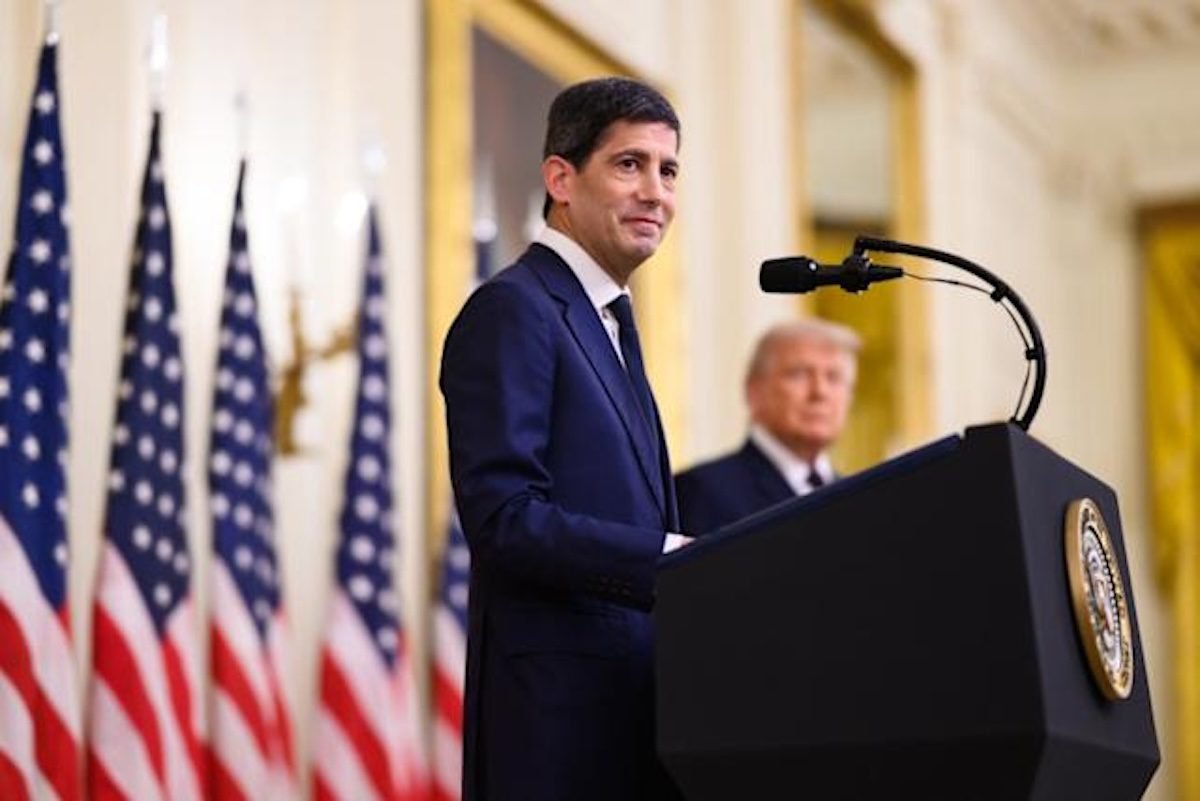
Last month’s 3.7% year-on-year increase in consumer prices didn’t just exceed forecasts. It ensured the Fed is on an even bigger collision course with both the bond market and US President Donald Trump’s White House. It’s arguably the last thing both Trump and US Federal Reserve Chairman Kevin Warsh wanted to see less than three weeks ahead of the mid-term elections.
Bad inflation news won’t help Trump’s Republican Party surprise pundits who predicted a “blue wave” for Democrats on November 3. Nor will it increase the odds that Warsh will get many nights of good sleep in the months ahead.
Warsh, after all, was hired by Trump to cut interest rates early and often. Since taking the helm in May, though, Warsh has realized the limits of a Fed chairman’s power to commandeer the thinking of a decision-making board staffed with smart people.
One policymaker standing in Warsh’s way is the man who led the Fed before him—Jerome Powell. Another — Fed Governor Lisa Cook — is a leading target of Trump’s Department of Justice. Warsh, in other words, would have his work cut out for him even if inflation wasn’t heating up in real time.
All this has Asia in a whirl. This region is on the front lines of Fed tightening cycles. It was a multi-year Fed tightening cycle that precipitated the 1997-1998 Asian financial crisis.
As the dollar surged, currency pegs in Indonesia, South Korea and Thailand became impossible to maintain. During that window, Long-Term Capital Management blew up and Russia defaulted on debt as rising US Treasury yields rocked the globe.
Years later, the Fed “taper tantrum” of 2013 shook the global system. The mere specter of the Fed draining liquidity sent US yields skyrocketing and markets everywhere into a panic. And now, the dollar’s runaway strength is upending Asia markets and fueling anxiety in capitals across the region.
The spike in 10-year Japanese government bond (JGB) yields earlier this year to 30-year highs set the stage for similar surges in the US, UK and Eurozone. Earlier this month, the 10-year US yield topped 5%, rising to the highest level since 2002, while the 30-year yield rose above 6%, the highest since 1998.
Markets are teeing off above-target inflation in virtually all major economies. And “until monetary tightening is delivered, bond markets will demand a premium for longer-term borrowing,” said Fred Neumann, chief Asia economist at HSBC.
In Bangkok this week, the International Monetary Fund spotlighted fast-growing debt levels – and how they’re a big vulnerability amid a war in the Middle East and AI-driven stock rallies running ahead of economic fundamentals.
For example, the IMF warns that a big drop in AI investment that slams asset prices could cut average global gross domestic product (GDP) growth 1.1% by 2028, including a 1.8% decline in US output.
“We now have an economy that is standing on one leg, the AI leg,” IMF Managing Director Kristalina Georgieva said in Bangkok. “What if it wobbles? What if there is disappointment and that leads to potentially a more difficult environment?”
The problem, the IMF argues, is “complacency” in safeguarding economies against a potential plunge in AI investment and stock valuations. “If there are questions about the monetization of AI, the equity investments will deplete in value, the debt may be difficult to service, and the revenue commitments in the future may not materialize,” said Jason Wu, a global markets analyst at the IMF.
In the first half of 2026 alone, global debt grew by more than $10 trillion to surpass $365 trillion, according to the Institute of International Finance. The problem is that these “high deficits” are now the “new normal,” said IIF economist Emre Tiftik.
Runaway deficit spending “has persisted despite relatively healthy labor market conditions,” Tiftik said. “Historically, fiscal deficits served as countercyclical tools, deployed during downturns to support activity. Today, large deficits have become entrenched across the economic cycle, signaling a structural shift in fiscal behavior.”
Tiftik added that “this convergence underscores the need for stronger debt management frameworks, in both mature and emerging markets. Average government borrowing costs across the G7 are now at their highest since mid-2008, while annual interest expenses are nearly 85% higher.”
Over the past year, Tiftik explained, advanced economies paid over $3.3 trillion in interest on internationally traded government bonds alone —more than estimated global spending on AI ($2.6 trillion), defense ($3.1 trillion), or clean energy ($2.3 trillion).
Not everyone thinks the IMF is right about debt worries. Gabriel Sterne, head of emerging market research at Oxford Economics, noted that “the median economy can stabilize debt by running a primary surplus of 0.1% of GDP, similar to 15 years ago.”
Sterne said that rather than fiscal-related tail risks, he thinks the grinding nature of relentless fiscal adjustment for a significant number of economies is the biggest issue. One quarter of nations have to run primary surpluses forever to stabilize debt. For corporates and consumers, that justifies long-term concerns about high tax burdens and weak public infrastructure.
The bottom line, “funding is available but expensive, further compressing room for fiscal maneuver,” Sterne added. “It’s a clear warning for Italy, Japan, South Africa, Mexico, and Colombia, which are in the long fiscal-grind category,” with debt-stabilizing primary balances above 1%. “Turkey, Spain, the UK, Belgium, France, Peru, and Canada also need to run primary surpluses indefinitely.”
The Fed’s tightening cycle is a complicating factor – and a fast-growing one. Last month, the Fed hiked rates for the first time since 2023. The quarter-point move pushed the Fed’s benchmark to between 3.75% and 4%. Policymakers are widely expected to move again by year-end, perhaps as soon as October 28. September’s worse-than-expected inflation data increase the odds.
In New York on Thursday, Fed Bank of Cleveland President Beth Hammack said more aggressive moves could be necessary as inflation expectations worsen. Hammack said: “What I worry about is, if you get this inflationary mindset, if you get these expectations that these price pressures become more and more persistent, it makes it much harder for monetary policy to do the work that we need to do, and we might need to move even more than if you don’t have an inflationary mindset set in.” She added that “I’m not feeling that there’s restraint coming from financial conditions at this point in time.”
On Friday, Warsh spoke at IMF-World Bank annual meetings in Bangkok, where he said he doesn’t “prejudge” interest-rate decisions, offering no preview of whether the US central bank will hike rates later this month. Warsh said: “We made very clear that we would deliver price stability.”
Yet the risk of Fed rates – and US yields – remaining higher for longer is a real one. That, along with investors growing skittish about AI, could pull the rug out from under the stock market. “AI-led equity weakness could further cap dollar upside by challenging the capital flows into US assets and wealth effects supporting resilient US growth,” said OCBC Group Research strategist Sim Moh Siong.
Trump’s chaotic war in Iran also has bond markets in a whirl as oil prices spike. While oil flows out of the Middle East are increasing, “it’s unclear if the increase is sustainable,” said Madison Cartwright, economist at Commonwealth Bank of Australia. “As long as the war is unresolved, risks of future disruption will persist.”
One thing is clear: Warsh’s arrival at Fed headquarters in May isn’t playing out the way Asia hoped. Since replacing Powell, Warsh has run notably more hawkish than Trump expected. He could still be looking for an opportunity to do Trump’s bidding and secure rate cuts. But with US inflation running close to 4% and the labor market holding up far better than expected, Warsh faces a complicated inheritance.
It’s a remarkable about-face — and it’s reshuffling Asia’s calculus at bewildering speed. Currencies across the region are on the brink, from the yen to the rupee to the rupiah, with the Philippine peso and Thai baht joining the rout.
The common thread is a runaway dollar that’s pressuring exchange rates almost everywhere, keeping governments from Tokyo to Jakarta on daily intervention watch. Iran war uncertainty is adding fuel, pushing the dollar higher and unleashing its wrecking-ball tendencies.
With US debt near $40 trillion, inflation elevated, and Trump’s tariffs, spending binges and Middle East war all in the mix, the dollar is rising anyway — defying gravity, outpacing gold and Bitcoin, even overpowering the AI trade.
That uncertainty has Tokyo engaged in a currency tug-of-war. The yen is near the psychologically charged 160 level — its weakest since July 2024. It sits just inches from 1986 lows.
All of this is tightening the vise on Prime Minister Sanae Takaichi. Since October 2025, her government has staked its economic strategy on three pillars: a weak yen, ultralow rates and fiscal loosening. That was a risky bet six months ago. With the world’s most powerful central bank now tilting hawkish, the foundation looks shakier than ever.
Jakarta is on the ropes. The rupiah is down 7% this year, moving even below the depths of the 1997-98 Asian financial crisis. President Prabowo Subianto’s government and Bank Indonesia are intervening frantically to stem capital flight from Southeast Asia’s largest economy.
The pressure coming from the US-Iran war is “materially impacting” Indonesia’s economy and external balance, said UOB Kay Hian analyst Suryaputra Wijaksana.
The political stakes couldn’t be higher, as index giant MSCI mulls whether to downgrade Jakarta stocks to “frontier” from “developing” status. The Fed’s hawkish pivot is compounding Indonesia’s pain.
India’s, too. A falling rupee is making crude oil and other critical imports — electronics, industrial inputs — significantly more expensive, boosting inflation and pushing foreign investors toward the exit. Dollar-denominated debt service is getting costlier by the day.
Nobody knows where the Warsh Fed lands six months from now — or how Trump, who’s top Fed officials or have them indicted, reacts if his chosen successor to Powell fails to deliver rate cuts. But the dollar surging amid a Fed tightening cycle wasn’t on Asia’s 2026 worry list. It is now.
Follow William Pesek on X at @WilliamPesek