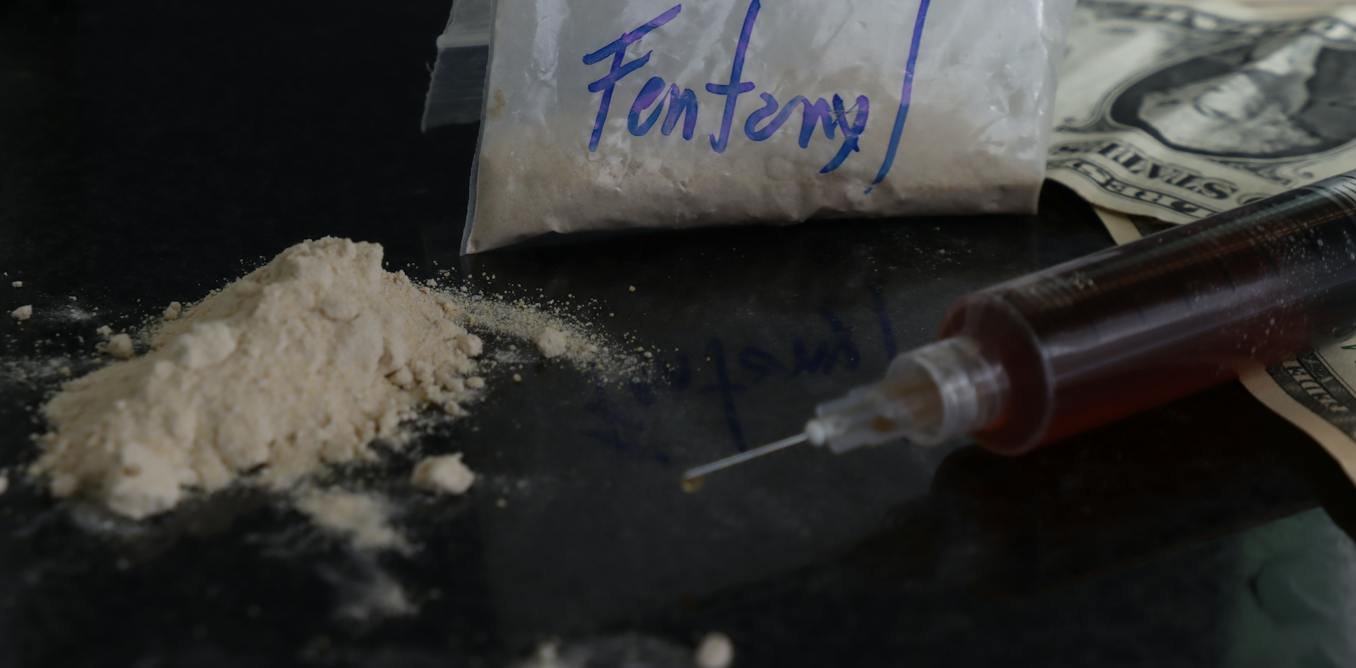
Fentanyl and other synthetic opioids are still the single biggest driver of overdose deaths in the US. They were involved in around 38,000 of the roughly 70,000 deaths recorded in 2025, according to the Centers for Disease Control and Prevention.
Europe’s figures are of a different order. In 16 countries that reported data, fentanyl and its derivatives were linked to a total of around 210 drug-induced deaths in 2024, up from about 130 in 2023. Most of that rise may involve medicines rather than illicitly made fentanyl.
Other potent synthetic opioids, notably nitazenes, have driven recent peaks in deaths in several countries. In Italy, the government’s latest report on addiction counted only five fentanyl-related deaths in 2025.
This gap has prompted a striking explanation: that Italy’s mafias, wary of a drug that kills their customers and draws police attention, have chosen to keep fentanyl out.
It is a compelling story. But it does not fit what we know about drug markets or mafias. Europe’s comparatively low fentanyl numbers are better explained by something less cinematic: there is very little demand for it.
Crisis built on prescriptions
America’s fentanyl crisis was largely manufactured and a result of entrenched corruption. From the late 1990s, aggressively marketed prescription painkillers such as OxyContin were handed out widely, with their addictive potential played down. Millions of people developed opioid dependence through entirely legal channels.
When access was tightened in the 2010s, that dependence did not disappear. People turned to the illicit market: first heroin, then fentanyl, which is cheap to make, easy to smuggle and so potent that tiny amounts go a long way. Drug trafficking groups from Mexico that already supplied heroin to the US simply added a new product to their range.
Europe never had an equivalent prescription wave. Opioid painkillers are prescribed far more cautiously there, so there was no large population suddenly cut off from a legal supply and looking for a substitute.
Heroin, meanwhile, never went away. It is still Europe’s most commonly used illicit opioid, according to the EU Drugs Agency. Most of it has historically come from Afghanistan, entering Europe through the Balkans, and the market has proved resilient and stable.
Even as Afghan opium cultivation collapsed after the Taliban banned it in 2000, and then issued a second ban after returning to power in 2022, stockpiles and production elsewhere have kept supply flowing.
People who use heroin in Europe have established habits, networks and treatment services built around it. There is no obvious reason for them to switch to an unfamiliar drug, and no mass of new users being pushed towards one.
The veto argument also rests on a picture of organised crime as one strategic group, able to weigh up a product and rule it out across a whole country. But that is not how Italian mafias work, and it is not how drug markets work.
Crime groups such as the ‘Ndrangheta are made up of families, clans and individuals who act on opportunity, shaped by local structures and contacts. They broker, invest and supply where there is money to be made.
Nobody inside one organisation can impose a marketwide ban, let alone across the different mafias and the many other organised crime groups active in Europe’s drug trade.
Nor are Italian mafias squeamish about dangerous drugs. Their central role in Europe’s cocaine trade is well documented, and has been a focus of my own research. But more crucially, their adaptation to changing markets is their distinguishing factor.
Two recent cases from Calabria, the ‘Ndrangheta’s home region, say more about where Italy’s drug economy is heading.
Police are uncovering more, and larger, cannabis plantations hidden in the region’s mountains. In early October, police found ten plantations with more than 4,500 plants in woodland around Caulonia, San Luca and Roghudi. The sites were reachable only on foot and fitted with drip irrigation and automatic timers.
Months earlier, in May, law enforcement found a clandestine cocaine refinery in the countryside of Sant’Agata del Bianco, with hydraulic presses and more than 500kg of cutting agents. The investigation points to a transnational network of South American and Italian traffickers, with its own chemist, rather than a ‘Ndrangheta operation.
Both cases point the same way. Italy’s drug economy is not a closed shop run by one or two organisations. Independent operators can set up there, process product locally and serve European demand.
The idea of a mafia that protects its customers hands criminal groups a reputation for order and restraint they have not earned. It also distracts from where the risks actually lie. Europe’s opioid market is becoming more complex and potent: new synthetic opioids such as nitazenes are already in circulation.
The answer to that is not to wait for a mafia decision. It is better drug monitoring, early-warning systems, drug-checking services and making naloxone, the opioid overdose antidote, easy to get hold of. Europe’s fentanyl story so far is a story about demand. Keeping it that way is a public health job, not a criminal one.