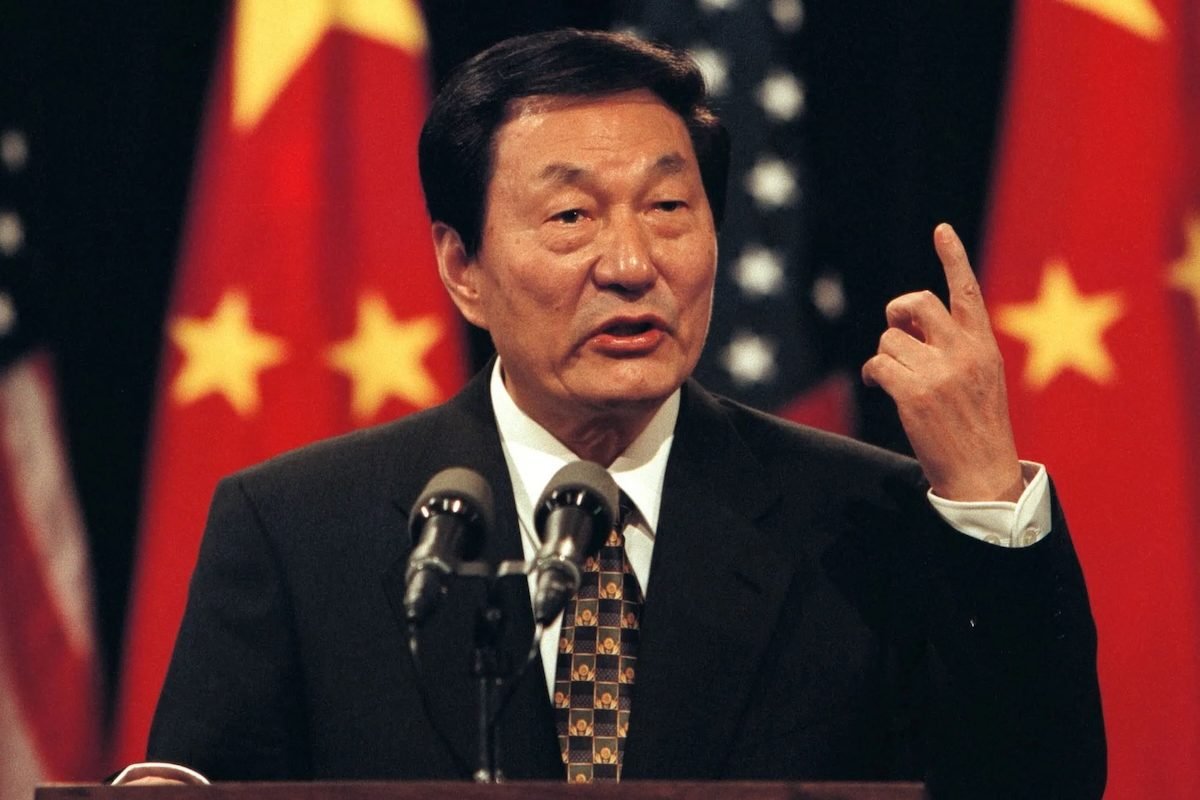
Zhu Rongji, born on October 23, 1928, died on August 12, 2026. He had been a prime minister, and a great modernizer of China’s financial system. Yet his legacy seems to have faded.
Premier Zhu was the man who pushed for China to join the World Trade Organization. He wanted China to be fully integrated into the global economy and for the renminbi to be fully convertible, the main currency of exchange in East Asia. He secured the WTO but not the rest. What is his legacy now?
He came to power with the task, assigned by Deng Xiaoping, of reforming and restoring order to China’s chaotic financial system. Central to the debate was a seemingly banal issue: the Chinese structure. At the time, trade operated on a dual track, with high tariffs on official imports and zero levies on a high rate of smuggling.
He and his advisors calculated that the country would actually earn more import duties by joining the WTO, lowering tariffs, and eliminating smuggling. The point was delicate and sensitive.
A significant share of this smuggling, which passed through the southern provinces of Fujian and Guangdong, occurred under the protection of the armed forces, the People’s Liberation Army. Leaders of the PLA, as part of a pact within the Party, had stepped back from internal politics and, in exchange, used their positions of privilege to enrich themselves through countless business activities.
To cut smuggling was to step on the PLA’s toes. But he did it; the PLA lost the battle.
By the end of the 1990s, his goal was to make the renminbi fully convertible by 2000. Two financial crises, ten years apart, upended Zhu Rongji’s plans.
The first crunch came during the 1997-98 Asian financial crisis. It showed how a fragile financial system could be attacked and crippled by global markets and speculation. After the 1997-98 crisis, the goal of full convertibility was not abandoned but postponed.
Yet postponement followed postponement, especially after he stepped down as premier in 2003. The convertibility of the Chinese currency remained pending when the 2008 financial crisis hit.
For the Chinese, this posed a double challenge. On the one hand, it showed that even the American financial system — the model for China and the world — might not be fully reliable after all. On the other hand, China embraced the idea of a massive economic stimulus plan, at the time worth perhaps close to a trillion dollars. It revived the global economy and, above all, China’s own economy — which, in fact, got hooked on drug-like stimuli.
After that massive stimulus package, the Chinese market began demanding ever-larger doses of stimulus. So large, in fact, that full convertibility of the currency receded farther into the distance with each passing year.
A currency fully convertible but saddled with murky financial accounts and even murkier debts would have been attacked by world markets. The Chinese stock market would have collapsed – along with the exchange rate and, indeed, the economy — and this would have brought about a social and political crisis without precedent.
Zhu was rumored to have bitterly protested the 2008 stimulus and even more so the subsequent stimuli. He was rumored to have been so vocal that he was confined at home and forbidden to meet anyone. He was possibly vindicated later, but the situation was, and is, out of control.
The real source of friction between China and the world is the full convertibility of the RMB, which Zhu, and possibly Deng, saw, but his successors failed to heed for over a decade.
I met him when ANSA correspondent Barbara Alighiero and I interviewed him in 1999. Shortly before that, I had met and interviewed President Jiang Zemin, along with with Corriere della Sera Editor Ferruccio de Bortoli. The two couldn’t be more different. Jiang was in control of the room and wanted to see everybody’s reactions to his words; Zhu was interested in the ideas and the person before him. With Jiang, all the Chinese staff were tense; with Zhu, nobody paid attention, and he didn’t care.
As a young man in 1957, Zhu was punished during the anti-rightist campaign. Deng noticed him in the mid-1980s, when he was a mid-level head of the Department of Industrial Economy at the Chinese Academy of Social Sciences (CASS). In 1988, reportedly, Deng sent him to Shanghai to serve as mayor to shake up the city, which was lagging behind Guangdong, and to make it a spearhead of the reforms.
The 1989 protests changed all priorities. Jiang, Shanghai party secretary, was called to Beijing to become party chief. In 1993, Zhu became vice premier, and in 1998 premier, China’s economic czar. Nobody has impacted the Chinese economy as he has. Yet his massive push to set things in order and clear books and accounts was abandoned once he left power. He knew market rules can’t be ignored forever. If this happens, the economy will collapse.
This article was first published by Appia Institute, of which the author is director, and is republished with permission. Read the original here.