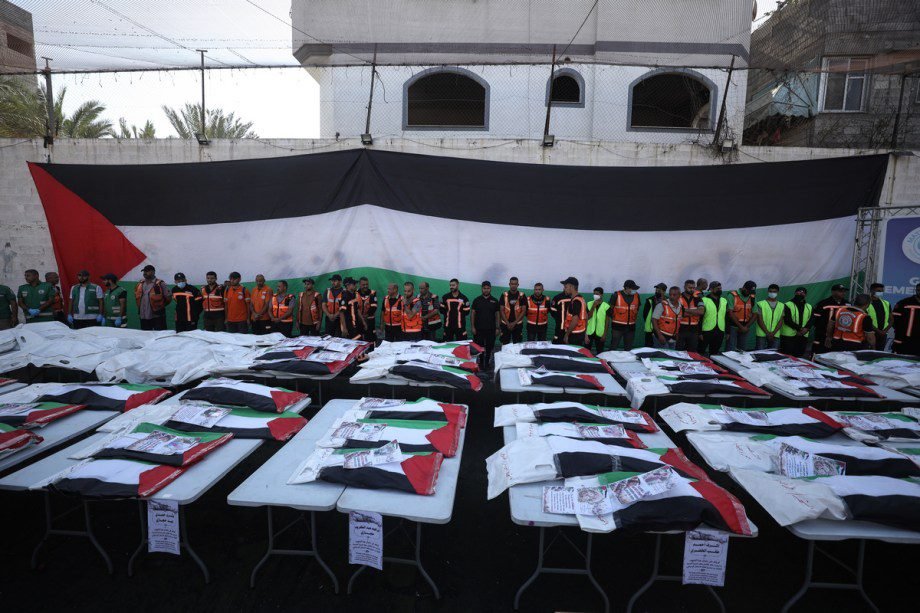
Gaza has become a landscape the world recognises but has somehow failed to confront. Apartment blocks reduced to concrete dust. Hospitals are struggling to function. Streets erased. Families searching through rubble for relatives. Children carrying the remains of childhood in plastic bags. Entire neighbourhoods transformed beyond recognition.
These are not scenes from a dystopian film. They are documented images from a real place, recorded by journalists, medical workers, humanitarian organisations and Palestinians who have kept filming while living through the destruction. The camera has become an unwilling witness to a catastrophe that diplomatic language too often makes sound abstract.
More than 70,000 Palestinians have reportedly been killed. But the scale of Gaza’s devastation cannot be understood through a death toll alone. The destruction of homes, healthcare, water systems, schools and the basic infrastructure of survival raises a deeper question: what happens to a people when the foundations of collective life are systematically dismantled?
That question now sits at the heart of South Africa’s genocide case against Israel before the International Court of Justice (ICJ). The Court has not yet delivered a final judgment finding Israel responsible for genocide. But its provisional-measures orders are binding, and the duty to prevent genocide does not begin only when judges deliver their final words.
The world should pay particular attention to what the ICJ said in its 19th November 2026 judgment in The Gambia v. Myanmar. Not because Myanmar and Gaza are identical. They are not. The importance lies in how the Court approached the evidence—and what that approach demands of anyone examining Gaza.
The ICJ found Myanmar responsible for genocide against the Rohingya. Crucially, it did not formally lower the legal standard for proving genocide. It retained the demanding requirement that, where genocidal intent is inferred from circumstantial evidence, that intent must be the only reasonable inference from the evidence.
What mattered was the Court’s examination of the totality of the record. It did not treat killings, serious bodily and mental harm, sexual violence, discriminatory policies, attacks affecting children and measures intended to prevent births as disconnected events. It examined how the evidence related to the broader treatment of the Rohingya.
The significance of individual acts became clearer when considered alongside the institutional and historical conditions in which they occurred. This is the central lesson for Gaza: the evidence cannot be understood by looking at each destroyed building, each displaced family or each military operation in isolation. The pattern matters.
READ: Remains of 129 more Palestinians recovered from rubble in central Gaza
A government’s stated security rationale cannot automatically settle the legal inquiry. The Court must examine what was done, how it was done, the consequences for the protected population and what the cumulative evidence reveals about intent.
For Gaza, that means confronting the destruction of civilian infrastructure, the collapse of essential services, repeated displacement, the devastation of medical facilities and the conditions in which Palestinians have been expected to survive. None of these facts, considered individually, automatically proves genocide. But none should be removed from the larger evidentiary picture.
The question is whether the complete pattern, assessed against the Convention’s demanding legal test, supports the conclusion that prohibited acts were committed with the specific intent to destroy Palestinians in Gaza, in whole or in substantial part, as a protected group.
Myanmar does not predetermine that answer. It makes clear why the question must be asked without looking away. The destruction of a place is also the destruction of the conditions for living
There is something profoundly misleading about describing Gaza’s devastation only in terms of buildings destroyed. A hospital is not merely concrete and medical equipment. It is the possibility of survival. A water system is not simply infrastructure. It is the difference between health and disease. A home is not just a structure. It is memory, privacy, family and belonging.
When these foundations are destroyed on a vast scale, the consequences reach beyond the immediate moment of an attack. They shape whether people can remain in their communities, whether children can grow up safely, whether patients can receive treatment and whether families have any realistic prospect of rebuilding their lives.
Article II(c) of the Genocide Convention addresses the deliberate infliction of conditions of life calculated to bring about the physical destruction of a protected group, in whole or in part. The legal test is exacting: deprivation and displacement alone do not automatically establish this offence. The Court must assess the nature of the conditions, their capacity to cause physical destruction and the specific intent required by the Convention.
The Myanmar judgment is instructive precisely because the Court did not stretch the law to accommodate every allegation. It examined conditions of life but was not satisfied that the evidence established the particular offence under Article II(c). Its genocide finding rested on other prohibited acts.
That distinction should strengthen the Gaza inquiry. It shows that the Court can recognise genocide without turning every form of suffering into the same legal category. It also reminds governments that the destruction of civilian life must be investigated through evidence, not dismissed through political explanations.
The camera has recorded what diplomatic language cannot soften. The documentary record of Gaza matters. Images and footage from journalists, humanitarian workers, medical personnel and residents have made it harder for the world to pretend that the destruction is distant or unknowable.
A filmed hospital ward, a family returning to a flattened neighbourhood, a child searching for water, or a rescue worker digging through rubble is not, by itself, proof of genocidal intent. Legal findings require verification, context and a rigorous assessment of evidence. But such documentation can help establish what happened, when it happened, who was affected and how the conditions of civilian life changed.
The preservation of that record is essential. Governments should support independent investigations, protect witnesses, preserve digital evidence and ensure that journalists and humanitarian personnel can work safely. The destruction of evidence must not become another route to impunity.
The world should also resist the temptation to turn Palestinian suffering into a spectacle consumed briefly and then forgotten. These images are not content. They are records of human lives and potential evidence in the pursuit of accountability.
READ: Hamas seeks emergency talks after Israeli strike killed 3 Gaza aid workers
The ICJ has not yet decided the merits of South Africa v. Israel. Its provisional measures orders are not a final finding of genocide, but they are binding. The case may take years to complete. That timetable cannot become an excuse for governments to postpone their own responsibilities.
Under the Genocide Convention, the duty to prevent arises when a state knows, or should normally have known, of a serious risk that genocide will be committed. The ICJ explained this principle in Bosnia v. Serbia. The obligation requires due diligence: states must use the means reasonably available to them, taking account of their influence and capacity to affect the situation.
For the United States, the United Kingdom, Germany, France, Canada and other governments with significant relationships with Israel, the implications are immediate. They must review arms transfers, military cooperation and other forms of assistance against the risks identified by the Convention and their own domestic laws. Where a serious risk cannot be adequately mitigated, transfers must be reconsidered or suspended as required by law.
They must also use diplomatic leverage to press for compliance with the ICJ’s orders, protect humanitarian access, support the restoration of essential civilian services and preserve evidence for accountability.
This does not mean that every state supplying Israel is automatically complicit in genocide. Complicity and the independent duty to prevent are separate legal questions. But governments cannot claim that their obligations begin only after a final judgment. Prevention would be meaningless if it required the world to wait until the harm was complete.
The global community has repeatedly portrayed itself as the guardian of a rules-based international order. It has demanded accountability for atrocities in Sudan and Myanmar. Yet its response to Gaza has exposed a deep credibility problem: international law appears less universal when enforcing it could threaten an ally’s interests.
The Myanmar judgment makes that inconsistency harder to defend. If governments accept the ICJ’s reasoning when the accused state is politically isolated but hesitate when the accused is strategically important, they are not defending universal law. They are defending a hierarchy of political convenience.
The Court must remain independent. Governments should not dictate their verdict or announce in advance what their judges must conclude. They must, however, respect its binding orders, support its proceedings and fulfil their own preventive responsibilities. The final judgment may take years. The images are already here. The evidence is being recorded. The human consequences are unfolding in real time.
Myanmar taught the world that the evidence of destruction must be read as a whole, not fragmented into convenient explanations. Gaza now asks whether the world has learned that lesson. The ICJ must decide the law. But the Global North must decide whether it will act before the opportunity to prevent further destruction disappears.
OPINION: Macron was right, and the scapegoats were chosen
The views expressed in this article belong to the author and do not necessarily reflect the editorial policy of Middle East Monitor.
Source: Iwpost.com