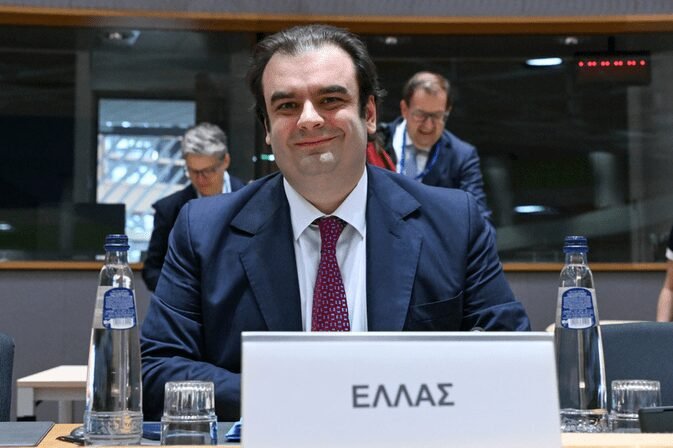
A European energy union is a prerequisite to other reforms that the European Union is planning to stay competitive against the U.S. and China, Kyriakos Pierrakakis, the chairman of the euro zone’s finance ministers’ group, said.
Speaking at the International Monetary Fund in Washington, Pierrakakis said the EU had to create a real energy union that would allow energy to flow easily across borders to lower electricity prices across the single market of 450 million people.
European energy prices are two to three times higher than in the U.S. or China, putting the 27-nation EU at a big competitive disadvantage to global competitors.
“Advancing the energy union in Europe … will have a direct … positive impact, both energy-wise, but I would say competitiveness-wise. We need that … to be able to implement the whole vision of the Draghi and Letta reports,” Pierrakakis told a seminar during the International Monetary Fund and World Bank spring meetings in Washington.
In 2024 two former Italian prime ministers – Mario Draghi and Enrico Letta – prepared reports on how to boost Europe’s competitiveness and make the EU’s single market work better, recommending dozens of reforms.
Among them are efforts to consolidate the EU’s 27 national capital markets into a single one, introduce a special legal regime for pan-European companies that would be the same across the bloc, and launch a digital euro that would be a European-controlled means of online payments.
“But without the deployment of a full-scale energy union, we won’t be able to generate the necessary conditions to be able to achieve these previous elements of policy,” Pierrakakis said.
The EU’s energy union is a project that has been running since 2015 to coordinate national energy policies and create a single, integrated market for power and gas, allowing electricity from one part of the continent to be easily sold and transferred to another.
Progress requires large investment in modernizing and connecting national European electricity networks, joint purchasing and storage, as well as overcoming vested interests of national energy sectors and other political obstacles.
The plan has become all the more urgent after the energy crisis of 2022 caused by the Russian invasion of Ukraine and, more recently, by the closure of the Strait of Hormuz, the gateway for a fifth of the world’s oil and gas, as a result of the U.S.-Israeli war with Iran.
Source: Reuters