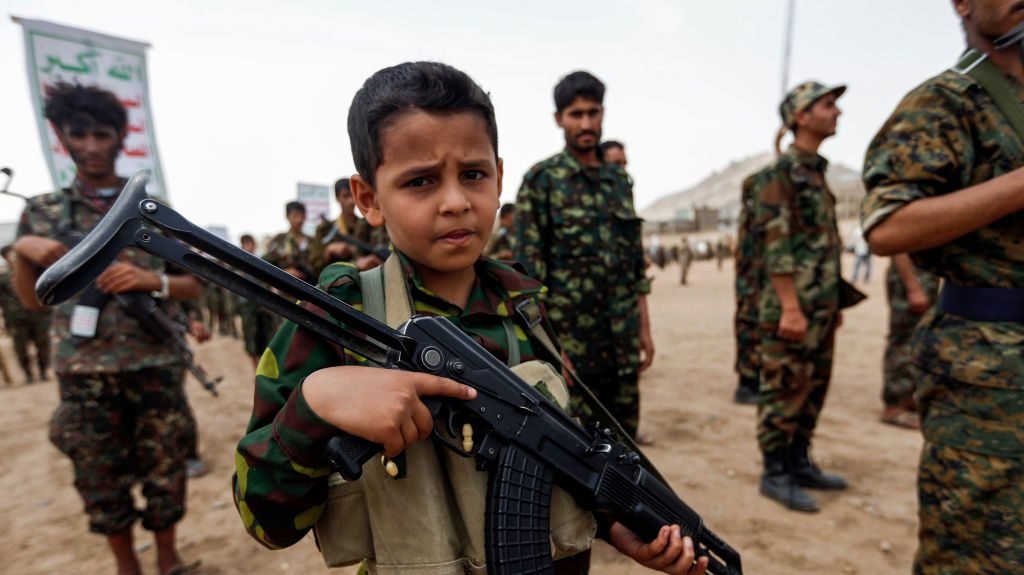
A 14-year-old who disappeared while buying groceries resurfaced 40 days later, telling his father he had joined the Houthis, as families across Yemen describe similar disappearances and forced recruitment
Fourteen-year-old Marwan Al-Hammadi, whose name has been changed to protect his identity, left his home in a quiet neighborhood of Sanaa, Yemen’s capital, to buy groceries for his mother. He did not return.
For 40 days, his family searched for him without success. Then his father received a call from an unfamiliar number. He recognized his son’s voice, but the boy’s words were unexpected.
Dad, I’m in Taiz. I’ve become a mujahid with Ansar Allah
“Dad, I’m in Taiz. I’ve become a mujahid with Ansar Allah,” Marwan said, according to his father’s account.
The family subsequently learned that Marwan had allegedly been abducted and taken to a closed camp, where he underwent ideological indoctrination and military training before being sent to fight in Taiz. His parents had neither known about nor consented to his recruitment.
Marwan’s account is among more than 120 cases of children reportedly abducted, recruited, or captured during fighting in Yemen examined in an investigation for The Media Line.
Based on interviews with families and information gathered from local authorities, medical personnel, and military sources in Marib, Taiz, and along Yemen’s western coast, the investigation examined different methods of child recruitment by the Houthis, formally known as Ansar Allah.
The findings concern cases examined during the investigation rather than a comprehensive count of child recruitment across Yemen. Some of the reported categories may overlap, and not all accounts could be independently corroborated.
Children Disappear, Families Search
In Sanaa, Jaber Al-Mazna’i described his search for his missing son.
We printed hundreds of notices and put them up on walls, utility poles, and hospitals
“I’ve been searching for my child for more than two weeks. We printed hundreds of notices and put them up on walls, utility poles, and hospitals. We reported his disappearance to the official security authorities and repeatedly issued appeals for help on social media.”
The appeals brought no answers. Al-Mazna’i said he eventually learned through a relative that his son had been transferred from Sanaa to the front lines in Al Hudaydah governorate, on Yemen’s western coast.
In Raymah, Wesab, and Sanaa, The Media Line’s investigation documented more than 19 reported cases involving children, some as young as 11.
Across the broader collection of cases examined, at least 47 children were reported to have been abducted without their families’ knowledge. Relatives said they learned what had happened only after the children completed ideological training or reached the front lines and managed to make contact.
Accounts from commanders fighting the Houthis provide another perspective on the recruitment of minors.
Abdel Fattah Bafadel, a field commander with the Southern Giants Brigades, told The Media Line that children were among the Houthi fighters captured following unsuccessful attacks in Al Hudaydah governorate and along the western coastal front.
Bafadel estimated that the number of minors captured in those operations ran into the dozens, possibly hundreds. Most, he said, were between 13 and 16 years old, and many had been abducted.
He alleged that some of the children were sent ahead of attacking forces and used as human shields. He also described children breaking down in tears after their capture.
His estimates and allegations, which come from a commander fighting the Houthis, have not been independently verified.
Threats Against Families
In Taiz, interviews with captured children suggest that abduction is only one part of the recruitment process.
A military commander stationed on the Taiz front, identified here by the pseudonym Sultan Al-Jaberi for security reasons, told The Media Line that government forces captured more than 34 children during clashes in late September.
According to Al-Jaberi, some of the children said they had been led to believe they would fight Americans and Israelis. Instead, they found themselves confronting other Yemenis.
Others said friends had encouraged them to join the Houthis. The commander said the children generally received approximately two weeks of military training before being sent to the front.
Al-Jaberi described 13 cases in which children were initially taken for training without their families’ knowledge. Their relatives were subsequently informed, but the children were still sent into combat.
In six cases, he said, families remained unaware that their children had reached the front lines until the children were captured by government forces.
Other accounts involved threats against parents and village sheikhs.
Al-Jaberi said some children described being pressured into fighting because their families faced punishment if they refused. Others had been assigned preliminary battlefield duties, including filming and identifying locations ahead of Houthi attacks.
Bafadel described a similar case involving a captured child who said his father had been threatened with immediate imprisonment unless the boy joined the Houthis.
A military source in Marib, speaking to The Media Line on condition of anonymity, also described dozens of minors allegedly abducted, recruited, or pressured into fighting through threats against their relatives.
Other children were reportedly enticed through financial inducements, including cash payments and distributions of qat, a stimulant leaf widely consumed in Yemen.
Coercion and the Question of Consent
The Media Line also obtained accounts of children among fighters captured by forces of Yemen’s internationally recognized government on the Marib and Al Jawf fronts.
Saddam Mohammed, a journalist specializing in political affairs, believes the recruitment of children reflects growing pressure on Houthi manpower.
He told The Media Line that abductions and threats against guardians suggest the group is seeking to compensate for shortages by targeting what he called “the weakest link in society.”
Mohammed said the methods often overlap, combining direct abduction, threats against families, financial inducements, and ideological appeals that persuade children they are preparing to confront foreign enemies.
Recruiters also exploit children’s youth and enthusiasm by presenting participation in combat as an act of heroism, he said.
These pressures complicate the question of consent. A child who apparently agrees to join an armed group may have little freedom to refuse, particularly when relatives face threats.
Researcher Mohammed Abdul Salam said the Houthis have expanded their recruitment efforts in poorer and less-educated communities, including Raymah, Wesab, and Utumah.
He warned that children are being exposed to danger not only as combatants but also in support roles, including monitoring roads, gathering information, and staffing military checkpoints.
What the United Nations Has Documented
The United Nations secretary-general has included the Houthis on his annual list of parties responsible for grave violations against children in armed conflict every year since 2011. The group was initially listed for recruiting and using children, with subsequent reports also documenting killings, injuries, and attacks on schools and hospitals.
In February 2024, Human Rights Watch reported that activists in Yemen had documented Houthi recruitment of children as young as 13, including campaigns invoking the fighting between Israel and Palestinian armed groups in Gaza.
In his annual report on children and armed conflict, dated June 16, 2026, the UN secretary-general documented the verified recruitment and use of 262 children in Yemen during 2025.
Of those cases, 127 were attributed to the Houthis, while 135 were attributed to the Yemeni Armed Forces and affiliated forces and groups.
The report also raised concerns about Houthi-run summer camps where children were exposed to military content and activities.
No separate cases of child abduction in Yemen were verified by the UN during 2025. That finding reflects cases meeting its verification standards and does not establish that no abductions occurred.
Access restrictions, particularly in Houthi-controlled territory, prevented the UN’s findings from reflecting the full extent of violations against children, the organization cautioned.
The previous annual report documented the recruitment and use of 182 children in Yemen during 2024, including 85 cases attributed to the Houthis.
A separate UN report on Yemen, published in March 2025, documented 564 children recruited or used by armed groups and military forces between 2021 and 2023.
Of those cases, 345 were attributed to the Houthis, while 210 were attributed to Yemeni government forces and affiliated groups. The children ranged in age from 8 to 17.
These UN-verified figures cover different reporting periods and cannot be directly equated with the case counts gathered for The Media Line’s investigation.
International Law and Broken Commitments
Under the Optional Protocol to the Convention on the Rights of the Child on the involvement of children in armed conflict, to which Yemen is a party, armed groups distinct from a state’s armed forces should not recruit or use anyone under 18 in hostilities.
The protocol also prohibits compulsory recruitment into national armed forces below the age of 18 and requires states to take all feasible measures to prevent underage members of their armed forces from directly participating in hostilities.
Recruiting or using children under 15 to participate actively in hostilities constitutes a war crime under international law.
In April 2022, the Houthi authorities in Sanaa signed an action plan with the United Nations committing themselves to prevent the recruitment and use of children.
The agreement called for identifying children under 18 serving in Houthi ranks within six months and facilitating their release and reintegration into civilian life.
Despite that commitment, subsequent UN reports have continued to document child recruitment by the Houthis.
Amnesty International has called on the group to end the recruitment of children under 18 and release minors serving in its forces.
The UN has also urged parties to Yemen’s conflict to treat children associated with armed forces and groups primarily as victims, ensure their release and reintegration, and use detention only as a last resort and for the shortest appropriate period.
Houthis and Yemeni Government Asked To Respond
As part of the investigation, The Media Line contacted a representative of a Houthi mobilization and recruitment body, seeking a response to allegations that children had been abducted, coerced, subjected to ideological training, and deployed in combat.
The Media Line also sought comment from Yemen’s internationally recognized government regarding allegations of child abductions attributed to the Yemeni Armed Forces and affiliated forces and groups.
Neither the Houthi representative nor the Yemeni government had responded by the time of publication.
The investigation’s interviews with families and military sources provide accounts of practices also documented by international organizations, although responsibility for individual cases and the full extent of recent recruitment remain unverified.
For children captured during the fighting, questions about their treatment and eventual release remain unresolved. The Media Line could not establish where all of them are being held, whether their families have been notified, or when they might be released.
Marwan’s father eventually heard his son’s voice. But the call brought no indication of when the boy might come home.