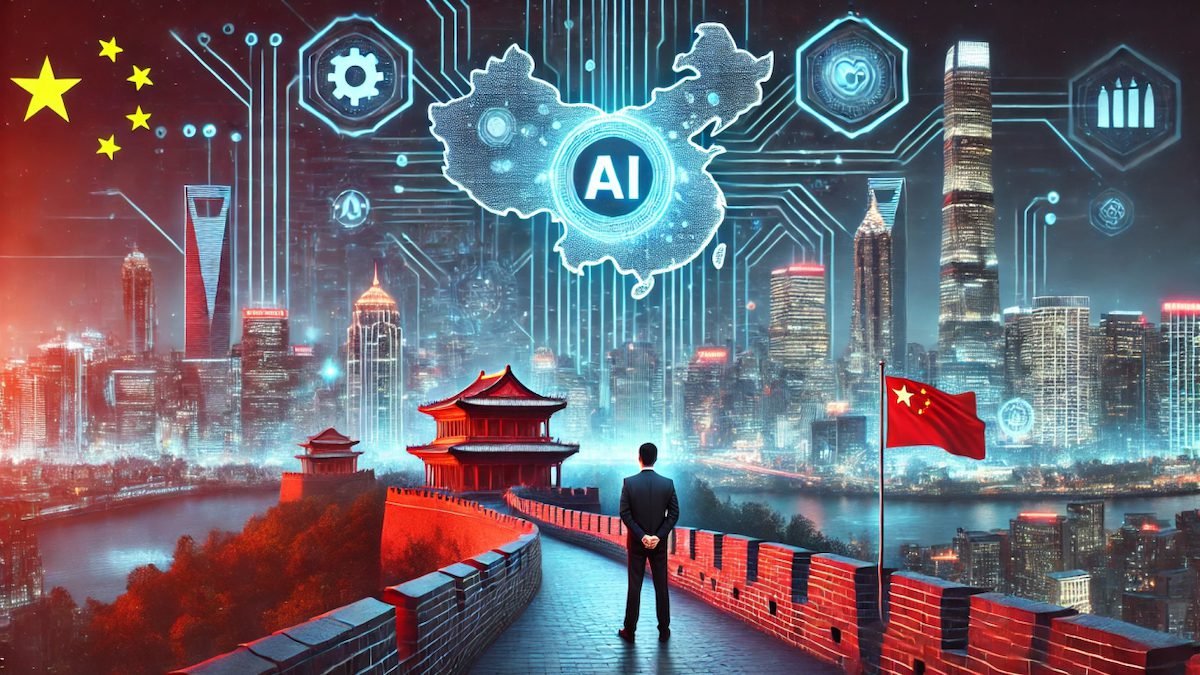
Every few months, another Chinese artificial intelligence (AI) breakthrough makes global headlines. A Chinese AI model closes in on American rivals, a Chinese research team tops a benchmark, a Chinese factory gets smarter, a city more connected, a supply chain more predictive.
The usual explanations follow: China has more engineers, more factories, more state support, more data. While often true, they miss something deeper.
China is not simply building bigger AI systems than America. From digital twins and smart cities to predictive logistics and intelligent manufacturing, it is increasingly building systems designed less for chatting than for coordinating, less for imitation than for management.
That difference points to a larger question. Why has China put so much emphasis on AI for navigating change, while much of the Western conversation has focused on chatbots, productivity software and artificial general intelligence?
The answer lies not only in economics or industrial policy, but in a much older Chinese way of thinking about intelligence itself.
The binary and the book
More than three centuries ago, an exchange of letters between Europe and Beijing brought together two very different ideas of intelligence.
In 1701, Gottfried Wilhelm Leibniz sent an explanation of his newly developed binary arithmetic to Joachim Bouvet, a French Jesuit at the court of the Kangxi Emperor. Leibniz had shown that every number could be expressed using only two symbols — 0 and 1— a discovery that would become foundational to digital computing.
Bouvet’s reply surprised him. He sent a diagram of the 64 hexagrams of the I Ching, or Book of Changes, one of China’s oldest philosophical classics. Each hexagram consists of six broken or unbroken lines, producing exactly 64 possible combinations.
To Leibniz, the resemblance was unmistakable. He concluded that the ancient Chinese had, in effect, anticipated binary arithmetic long before Europe formalized it.

That claim is too neat to take at face value. The I Ching was never a mathematical system. But Leibniz noticed something real: the hexagrams arrange discrete symbols in a way that invites pattern, classification and transformation.
That is, the I Ching is not just a system of forms, but a guide to change. When a hexagram is cast, certain lines “move,” transforming one pattern into another. What matters is not only what appears, but what it is becoming.
Leibniz saw the hexagrams mainly as a symbolic code. What he missed is that they hold two dimensions at once: structure and transformation. Their six lines are discrete symbols, countable and classifiable.
But those symbols carry meaning only in relation to the process of change they were built to track. Remove the movement, and a hexagram is just a pattern. Restore it, and it becomes a moment inside something larger and ongoing.
This is not to claim that the I Ching somehow “predicted” modern AI, or that today’s Chinese engineers are consciously channeling ancient divination.
Rather, the I Ching exemplifies an intellectual orientation that has persisted in various forms across Chinese thought: an attention to flux, interdependence and the direction of change rather than fixed categories and static representations.
That broader orientation did not disappear from Chinese intellectual life. Although modern AI draws on global science and engineering, it is striking that some of its most prominent applications in China — digital twins, intelligent infrastructure and predictive urban management — place continuous adaptation at their center.
That orientation did not determine China’s AI strategy, but it may have made certain engineering questions seem more natural to ask — and certain kinds of systems more natural to build.
The great split
Mathematicians later gave formal names to the two dimensions at work here: discrete and continuous.
Aristotle had already separated discrete from continuous quantity, and Euclid built the distinction into the structure of the Elements. What changed in the 19th century was the rise of two rigorous traditions built around that split.

Continuous mathematics, shaped by calculus, became the language of flow, motion and change. Discrete mathematics grew alongside it, concerned with numbers, logic and symbolic operations.
Computing inherited the discrete tradition. George Boole turned logic into algebra. Claude Shannon showed how Boolean logic could be implemented through electrical circuits. Alan Turing demonstrated how symbolic operations could become computation. Once the world could be represented as bits, digital technology advanced with astonishing speed.
AI inherited the same representational logic. Every interaction with an AI system begins with translation: language becomes tokens, images become pixels, behavior becomes data. A continuous world is rendered into discrete forms that machines can manipulate.
That strategy has been extraordinarily successful. But the systems AI increasingly seeks to understand — cities, supply chains, financial markets, ecosystems — are never still. They shift while decisions are being made.
A map can become infinitely more detailed and still capture only a moment. A compass, on the other hand, serves a different purpose: it helps us navigate a landscape that is already moving beneath our feet.
The distinction between map and compass is no longer philosophical – it represents an engineering problem.
Intelligence as infrastructure
Most people meet AI today as a chatbot, a search tool, a translator or an image generator. AI appears as another app on a screen: useful, increasingly capable, but still something we consult when we need it.
Now imagine AI in a different role. Instead of answering questions, it adjusts traffic lights as congestion builds. It balances electricity across a grid as demand shifts. It predicts equipment failures before they occur, reroutes freight around disruptions or continuously updates a digital model of an entire city as millions of people move through it.
In that vision, AI is no longer just a tool. It becomes part of the infrastructure through which society runs.
China, unlike America, has made that vision especially visible. It has invested heavily in digital twins, smart manufacturing, predictive logistics and urban management systems. The emphasis is less on chatbots than on systems that coordinate continuous change.
Hangzhou’s City Brain is a useful example. Rather than merely collecting traffic data, the system analyzes vehicle flow, congestion, emergency routes and public transport in real time, then adjusts signals and routing accordingly.
The city is treated not as a set of separate intersections but as a single evolving system whose parts constantly affect one another. A static traffic model can describe yesterday’s congestion. A continuously updated digital twin tries to anticipate tomorrow’s.
The same orientation appears in Chinese discussions of AI itself. Yucong Duan’s DIKWP framework — Data, Information, Knowledge, Wisdom, and Purpose — extends the familiar hierarchy by adding purpose as a fifth element. The point is simple: intelligence is not just about processing inputs; it is about why those inputs matter and what goals they serve.
Another useful concept is “gongsheng” (共生), often translated as symbiosis or co-evolution. Rather than treating humans, machines and institutions as separate entities, it emphasizes continuing interaction and mutual adaptation. Intelligence, in this view, emerges not only from computation but from relationship.
Where the I Ching asked how to read the direction of change through moving lines, DIKWP asks how an AI system can keep its purpose as the data it processes shifts around it. Both treat stability as a dynamic relationship rather than a fixed state.
These are contemporary engineering ideas, not revivals of ancient philosophy. Still, they address an old problem with striking continuity: how should we act when the world is in motion?
Map and compass
Leibniz never fully understood what he had found. He died in 1716 still convinced that the hexagrams were an ancient Chinese version of binary arithmetic. He had the mathematics right and the larger meaning wrong. The lines were never just code – they were a record of things becoming other things.
Three centuries later, the same gap still separates many AI systems. A chatbot completes a static exchange: language in, language out, one turn at a time. A city management system does something else: it watches a city change and adjusts with it.
Neither is more intelligent in the abstract than the other, as they are built for different tasks. One asks what is being said; the other asks what is happening next.
China’s AI investments in digital twins, predictive logistics and urban management systems are not proof of a superior philosophy. Rather, they reflect different engineering priorities, shaped by a state that has long treated infrastructure and governance as closely linked, and by a longer intellectual habit of attending to direction rather than fixity.
But it would be a mistake to frame this as a civilizational contest pitting a “holistic East” versus an “analytic West.” American and European AI research is already moving toward related ground: world models, continuous control, embodied systems and agents that track a moving environment instead of describing a static one. The frameworks differ, but the underlying challenge does not.
And that challenge will only grow. Cities, power grids and supply chains do not pause while a model is trained on them. The systems meant to manage them will need to do two things at once: represent the world in discrete, computable pieces and track the continuous change that never stops running underneath those pieces.
For AI researchers and engineers alike, the challenge is becoming increasingly practical: how to combine accurate representation with continuous adaptation.
A map and a compass solve different problems, with the former fixing a place and the latter holding a direction. Neither replaces the other, and no one crossing unfamiliar terrain would carry only one. The challenge is not choosing between them, but learning to use both in tandem.







 breakthrough makes global headlines. A Chinese AI model closes in on American rivals, a)