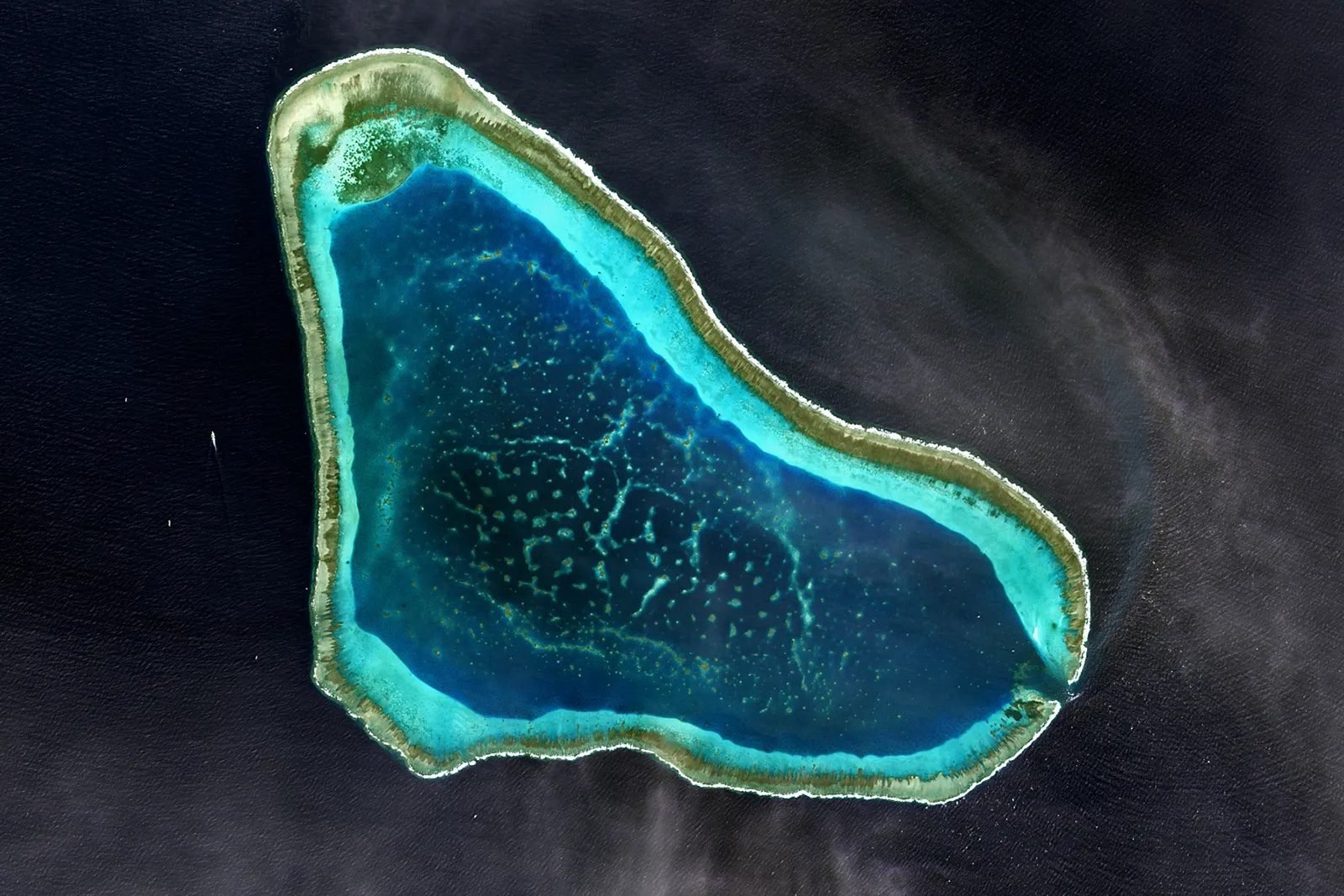
The epicenter of the latest South China Sea tensions is near the Philippines, but the shock waves have reverberated across several countries. The new bump in tensions results from two developments in late May and early June.
First, the Philippine government announced the appearance of several large objects in Scarborough Shoal (known in the Philippines as Bajo de Masinloc or Panatag Shoal), presumably placed there by China, which has effectively controlled the atoll since 2012, even though it is well within the exclusive economic zone (EEZ) of the Philippines.
The 2016 arbitration decision by the Permanent Court of Arbitration ruled that China’s “10-dash line” territorial claim is invalid and that China’s exclusion of Filipino fishermen from the shoal is illegal, but Beijing rejected that ruling.
The new objects observed within the shoal include two large buoys with antennae and a floating platform that once had six personnel aboard. China did not confirm or deny responsibility, but a June 5 statement from China’s Ministry of Foreign Affairs asserted China’s right to “scientific research.”
A June 9 statement repeated that assertion and also accused the Philippines of “false accusations.” It seemed a case of “tell me you’re responsible without telling me you’re responsible.”
The second set of incidents began with Philippine President Ferdinand Marcos Jr. and Japanese Prime Minister Sanae Takaichi announcing on May 28 that that they would hold bilateral talks to delineate the two countries’ EEZs, excluding Taiwan, which lies between the Philippines and Japan.
China’s Ministry of Foreign Affairs spokeswoman said on June 7, “the so-called delimitation negotiations between Japan and the Philippines are entirely illegal and invalid.” Beijing dispatched the Chinese Coast Guard and other PRC government vessels to patrol the waters east of Taiwan on June 1 and June 8.
Chinese sources confirmed that these patrols were in response to the Japan-Philippine negotiations. China’s use of law enforcement rather than naval ships for these operations signaled this was a sovereignty claim. Significantly, the designated patrol area stretched beyond China’s own 10-dash line claim.
The presence of Chinese ships near Taiwan’s east coast prompted Taiwan’s coast Guard to deploy its own vessels in response. Taipei also reported that the Chinese ships contacted some commercial vessels in the area by radio and demanded to know their ports of origin, destinations and what they were carrying.
China’s fear of Japan
The strong Chinese reaction to Japan’s negotiations with the Philippines about EEZs near Taiwan has layers of context.
Observers in China are keenly aware of and profoundly worried about Japan gradually shedding the constraints imposed on its military capabilities and posture by the US-drafted postwar “peace constitution.”
This movement has accelerated since the outbreak of the Ukraine war — a fitting consequence of China’s diplomatic and material support for Russian President Vlaidimir Putin’s aggression.
Thus, for the Chinese government and its Chinese media and academia mouthpieces, the starting point for analyzing Japanese foreign policy is Japanese remilitarization and Japan’s purported objective of re-conquering the region, as if nothing has changed since the 1940s.
A more specific and related Chinese fear is the possibility that Japan might help protect Taiwan from attempted forcible annexation by China. Beijing has been on high alert since the ascension of Sanae Takaichi to the position of Japan’s prime minister in October 2025.
The Chinese knew her as an advocate for completing Shinzo Abe’s quest to revise the Japanese constitution. China was therefore primed to overreact when in November, she said publicly that a Chinese attack on Taiwan might lead to Japan taking military action under the principle of collective self-defense.
The Taiwan scenario also causes the Chinese to view the recent increase in security cooperation between Japan and the Philippines with great alarm, as the two countries bracket Taiwan. The September 2025 Reciprocal Access Agreement allows Japanese military forces to deploy into the Philippines, as they did during joint exercises the following October.
In May, Japan joined the Balikatan exercise and fired a Type 88 anti-ship missile from Philippine territory. Manila and Tokyo are discussing the transfer of Abukuma-class destroyers to the Philippines, now legal under Japan’s newly liberalized rules for arms exports. The two countries are also negotiating intelligence sharing.
The perception of growing security cooperation between Japan and another regional country threatened by China seems to be the core issue for Beijing. A commentary by the Chinese Communist Party-run Global Times warned that if Tokyo and Manila “go further in their illegal collusion,” China will “further advance its exercise of jurisdiction in waters east of Taiwan island in the future.”
Ironically, this seems to threaten neighbors banding together against Chinese expansionism with further Chinese expansionism. The Global Times commentary also contained what may be the first instance of Beijing invoking its interpretation of the Trump-Xi summit in May, as the article implicitly calls on the US to stop Japan-Philippines collaboration because of the “important consensus” on “stability” reached by Trump and Xi.
The Tokyo-Manila EEZ negotiation amplifies a schism in Taiwan’s domestic politics. The opposition Kuomintang (KMT) is dominated by the descendants of mainland Chinese who suffered through the Japanese invasion of China and then fled to Taiwan after the war to escape Mao’s communist takeover.
They are more anti-Japan than the ethnic Chinese whose ancestors lived in Taiwan before and during the war, and who now belong to or support the Democratic Progressive Party (DPP). KMT politicians accuse the ruling DPP government of being excessively pro-Japan.
In a May 31 press release, Taiwan’s Ministry of Foreign Affairs said it “commends” Japan and the Philippines for their EEZ talks and “looks forward to cooperating with Japan and the Philippines” in “maintaining the maritime security of the Indo-Pacific region.”
Opposition politicians immediately criticized the ruling government for supporting the Tokyo-Manila negotiations rather than immediately issuing a protest, seeing this as another instance of excessive Japanophilia by the DPP. One KMT legislator called the Japan-Philippine talks a “loss of sovereignty and national humiliation” for Taiwan.
Apparently chastened, a Taiwan government spokesman made a stronger statement on June 2, saying Taipei would consult with Japan and the Philippines and insist on the protection of Taiwan’s fishing rights.
Scarborough and US reliability
Scarborough Shoal has a fraught history. In 2012, the Philippine government discovered Chinese fishing boats anchored at the shoal and, upon inspecting them, reportedly found evidence of illegal fishing.
Two Chinese maritime patrol vessels arrived and impeded the arrest of the fishermen. After a tense months-long standoff, the Philippines tried to de-escalate by replacing its navy vessel on the scene with a coast guard vessel.
By contrast, the Chinese reinforced their position with a third ship. Eventually, more ships from both sides arrived. The fishermen avoided prosecution as Chinese ships escorted them out of the shoal.
The US government negotiated a face-saving deal under which both sides would withdraw all of their ships. The Philippines complied, but the Chinese did not. Accused of reneging, they claimed there was no deal. China has effectively occupied the shoal ever since.
The 2012 incident remains a sore point with some Filipinos, as well as some Americans, who feel the US was insufficiently supportive of its ally out of a desire to avoid worsening US relations with China.
Subsequently, both the US and Philippine governments have insisted that China cannot build on Scarborough. In 2018, Philippine Foreign Affairs Secretary Alan Peter Cayetano called this “Our red line.”
The appearance of large pieces of Chinese equipment in the lagoon of Scarborough Shoal is triggering for regional observers because of China’s past pattern of “creeping expansionism” through gray-zone salami-slicing.
The Chinese occupation of another atoll, Mischief Reef, started with a collection of frail huts on stilts in the 1990s. Now it boasts a 2,600-meter airstrip and numerous concrete buildings on 1,380 acres of reclaimed land.
In the Yellow Sea, in violation of an agreement with Seoul, China has placed steel structures in an area where the two countries’ EEZs overlap, seemingly to unilaterally advance China’s sovereignty claims.
It is reasonable for Manila to worry that China intends to build another military outpost on Scarborough Shoal, with the floating structures as a first step in a process that, in the eyes of observers, normalizes the gradual Chinese development of the atoll, along the lines of the slowly-boiling-frog metaphor.
In 2025, China declared Scarborough a national nature reserve. That, however, was more an assertion of Chinese sovereignty than a reason to believe environmentalist sentiment will restrain Beijing from converting the atoll into a military base. China has thought nothing of destroying or damaging an estimated 20,000 acres of marine habitat in the building of its artificial islands elsewhere in the South China Sea.
Why would the Chinese want a base at Scarborough? First, it would fill out China’s strategic leverage in the middle of the South China Sea, complementing the other bases on Woody Island, Subi Reef, Fiery Cross Reef and Mischief Reef.
Those four leave a gap in coverage near the main Philippine home island of Luzon. Scarborough would close that gap. The atoll is near the edge of China’s 10-dash line and close to a sealane heavily used by tankers, container ships and bulk carriers transiting the South China Sea.
Second, a base at Scarborough would reinforce the message Beijing wants to send to Manila: the US will not protect you against the inevitable rise of China as the new regional sheriff.
In April, perhaps because Washington was focused on the war against Iran, the Chinese reinstalled a floating barrier across the entrance of the shoal. More importantly, the Trump administration is clearly very interested in securing a major bilateral trade deal with China. Beijing may therefore see this year as an opportune time to test the Scarborough red line.
Code of Conduct complications
The latest Scarborough incident could further impede progress toward a Code of Conduct among the countries pursuing disputed territorial claims in the South China Sea. Negotiations have dragged on for two decades.
Key sticking points have arisen from several Chinese demands. China wants the Code to be a guideline rather than legally binding—an ominous sign. The Chinese delegation says the Code must accept the principle of “historical usage” as a basis for territorial sovereignty claims. China has relied heavily on this principle for its own claims.
Some Southeast Asian governments, however, want to follow the UN Convention on the Law of the Sea, which rejects the historical usage argument. Beijing wants the group to rely on consensus or bilateral consultations rather than a clear arbitration mechanism to settle future disputes.
Finally, China insists on restricting the presence and activity of foreign military forces (such as the US and its allies) in the South China Sea, while some Southeast Asian countries welcome these outside forces as bulwarks against Chinese domination.
The draft Code of Conduct under negotiation is secret, but it almost certainly includes a requirement that claimant states not unilaterally advance their claims by means such as inhabiting currently uninhabited islands, reefs or rocks — a principle included in the 2012 Declaration on the Conduct of the Parties in the South China Sea, which is a warm-up for the Code of Conduct and to which the PRC is a signatory.
China’s most recent action at Scarborough revives suspicions that the entire exercise is futile and that, even if all the participants agree to a Code of Conduct, Beijing will ignore any provisions it finds inconvenient.
These events in the vicinity of the Philippines underscore three regional trends of 2026. Amidst doubts about US reliability as a protector, regional governments are doing more to balance against China rather than accommodating Beijing (although Taiwan’s policy is pulled in different directions between resistor and accommodationist political parties).
Japan, in particular, is taking on a more regional leadership role as a security provider. And China’s strategic agenda increasingly clashes with most of the rest of the region.
Denny Roy is a senior fellow at the East-West Center in Honolulu.