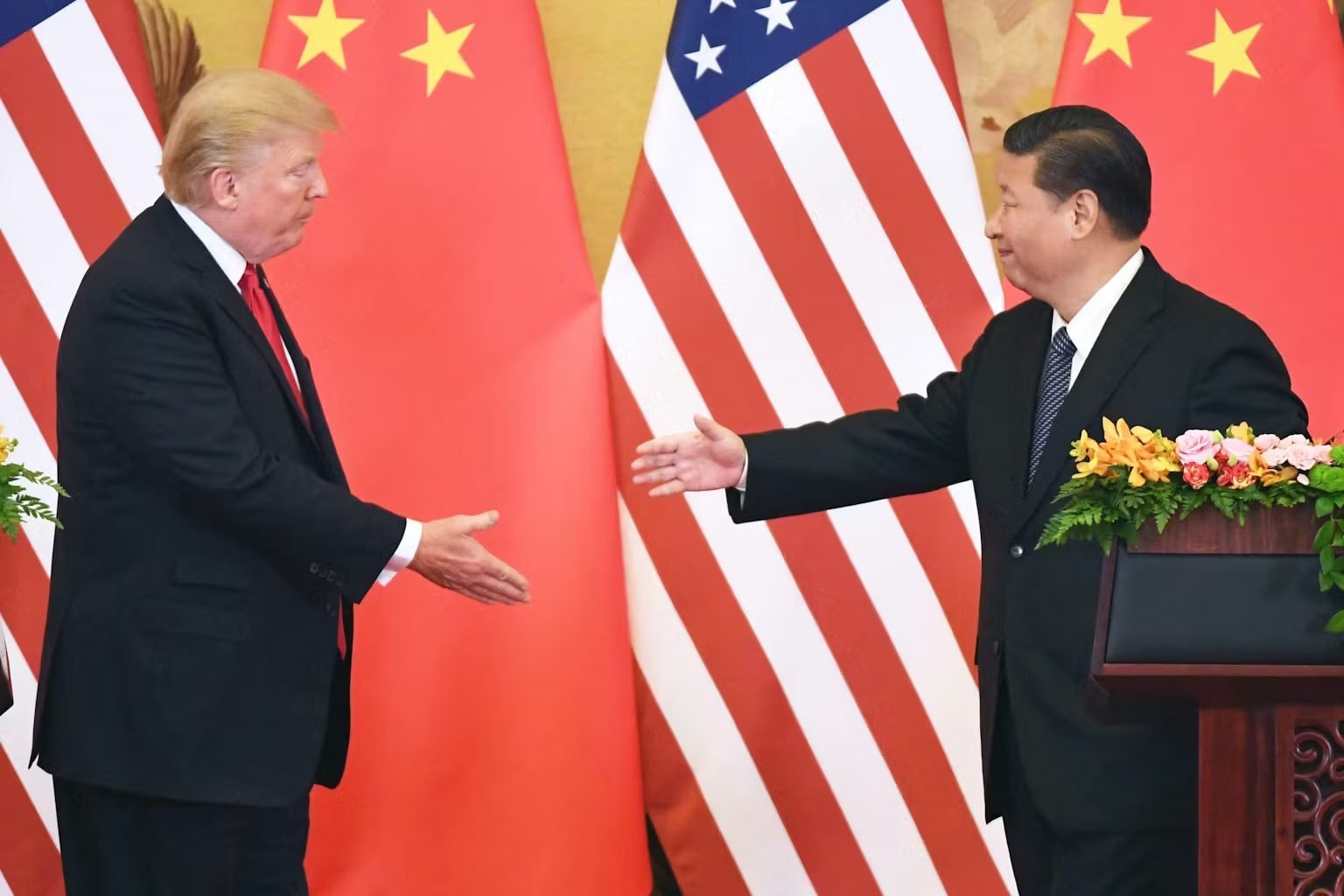

Donald Trump and Xi Jinping are likely to discuss many issues as they meet this week in Beijing. But alongside trade, technology and the war in Iran, one topic of conversation will stand out – the future of Taiwan.
Taiwan has long been a sensitive issue in Sino-American relations. Beijing regards the island as a breakaway province which must be reunited with the mainland. The United States has long opposed such a step. Yet in recent months, Trump has fueled speculation that he may be ready to change key aspects of US policy on the issue, potentially granting Beijing long-sought concessions.
Trump’s possible readiness to make these moves means that Taiwan is one of the issues on which we might see the most significant policy developments at the summit. And that could happen simply through the famously voluble president uttering just a few simple words.
The president’s policy towards Taiwan has been inconsistent and seemingly more malleable than that of previous administrations. Advocates for Taiwan point out that his administration recently approved the largest ever US arms sale to the island. But at the same time, he has sowed doubts about the strength of his support for Taiwan’s independence.
US policy towards Taiwan has traditionally been based on two principles. The first is “strategic ambiguity,” which means that the US declines to explicitly state whether it would actively use its military to defend Taiwan from attack by China. This policy is supposed to deter China while also discouraging Taiwan from formally declaring its independence from Beijing.
The second principle is the “one China policy.” According to this policy, the US recognizes Beijing as the legitimate government of China, while opposing any violent solution to its dispute with Taiwan. It also retains robust informal links to the Taiwanese government in Taipei.
Observers are concerned that Trump may water down these principles during his summit with Xi. For instance, he might state that the US not only “does not support” Taiwanese independence but actively “opposes” it. Or he might double down on previous comments he has made indicating that whether or not Xi invades Taiwan is “up to him”.
Trump has also explicitly stated that he will discuss future US arms sales to Taiwan with Xi during this week’s summit. This violates one of the so-called Six Assurances that the US has upheld towards Taiwan since the 1980s, and which were endorsed by the US Congress in 2016.
Even securing a discussion of arms sales would be a victory for Xi, who would welcome an opportunity to chip away at the Six Assurances. Presumably he would then try to weaken the US commitment to the other five, which include a US commitment not to change its position on Taiwan’s sovereignty.
More concretely, if Xi succeeds in making US arms sales to Taiwan a legitimate topic of negotiation in Sino-American relations, then he could head them off in the future by offering the US concessions in other areas. For instance, if Trump or a future president asks Beijing for its help settling a conflict like that in Iran, Beijing might demand an end to US arms sales to Taiwan as the price.
High stakes
Given Trump’s reputation as a formidable China hawk, his attitude towards Taiwan may seem surprising. But it’s actually part of a longstanding pattern.
In relations with China, Trump arguably has always prioritized economic issues, while appearing less concerned about the security of America’s regional allies. He has also raised doubts about whether Taiwan is even defensible. In his first term, he reportedly told aides that “Taiwan is like two feet from China. We are 8,000 miles away. If they invade, there isn’t a fucking thing we can do about it.”
Trump is also both highly transactional and less focused on abstract principles of foreign policy than most previous presidents. He views America’s support of allies such as Taiwan as a gift that it gives them, one that is often not worth the cost. If he can achieve a concrete victory for himself today by trading away support for Taiwan tomorrow, he may well be willing to do so.
All of these developments matter because they make a violent conflict between China and Taiwan, potentially ultimately involving the US, more likely. If Trump makes concessions to Xi, it will be the latest signal that US support for Taiwan is wavering. That may be read in Beijing as permission to change the status quo violently. Even though such an act might belatedly then be met with force from Washington in response, it is made more likely by Trump’s stance today.
Even worse for Trump, the summit comes at a time when American power and the wisdom of its long-term strategy are being visibly called into question in the Middle East. The US is bogged down in an intractable conflict and has severely damaged its deterrent capacity in the Indo-Pacific by burning through advanced munitions at a high rate. Trump’s personal unpopularity is also rising at home amid the war and its economic fallout.
This weakened position makes it even more likely that Trump will want to strike a deal with Xi to help end the war in Iran or ease trade tensions to help the economy at home. Taiwan may be the price of that – and, ultimately, peace.
Andrew Gawthorpe is a lecturer in history and international studies, Leiden University.
This article is republished from The Conversation under a Creative Commons license. Read the original article.