In recent days, India has announced a slew of defense launches, demonstrating the emergence of a new strategic doctrine in which manufacturing capability, technological self-reliance and national security are becoming intertwined.
From intercontinental ballistic missile-class systems to the rollout of indigenous glide weapons, smart artillery rockets, advanced stealth frigates and startup-built autonomous systems, India is no longer approaching defense production as a procurement exercise but as industrial statecraft.
Asia’s strategic balance is becoming more unstable, not less. Post-Operation Sindoor against Pakistan, in May 2025, India’s defense-industrial push has acquired a new strategic legitimacy. Future wars will depend as much on domestic manufacturing resilience, rapid technological adaptation and scalable precision systems as on conventional force structures.
China’s military-industrial capabilities, intensifying great-power competition across the Indo-Pacific, supply-chain fragmentation and the growing use of sanctions and export controls have all changed how states think about security.
In that environment, India’s recent defense launches are significant not only for what they do militarily, but also for what they signal economically and strategically.
The most striking example came this week with India’s maiden test of a nuclear-capable intercontinental ballistic missile-class platform. The test demonstrates advances in propulsion, guidance and re-entry technologies that only a handful of countries possess.
It also underscores how defense capability development drives wider industrial sophistication. Long-range missile programs require domestic ecosystems involving advanced metallurgy, electronics, precision engineering, computational systems and materials science. Countries capable of building these systems inevitably build wider technological depth.
The same logic underpins the DRDO-IAF trial of the Tactical Advanced Range Augmentation, or TARA, glide weapon system. TARA converts conventional unguided bombs into precision-guided stand-off weapons using low-cost indigenous technology.
Militarily, that improves survivability and strike precision. Economically, it demonstrates India’s attempt to move away from expensive import-heavy combat architectures towards scalable domestic precision manufacturing.
The Indian government recently articulated a four-pillar framework that effectively captures the country’s emerging strategic logic. Expanding manufacturing capacity addresses scale. Building resilient supply chains reduces external vulnerability.
Prioritizing innovation recognizes that future warfare will be increasingly AI-driven, autonomous and network-centric. Positioning India as a global defense manufacturing hub ties industrial growth directly to geopolitical influence.
The framework’s significance lies in its integrated approach. Defense production is becoming part of a wider economic-security architecture linking industrial policy, technology development, export growth and strategic autonomy. That shift is visible across India’s expanding defense ecosystem.
The guided missile program, Pinaka, is indicative of how indigenous production is altering the economics of India’s warfare capabilities. India’s guided rockets reportedly cost significantly less than comparable foreign systems while delivering precision deep-strike capability.
Pinaka is an indigenous, all-weather, multi-barrel rocket launcher (MBRL) system developed by India’s Defence Research and Development Organisation (DRDO) for the Indian Army.
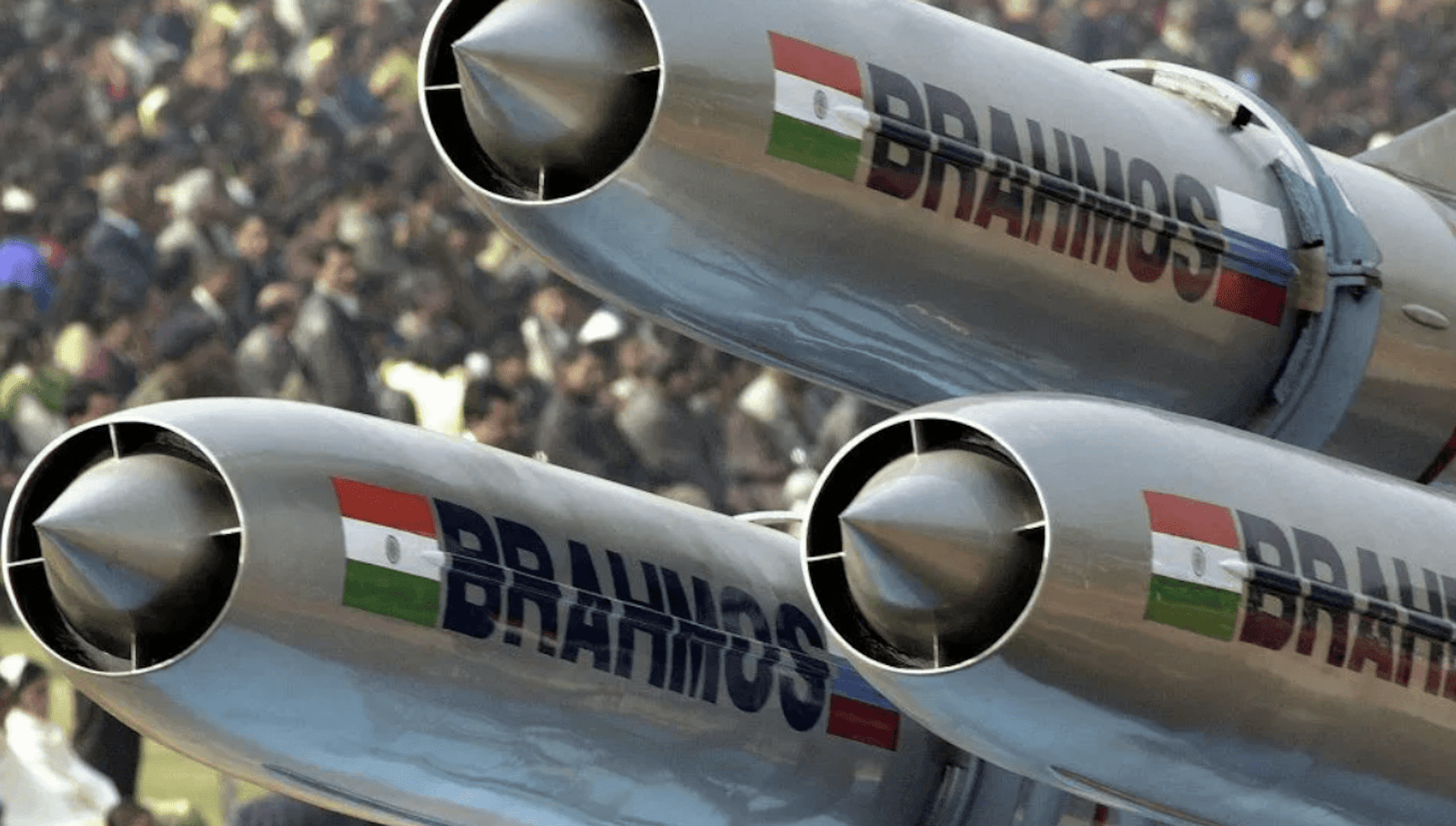
India’s strategy is clearly evident in the exports of its BrahMos and Pinaka missiles. New Delhi is using indigenous defense manufacturing as an instrument of strategic influence across the Indo-Pacific and beyond. Pinaka missiles have recently been bought by Armenia.
India has thus far delivered two of the three BrahMos missile systems — a US$375 million deal concluded with the Philippines just over four years ago. The third battery is slated for delivery soon.
India is now advancing a potential deal with Vietnam, a country at the center of maritime tensions in the South China Sea. Such exports are strategically significant because they extend India’s security partnerships while reinforcing deterrence architectures against expanding Chinese assertiveness across Asia.
The BrahMos missile ecosystem itself captures the wider logic behind India’s defense-industrial strategy. Producing and sustaining a supersonic cruise missile program requires advanced capabilities across propulsion systems, guidance technologies, precision manufacturing, software integration and complex supply-chain coordination.
Export growth validates industrial credibility while sustaining economies of scale. As exports expand, these ecosystems gain economies of scale, deepen localization and attract wider private-sector participation.
In strategic terms, BrahMos exports allow India to simultaneously strengthen global and regional partnerships, expand defense diplomacy and build long-term manufacturing depth. In economic terms, they help create exactly the kind of high-value industrial capability that India sees as critical in an era where technological sovereignty increasingly defines geopolitical power.
These programs also matter because they reduce import dependence, but because sustainable military readiness increasingly depends on production scalability during prolonged crises where industrial endurance often matters more than headline inventories.
At roughly $80,000 per guided rocket, the Pinaka system is reportedly substantially cheaper than comparable Western precision artillery systems such as the US GMLRS, which can cost upwards of $140,000 per round, giving India an important cost-efficiency advantage in sustained high-volume warfare.
Indian systems are increasingly attractive because they combine lower acquisition costs with operational flexibility and fewer political conditions than the US or China.
India’s naval expansion reflects the same strategic recalibration. The commissioning of INS Taragiri, with over 75% indigenous content, was not merely another naval induction but evidence that India’s shipbuilding ecosystem is achieving greater systems integration capability involving propulsion, stealth architecture, radar management and weapons integration.
This consciously developed interaction between defense production and economic capability is becoming central to India’s geopolitical positioning in the Indo-Pacific.
Beijing’s growing maritime presence across the Indian Ocean has forced New Delhi to think in terms of long-duration strategic competition rather than episodic military balancing. That requires manufacturing resilience. States dependent on external suppliers eventually face strategic constraints during crises, sanctions or supply-chain disruptions.
It also needs the localization of capabilities. The India-Germany submarine collaboration under Project-75(I) reflects this shift. The real significance of the deal lies not in platform acquisition but in technology transfer, domestic production capability and long-term industrial absorption. The objective is to reduce vulnerability in strategically sensitive sectors while building sovereign manufacturing depth.
The most important development, however, may be occurring inside India’s startup ecosystem. Noida-based IG Defense’s JWALA system reflects the new direction. Marketed as a hybrid between a missile and a one-way attack drone, it is designed to operate in the contested space between short-range and medium-range air defense.
Whether every technical claim ultimately survives operational testing is secondary to the larger trend: private Indian firms are now developing sophisticated battlefield systems involving AESA radars, autonomous guidance and multi-role engagement capability.
The same shift is visible in space security. Indian startups are working with government agencies on “bodyguard satellites” capable of protecting strategic space assets from hostile interference. That places India within an emerging frontier where commercial space capabilities, military deterrence and strategic surveillance increasingly overlap.
Drone manufacturing may become India’s largest asymmetric opportunity. India is now attempting to build indigenous capability across swarm intelligence, UAV propulsion, autonomous navigation and electronic warfare-linked drone operations. If Indian firms achieve scale and reliability, they could become globally competitive suppliers in a rapidly expanding market.
Execution risks remain a factor. India still depends heavily on imports for engines, semiconductors and advanced electronics. But the broader trajectory is becoming difficult to miss. India is attempting to convert defense manufacturing into a long-term geopolitical advantage.
In a world where industrial depth increasingly determines strategic power, that may become one of India’s most consequential shifts of the decade.
Vivek Y. Kelkar is a researcher and analyst focused on the intersection of geoeconomics, geopolitics and corporate strategy