Do screens in cars represent luxury? Judging by the latest car interiors, the answer would seem to be an emphatic “yes.” Screens aren’t just getting larger; they are multiplying across the dashboard and morphing into different forms and concepts. Indeed, an interior’s screens are a pretty good indicator of what brand made the car—or at least how much the owner paid for it.
But is this actually what customers want? Are more screens really better? And even if they are, luxury car features inevitably trickle down to cheaper, more mainstream offerings, and screens can only get so big. That leaves luxury automakers with another question to answer: “What’s next?”
Mercedes-Benz is working on a new display alternative that could provide an answer. For now, it’s known as the holographic display. Forget the images from Star Trek and Star Wars that just popped into your head, though. It’s effectively a more advanced form of heads-up display, or HUD.
Eyes on the road, not the dash
Whereas a traditional HUD projects images onto the windshield glass, the holographic display has two main components. It still uses a projector, but its key element is a special transparent film laminated into the glass. The film uses holographic optical elements, or “super-small mirrors,” as Mercedes development engineer Lena Hees described them, that selectively reflect the light emitted by the projector, keeping the image visible even in direct sunlight while hiding it from the driver’s view.
Today, the passenger-side touchscreens in Mercedes and other luxury vehicles rely on driver-monitoring cameras or screen polarization to keep the driver from seeing what is playing on the passenger side.
Speaking of passenger screens, the holographic display is clearly being considered as a future alternative or replacement for this technology. Although screens in cars are increasingly ubiquitous, a recent JD Power study indicated that car owners classify passenger screens as “not necessary” and have generally negative opinions about them. Mercedes has clearly observed similar opinions but for slightly different reasons.
“We have customers who like the Hyperscreen,” said development engineer Maximilian Hilger of the pillar-to-pillar screen found in an increasing number of Mercedes models. “But there are others who want to maintain luxury materials.”
In other words, the massive screen design doesn’t seem as luxurious as the pillar-to-pillar bands of wood or other materials found in previous-generation models. And that’s not an opinion isolated to Mercedes’ customers.
New Mercedes chief design officer Bastian Baudy recently told German magazine Auto Motor Sport that “Materiality and haptics must remain tangible—with switches, buttons, and intuitive controls. Real materials are at the heart of Mercedes: metal, wood.”
Mercedes CEO Ola Källenius went further, grouping interior quality and materials among the brand’s “forever values,” along with safety and maintaining what a Mercedes is like to drive.
That presents conflicting priorities, however.
“Yes, you need to have all the [technology] that a customer could ever dream of and wants,” Källenius told Ars. “But you need to package it in an aesthetically pleasing way. That’s also part of it.”
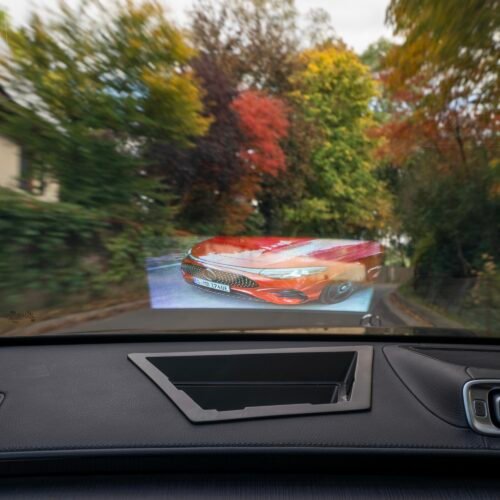
That brings us back to the holographic display. Keep in mind that the photos in this article show early prototypes I saw at Mercedes’ research facilities in Sindelfingen, Germany. The prototype projector sits inside a rather crude, trapezoidal hole dug into the dash of a right-hand-drive, pre-2027 S-Class. It’s also loud, with a cooling fan whirring like a laptop visiting too many junk-filled websites.
The production version would have a much smaller projector opening than those of the prototype and existing heads-up displays. Manual Holstein, a manager working in Mercedes research for future displays, indicated that the projector could be small enough to be hidden behind wood or metal trim pieces. Holstein also said you won’t hear a fan in the production model and that the resolution would improve.
The resolution is certainly considerably better than any current head-up display, including Mercedes’ own, which features augmented reality elements. Full-color, commercial-like videos of the C-Class Electric played during the demonstration, and the display was sufficiently bright, even though Holstein said the prototype was operating at just 20 percent of its maximum brightness.
It’s not there yet
Issues remain, however. The resolution may be good compared to the arrows, script, and graphics of a current HUD, but it’s poor when compared to a passenger touchscreen. The video’s contrast was also too high, and as you can see in the photos, the picture was distorted into a narrow height due to the angle of the windshield. Frankly, no one would choose to watch anything on it over a phone, tablet, or conventional passenger screen. It needs to improve by orders of magnitude before becoming a viable alternative.
Again, though, this is just a prototype. Holstein said the holographic film size, or “eyebox,” can be made much bigger and be raised higher than the HUD-like height of the prototype. He also dismissed the distortion as a problem unique to the prototype.
Imagine nearly half the windshield transformed into a virtual screen that’s visible only to the passenger. Beyond videos or other entertainment, Mercedes envisions the holographic display highlighting points of interest in the view through the windshield. A similar display could be placed on the driver side, showing situational information, enabling video calls, or providing entertainment when parked. In the future, it could even let drivers watch things other than the road when Mercedes’ Level 3 autonomous driving system allows them to take their eyes off it. At the very least, the technology could replace today’s HUDs and their larger projector boxes.
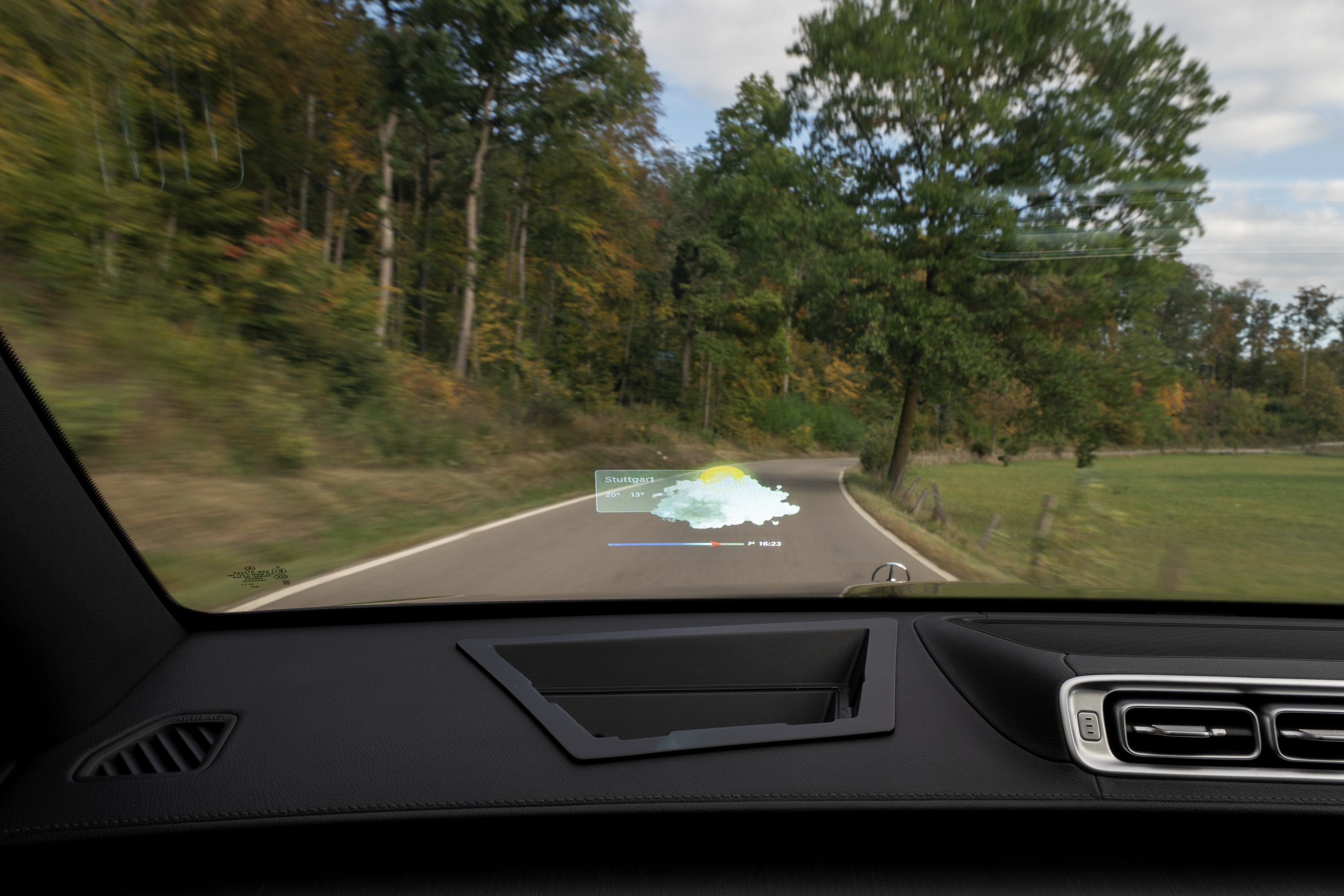
Having experienced the prototype while the car was moving, I also think the holographic display could help prevent the motion sickness that can come from staring at a passenger screen while the car is moving. The higher screen angle and ability to see more of the outside world beyond created a notably different visual experience.
Of course, the question remains: “Is this what customers want?”
If the JD Power survey found that customers don’t care about passenger touchscreens, will they be any more enthusiastic about holographic video displays? That seems doubtful. But that’s just as much of an open question as whether the production version will actually live up to its promises.
There’s also another matter: What, exactly, defines luxury? Before Bastian Baudy took over as Mercedes’ chief design officer this year, his predecessor and former boss Gordon Wagener echoed Källenius’ thoughts about the direction of the brand’s interiors. He was considerably blunter, though.
“Screens are not luxury,” Wagener told ABC News. “You have a better—and bigger—TV at home, right? And every car has a big screen. So we have to create luxury beyond the screen. That’s why I talk about craftsmanship and sophistication.”
If the holographic display lets automakers emphasize traditional design and materials while still offering unique technology, it could be a promising way forward.