Could we see Vladimir Putin’s control of Russia seriously challenged – or even destabilised in the coming months? Predicting when authoritarian regimes might fall is notoriously difficult. Their hold on power can appear solid until suddenly it crumbles. But there are signs that the Kremlin is concerned about the potential for upcoming elections to become a source of political instability.
In September, Russians go to the polls to elect the national parliament, the State Duma, as well as the parliaments and governors in Russia’s regions. At one level, it is hard to image why Russian officials would be concerned about these elections. The Russian state has considerable experience managing elections to get the desired result, and no one seriously doubts the outcome. The ruling party, United Russia, which currently holds about 70% of the seats in the State Duma, is widely expected to sweep the board, as usual.
But these are the first national elections in Russia since its full-scale invasion of Ukraine in 2022. This means that a smooth campaign and a comfortable win for United Russia can be presented as an endorsement of the war and the way that Putin has handled it. Such an endorsement is especially important because the war has not been going well for Russia lately.
Russia’s progress on the battlefield in eastern Ukraine has slowed to a crawl, with Ukraine taking back more than 700sq kms of occupied territory in July. And Moscow is paying a high price for the small territorial gains that it is making. Russian forces are estimated to have suffered 1.4 million casualties. Soldiers are dying and being injured at a higher rate than they can be replaced with recruits.
The Russian military has sought to fill the gaps in its ranks by recruiting prisoners and foreign fighters – among them reportedly another 50,000 troops from North Korea.
Read more: North Korea grows stronger as South Korea reckons with fading US support
There are widespread rumours that Putin will be forced to launch another round of compulsory mobilisation – perhaps calling up as many as half a million citizens – in order to replenish the armed forces and continue the war. In response to the last mass mobilisation in September 2022, an estimated 700,000 Russians, mostly young men of military age, left the country to avoid fighting in the war.
Mobilisation has been deeply unpopular with the soldiers and their families. Mobilised soldiers do not serve for a specified term but instead have an open-ended obligation. Families of the mobilised have been willing to complain about the conditions of their service, including a lack of adequate training and equipment, and the infrequency of leave periods to return home.
Some of the wives of these soldiers have even openly campaigned for an end to mobilisation and the return of their husbands.
Hardship on the home front
Meanwhile, Ukraine’s strategy of drone attacks deep inside Russia mean that the war is making everyday life more difficult for millions of Russians who might otherwise not have been significantly affected by it. Ukrainian strikes on oil refineries have created severe fuel shortages throughout the country. Most of Russia’s regions have experienced some form of fuel rationing, with long queues reported at filling stations.
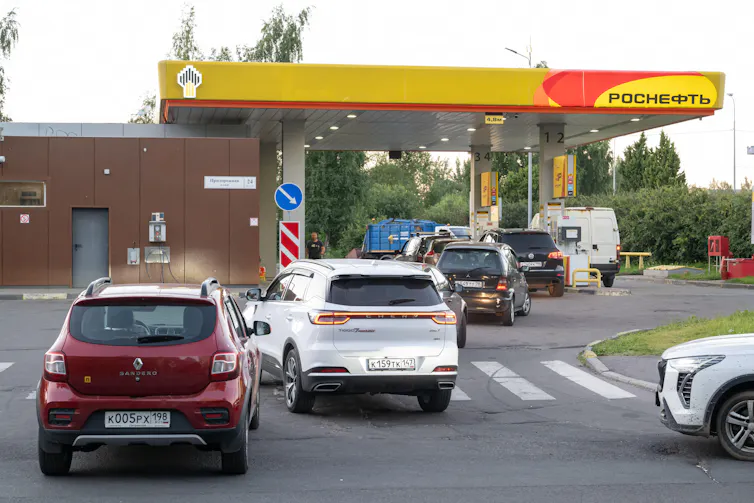
Extraordinarily high rates of cash withdrawals from Russian banks demonstrate the economic insecurity experienced by ordinary citizens, who fear the government could seize private savings to help fund the war in Ukraine
Recent public opinion polls in Russia provide evidence that society’s views are shifting. Support for the war in Ukraine has dropped over the past year from 78% in July 2025 to 66% in July 2026. Over the same period, the percentage of Russians who believed their country was moving in the right direction dropped from 69% to 54%. In a country where the state exercises tight political control and expressing opposition to the war can lead to arrest, fines or even imprisonment, these are remarkably bad results.
In the run up to September’s elections, only one political party in Russia has expressed outright opposition to the war. Yabloko, a small, pro-democracy party, adopted the campaign slogan: “For peace and freedom, for a life without fear.” But Russia’s supreme court has now banned the party from participating in the elections, while another court has sentenced its deputy leader to 11 years in prison.
The banning of Yabloko is a measure of the Kremlin’s concern that the elections could provide an outlet, no matter how small, for a public expression of anger. In the previous elections in 2021, Yabloko only received 1.34% of the vote and failed to win a single seat in the State Duma.
Even if it had been allowed to participate in September’s elections, Yabloko would have had no realistic chance of making a dent in United Russia’s dominant position. No political actor, no matter how insignificant, can be permitted to threaten the state’s narrative that the war is under control and society is united behind Putin.
In an attempt to reassure the public that all is well, Putin himself has been visiting cities across the country this summer in a pre-election tour of Russia. This is an unusual step for a leader who is notoriously fearful of assassination and reluctant to leave the security of Moscow.
Putin’s visits have been accompanied by the sudden reappearance of petrol at the pumps wherever he goes, and its availability at surprisingly low prices – an indirect admission of the importance of bread and butter issues for Russia’s voters.
In all likelihood, Russia’s election management machine will swing into action next month and deliver the outcome that Putin both wants and needs. But the state’s lack of confidence in that victory, despite all the tools at its disposal, suggests that Putin and his allies are not nearly as confident in their ability to maintain their grip on power as they would like the rest of the world to think.