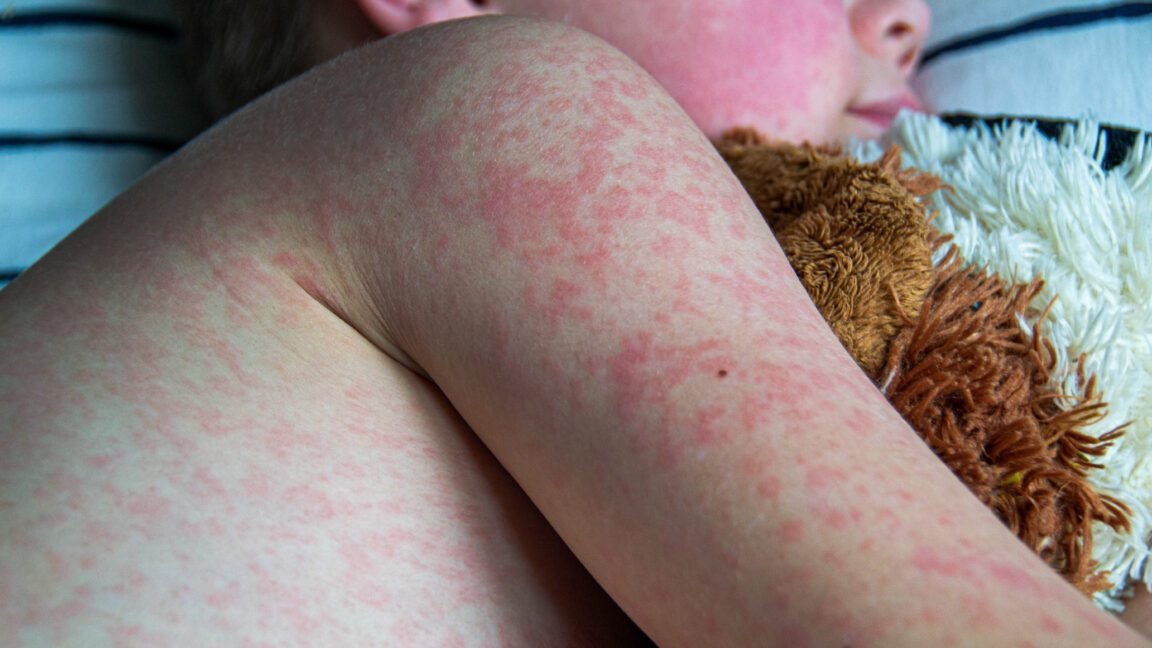
For years, anti-vaccine Health Secretary Robert F. Kennedy Jr. and his zealous followers have downplayed measles as “just a rash” and falsely claimed that “Measles outbreaks have been fabricated to create fear.”
In 2021, when Kennedy wrote those words, the US recorded just 49 measles cases. Yearly case counts have generally been low since 2000, when the US declared measles eliminated thanks to a decades-long vaccination campaign. But with the rise of Kennedy and his ilk in the past few decades, that public health triumph is being undone. Vaccination rates have slipped, and large, multistate outbreaks of vaccine-preventable diseases have inevitably come roaring back. Now it’s becoming painfully clear once again how wrong Kennedy and his cohorts are about infectious diseases and vaccines.
In a study published yesterday in the Morbidity and Mortality Weekly Report, state and federal researchers provided a detailed postmortem of last year’s massive multi-state measles outbreak that mushroomed out of West Texas. The data reveals a disease that’s far from just a rash, with about 20 percent of people—mostly younger children—being hospitalized.
“The outcomes experienced by patients hospitalized during this outbreak underscore the seriousness of measles infection and highlight that measles can cause life-threatening complications affecting multiple organ systems and place significant stress on patients and health care systems,” the authors conclude.
By the end of the outbreak, there were 762 outbreak-related measles cases in Texas alone. The new analysis focused on 325 cases in the outbreak’s first three months (January 20 to March 18, 2025). Of those, at least 60 were hospitalized (18.5 percent). The researchers collected medical and case information from 54 of the hospitalized patients. All of them had no record of being vaccinated.
Thirty of the 54 (56 percent) were young children between the ages of newborn and 4 years old. Nineteen (35 percent) were children ages 5 to 17. The five remaining cases were in adults, four of whom were pregnant women in their third trimester.
Outcomes
Only six of the 54 hospitalized patients had an underlying medical condition that may have put them at higher risk. None of the 54 hospitalized patients were immunocompromised.
Of the 54 hospitalized, 47 (87 percent) developed a complication of measles, including 39 (72 percent) who developed pneumonia, 25 (46 percent) had dehydration, and 21 (39 percent) developed diarrhea. Seventeen (31.5 percent) patients developed co-infections with other pathogens, a known risk with measles, and 28 (52 percent) were treated with antibiotics.
Thirty-eight (70.4 percent) patients required supplemental oxygen to breathe. Thirty-seven (68.5 percent) experienced hypoxia, which is insufficient oxygen levels to support the body. Four of the hospitalized patients, all children, required treatment in an intensive care unit. Three had dehydration. Two required intubation and mechanical ventilation. One child died.
(There was a second child death in the Texas outbreak, but it occurred after the timeframe of the study and was not included.)
Of the five adults, four were pregnant women. Two of them gave birth during their hospitalizations and their two infants were diagnosed with active measles cases. One infant went on to experience symptoms suggestive of acute measles meningoencephalitis and was hospitalized weeks later, outside the timeframe of the study.
With all this, the authors concluded that “although many cases of measles are mild, approximately one in five persons with confirmed measles in this outbreak required hospitalization for pneumonia, dehydration, or other complications, including rare cases of serious illness or death. Measles vaccination remains a critical tool in both routine and outbreak settings for the prevention of measles infections, severe disease, and hospitalizations.”
In 2025, the US recorded 2,288 measles cases overall, the highest total since 1991. Not yet six months into 2026, and the country is already close to reaching that number; as of May 28, the US has reported 1,983 confirmed measles cases across 40 jurisdictions. There have been 30 new outbreaks since the start of the year. Overall, the country is on track to lose its measles elimination status.