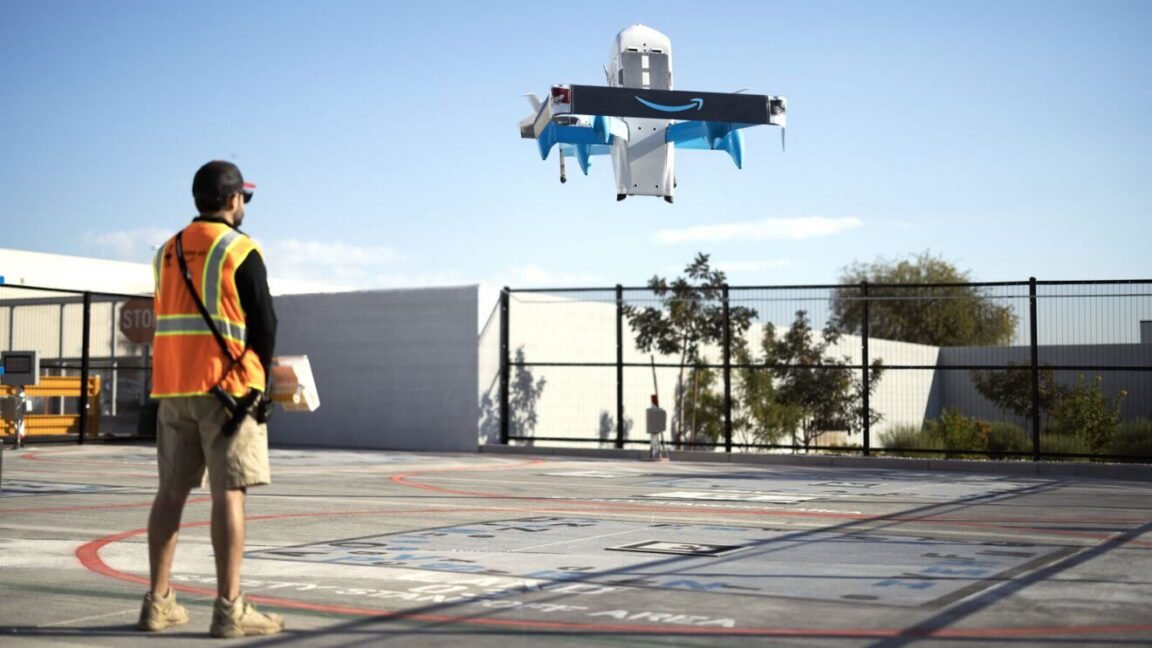
Amazon wants to grow its Prime Air delivery drone service sixfold to reach nearly 500 cities and towns across the United States by the end of 2026. The planned expansions from Amazon and its rivals could make the convenience of delivery drone services available to tens of millions more people in the coming months—but will also test more communities’ tolerance for increased noise from daily drone flights.
On August 19, Amazon announced it would soon launch Prime Air in the metropolitan areas of Chicago; Cleveland; Atlanta; Syracuse, New York; and Boise, Idaho, with more to come later in the year. Each Prime Air site offers delivery drone service within an area of about 175 square miles, with delivery times ranging from half an hour to an hour.
Prime Air already operates out of Amazon warehouses in 10 cities across seven states. Those include primarily suburban neighborhoods of Phoenix; Tampa; Kansas City; Omaha, Nebraska; Baton Rouge, Louisiana; Detroit; Houston; and San Antonio, Dallas, and Waco, Texas.
The Amazon Prime Air expansion comes as competitor Walmart has teamed up with the companies Wing and Zipline to scale up its own delivery drone service. Walmart recently celebrated the milestone of surpassing 1 million drone deliveries after operating from 66 stores across four states, and is looking to expand that service footprint to more than 270 Walmart stores by 2027.
Separately, Zipline also just announced a partnership with Uber aimed at scaling up to 1 million drone deliveries per day by the end of 2029. Having initially pioneered long-range drone deliveries of blood and other crucial medical supplies in Africa, Zipline has been steadily growing its US delivery operations and claims to have already made more than 2.7 million deliveries worldwide.
Even DoorDash is looking to build its own in-house delivery drone program. In July, the delivery service company announced it had received its FAA Part 135 certification to launch what it describes as DoorDash Air—though it is still in the early phases of designing its delivery drone and planning out operations.
The accelerating US expansion of drone delivery services promises speedy deliveries to customers within an hour, and sometimes within minutes in the fastest cases. Such autonomous drones typically run on battery-electric power and potentially offer lower-emission, lower-cost operations without putting more vehicles on the road for last-mile deliveries.
However, delivery drones are still limited in how much they can carry. For example, Amazon describes its drones as being capable of handling nearly all items weighing five pounds or less that can fit within a large shoebox. Strong winds, heavy rain or snow, and extreme cold can also prevent drones from operating.
There have also been community concerns about safety, privacy and especially noise pollution in neighborhoods serviced by drones. None of those issues are likely to go away as US companies ramp up delivery drone services nationwide with the regulatory approval of the US Federal Aviation Administration.
Safety records
Zipline appears to have the cleanest safety record despite its autonomous drones having collectively flown over 100 million miles. The company includes backup parachutes for its drones, which have apparently proven handy on a few occasions when individual drones ran into trouble while delivering Walmart orders this year.
By comparison, Amazon Prime Air’s operations have led to several safety incidents that sometimes triggered investigations by the FAA and the National Transportation Safety Board.
Two Amazon delivery drones crashed into a stationary construction crane in Tolleson, Arizona in October 2025, while another delivery drone took down an overhead Internet cable in Waco in November 2025. The federal government’s investigations into those incidents are ongoing.
“We trained our algorithms; we felt pretty good, but we found in the real world the performance just wasn’t good enough, and let me tell you, that was a humbling experience,” said David Carbon, vice president of Prime Air at Amazon, in a recording of an internal staff meeting in March that was obtained by CNBC.
The most recent incident saw a vertically ascending Amazon delivery drone collide with an apartment building before falling to the ground in Richardson, Texas, in February 2026.
Alphabet-owned Wing has experienced at least one notable safety incident when a food delivery drone caught fire after landing on top of overhead power lines in Brisbane, Australia, in September 2022. That forced the energy company Energex to temporarily shut down electricity service to about 2,000 people.
A Wing delivery drone fulfilling Walmart orders also crashed and burned on grassy ground in Kemah, Texas, in March 2026.
Losing the sound of silence
The most common complaints about delivery drones have less to do with safety than with the persistent noise. Some people have described hearing delivery drones multiple times a day over their houses.
“It’s the equivalent of a flying leaf blower, lawnmower 20 feet over my house, 50 times a day,” said Joshua Brent, a resident of Hazel Park, Michigan, in an interview with the TV station WDIV. “My dogs lose their minds and get upset.”
Multiple posts on the topic of delivery drone noise have also appeared on community-focused subreddits on Reddit. Although Wing and Zipline drones are sometimes mentioned, many posts tend to focus on the noise from Amazon’s delivery drones.
“Some days I hear them 5 or 6 times back and forth every 15 minutes,” commented Reddit user Puzzleheaded_Belt740 in a subreddit for Royal Oak, Michigan. “They are so LOUD, it sounds like a small helicopter hovering.”
Some Reddit users described attempting to ask Amazon customer service to reroute drones around their house but without much success. Others said they had filed noise complaints with the FAA.
“More often than any actual street traffic in our neighborhood. it’s actively altered the ambiance of our home,” wrote Reddit user le_artista in a subreddit for Richardson, Texas. “A business gets to loudly disturb our home, unsolicited, unwanted and with no recourse to keep them out apparently.”
Residents from several neighborhoods in Richardson even held a public protest over the noise from Prime Air operations in June. Amazon responded by describing its efforts to do public outreach before launching delivery drone services and its willingness to continue engaging with local community concerns.
Some people also voiced privacy concerns about having drones constantly fly or hover over their backyards. “I was in my backyard sunbathing and had like 4 drones go over my house and felt super creeped out and ended up going inside,” said Reddit user redheadjo8 in the Royal Oak subreddit.
Amazon has described its delivery drones as only using onboard cameras and sensors for navigation, obstacle detection, and dropping off packages, without tracking individuals or recording people’s movements.
“There is no live camera feed monitored by any person,” according to an Amazon News article about the Prime Air service expansion. “The onboard camera data is processed by the drone itself for safe navigation.”
It will be worth seeing how many people voice their concerns to local city councils or the FAA in the coming months. The FAA’s latest data shows that the total number of registered noise complaints and inquiries for drones is still relatively low compared to noise complaints for helicopters or fixed-wing aircraft—but that could change as US delivery drone operations continue expanding nationwide.