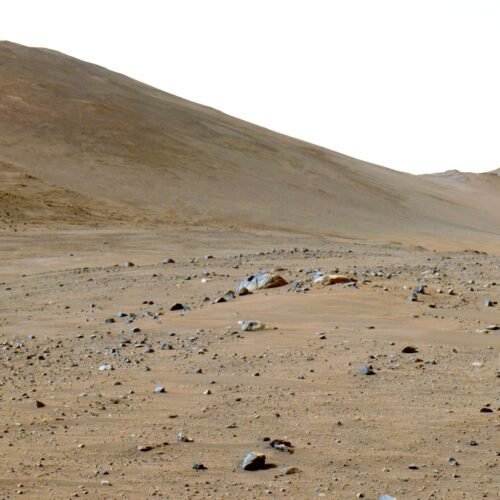
NASA’s Perseverance rover has spent five years traversing Jezero Crater looking for the chemical leftovers of whatever processes were at work on Mars billions of years ago. The rover has found organic carbon, but it has mostly been inside rocks that had to be drilled or abraded to expose it. But now, at an outcrop on the edge of an ancient river channel named Neretva Vallis, Perseverance detected complex macromolecular carbon sitting right on the rock’s surface.
“To our knowledge, that’s the shallowest detection of organic matter on Martian surface to date,” said Ashley E. Murphy, a researcher at the Planetary Institute in Tucson, Arizona, and lead author of the study of the rock, which was found at a site called Bright Angel. On Earth, this much macromolecular carbon usually suggests a biological origin. But to learn what this Bright Angel carbon is and where it came from, we might need to bring samples back to Earth.
Carbon on the rocks
The detection of Bright Angel carbon came from SHERLOC (Scanning Habitable Environments with Raman and Luminescence for Organics and Chemicals), a UV Raman spectrometer fitted on Perseverance’s robotic arm. SHERLOC fires a deep-ultraviolet laser at a target and reads the light that bounces back at shifted energies, a signal that enables scientists to identify specific molecular bonds.
Between sols 1180 and 1218, the rover pointed this UV laser at four targets at Bright Angel. One, called Steamboat Mountain, was an ordinary rock the team used as a control. The remaining three (called Cheyava Falls, Apollo Temple, and Walhalla Glades) returned a spectroscopic signature of macromolecular carbon. This signal, called the graphitic band (G-band), indicates the presence of a tangled, cross-linked network of mostly reduced carbon atoms that is resistant to chemical and thermal breakdown.
At least within the precision limits of the Perseverance’s instruments, the material roughly matches terrestrial kerogen. Using the word “kerogen,” though, was a no-go, the researchers decided. On Earth, kerogen is made almost exclusively of biological matter, mainly fossilized microbes that were buried millions of years ago. “The term kerogen implies biogenic source,” Murphy explained. “Macromolecular carbon implies we don’t know whether its origin is biotic or abiotic.”
The material found on Martian rocks, Murphy’s team warns, might have originated from non-biological processes as well.
A result like this usually invites two major questions, and the team immediately got busy trying to answer them.
Artifacts and stowaways
The first concern was that the signal could have been light bouncing off SHERLOC’s own fused-silica front window. Bright Angel was the first site SHERLOC examined after a dust-cover anomaly disabled its focusing mechanism, forcing the team to adopt a new operating mode.
To characterize the new mode, Kyle Uckert, SHERLOC’s deputy principal investigator at NASA’s JPL, and his colleagues collected spectra from spare flight optics in their own lab. They also pointed SHERLOC at nothing in particular on Mars and at known calibration targets. All these were used to confirm that SHERLOC was working properly.
The final confirmation of the data came when the team pointed it at Steamboat Mountain. “Other rock targets nearby do not exhibit the G-band spectral signal,” Uckert said. The Bright Angel signal was not coming from hardware.
The second concern was contamination—perhaps the rover itself dragged the organic material from Earth? Scientists pointed out that the abrasion bit the rover used to expose the rocks was sterilized before launch and has cut into other rocks across Jezero without ever producing a G-band this strong.
Also, the Cheyava Falls rock was never touched by the hardware; the rover just blew the dust off its surface with a nitrogen puff. On top of that, the Steamboat Mountain scientist used as a control again came up empty. “It did not exhibit spectral evidence of organic matter,” Uckert explained.
Chemical company
Once it was clear that the finding was most likely real, the team took a closer look at the chemistry of the material nearest to the Martian macromolecular carbon. “It suggests the carbon emplacement may have occurred during at least two different events over geologic time,” Murphy said.
At Apollo Temple, the signal clustered with carbonate and sulfate minerals–the kind that precipitate out of water moving through older rock. At Walhalla Glades, the carbon instead sat within silicate-rich sediment.
Murphy sees that split as evidence for at least two separate windows in which carbon could have been locked into these rocks. First, as organic matter settled into mud at the bottom of an ancient lake and was buried alongside the sediment and again when groundwater later moved through this buried rock and left behind new carbonate and sulfate minerals.
In the end, though, the question of whether Bright Angel carbon is a remnant of ancient Martian life will remain open for quite a while. “The science payload of the Perseverance rover was not designed to distinguish between abiotic and biotic processes but to identify compelling rocks to be collected for possible return to Earth,” says Uckert.
The unanswered question
“Perseverance rover has an incredible instrument payload, but those instruments pale in comparison to world-class techniques that could be used to analyze these samples when they get back to Earth,” said Kevin P. Hand, the Perseverance principal investigator at JPL.
Hand is especially interested in the isotopic signature of Bright Angle’s carbon, which might provide some indications of life. Another thing he wants to look into is chirality—a preference for one type of molecular handedness over another that is strongly associated with biotic origin. “We could also use some of the most powerful microscopes on Earth to search for ancient microbial fossils, if you will, that could be indicative of past life on Mars,” Hand explained.
There is no shortage of abiotic mechanisms that could create such a material. Fluid-rock reactions in some environments are known to synthesize organic compounds with no life involved. Murphy notes that carbon found near carbonate minerals on Earth can be traced back to either water-rock chemistry or microbes, depending on the setting. Hand, though, hopes Perseverance still has a lot to discover on Mars before we ship the samples it has collected to Earth.
“Now we are exploring the region outside of Jezero crater—the rocks over which we’re currently roving are perhaps some of the oldest rocks ever investigated by a rover on Mars,” Hand said. “There’s a chance that if life arose early on in the history of Mars, we might find some hints of it in the rocks we’re looking at now,” he added.
Science Advances, 2026. DOI: 10.1126/sciadv.adx0047