The city of Kashiwa, in Chiba Prefecture, is quiet for its size. Lying less than an hour’s train ride to the northeast of mega-metropolis Tokyo, Kashiwa – home to many commuters and their families – presents a calm contrast to the hectic pace of its big-city neighbor. Politics in Kashiwa is milder, too.
Tokyo is not just an urban giant, with all the political cut and thrust that comes with millions of competing interests. It is also Japan’s political capital, a fact intensified by Japan’s close relationship with the United States and the geopolitical complexity that that entails. When one is talking politics in Tokyo, one is talking about intrigue with international resonance.
When one is talking politics in Kashiwa, one is talking about building playgrounds and keeping fire departments properly funded. But because Kashiwa is much less visible than Tokyo, and much freer of partisan straitjacketing, there is room for those who practice a politics of purpose over a high-profile act of national and international performance.
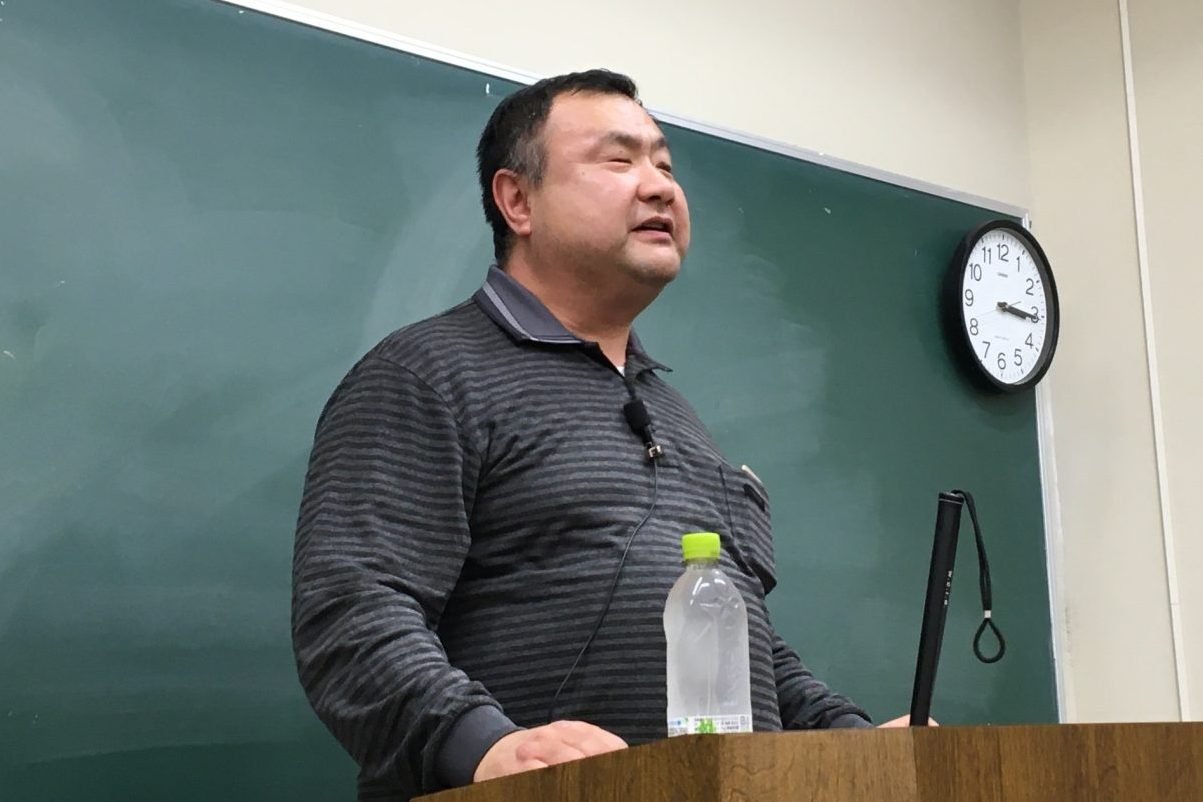
In the relative calm of Chiba, Hiroki Uchida, a Kashiwa City Council member, spends his days fighting not to be seen but to be heard. He speaks also on behalf of others whose voices have often been squelched in the political arena. I recently spoke with Uchida about his political work. What I found was a man who puts human dignity over partisan politics.
Q: Please tell me a little about your background.
A: I was born not far from Kashiwa in Noda, Chiba Prefecture, in 1971. I was born with a visual impairment, completely blind in my right eye, but able to discern some visual information, although very weakly, with my left eye. Now, however, I have no sight in either eye.
I had perfect attendance in my third year as an elementary student, but as a fourth-year student I was very severely bullied by my teacher. This bullying continued through much of my time in elementary school. Because I was often not in class, my teacher had a kind of funeral for me, putting my photo on my classroom desk and burning incense in front of it as though I had died.
As a result, I stopped going to school – except on days when we had music lessons. I was very fond of music.
I had some friends in middle school, but as high school entrance exams approached they became busy with studying and we drifted apart. I thought sometimes of suicide, and attempted suicide as well.
I also was studying, though, and was able to enter high school. There, I met other people with visual impairments like myself. I also met people with hearing impairments, people with psychological conditions, people from foreign countries and others who might have been subjected to bullying as I had.
I entered high school in 1985. The next year, 1986, there was a nuclear accident in Chernobyl, in the Soviet Union, in what is now the country of Ukraine. My friends and I began working to ensure that there would be no such accidents in Japan, and that Japan would use renewable energy resources instead.
We also fought against discrimination, often as part of the disabled liberation movements of the day, and on behalf of hisabetsu burakumin [descendants of hereditary outcastes], women, people of African descent and other groups facing social exclusion. I found that the problem of discrimination, at root, lay in the social structure.
When I graduated from high school I began to work in rehabilitation at a hospital. In addition, I was volunteering at a night school that a friend had started, helping twice a week with students with various disabilities and from various disadvantaged social backgrounds.
It was also around this time that I decided to work in a more dedicated way toward eliminating discrimination in society. And, I discovered the great danger that discrimination poses to society. Fighting for one’s rights is fighting for one’s survival.
Q: Sadly, this has been proven true in recent years.
A: Yes. Ten years ago, in July, 2016, Satoshi Uematsu, an employee of the Tsukui Yamayuri En care home in Sagamihara, Kanagawa Prefecture, murdered nineteen people with disabilities who were residents there. The murderer said that such people’s lives had no value.
Q: You work as a politician in Kashiwa. Please tell me about the history of discrimination here in our part of Chiba Prefecture.
A: A very unfortunate historical example from right here in Kashiwa also illustrates the dangers of discrimination. This is the Fukudamura incident of more than a century ago. This incident was the culmination of many different kinds of discrimination, most prominently against people thought to be from the Korean peninsula.
The Fukudamura incident happened on September 6, 1923, five days after the Kanto earthquake on September 1 of that year. In the immediate aftermath of that natural disaster, while fires were blazing in Tokyo, a baseless rumor started to circulate that Koreans had been poisoning wells. Chiba Prefecture was placed partially under martial law on September 4.
In Fukudamura, a village near the Tone River later incorporated into Noda City – next door to today’s Kashiwa – a group of fifteen medicine salespeople traveling from Kagawa Prefecture, in Shikoku, had stopped to rest before crossing the Tone and continuing on into Ibaraki Prefecture.
Impromptu militias formed after the earthquake were on high alert. Militias from Fukudamura and Tanakamura, later part of Kashiwa City, rounded up the salespeople on the suspicion that they were Koreans who had been poisoning wells as rumored.
The salespeople were not Koreans, however, but hisabetsu burakumin. Discrimination against them meant that they often could find no other work besides traveling sales. This is why they were in Chiba at the time, far from Kagawa.
But because they spoke a dialect of Japanese very different from that spoken in Chiba, some of the militia members jumped to the conclusion that they were Koreans. Of the fifteen people in the group, the guards killed nine. Three of the murdered people were small children. Eight people drowned after being thrown in the Tone River, while the ninth, also thrown in the river, was cut down after managing to swim to shore.
These murders sprung entirely from discrimination—against Koreans, against hisabetsu burakumin and against traveling salespeople.
Q: I believe one of the murdered women was pregnant, so her unborn child would be the tenth person killed. It seems that the people who killed the traveling salespeople from Kagawa were prosecuted, but later pardoned and released from prison. One of the murderers became the head of Tanakamura village, and later a member of the Kashiwa City Council. He had murdered people thought to be Koreans, and because of that he was lionized by some in Kashiwa.
A: It is a very dark chapter in Chiba history.
Q: How has the Fukudamura incident affected your political career?
A: I do my political work in Kashiwa today rooted in the lessons that must be learned from this history. I think that everyone working in politics in Kashiwa, and all of us who live here as well, must learn these lessons, too. People with disabilities, people from foreign countries – there are many today whose rights and dignity are violated by discrimination.
I likely would not have known about the Fukudamura incident had I not myself experienced discrimination. Even if I had learned about it, I would not have seen it in the way that I do had I not also been discriminated against.
Today, Kashiwa has developed into a big and prosperous city. It is just for this reason that I think the Fukudamura incident must not be forgotten. As immigrants come into Kashiwa, especially from neighboring countries in Asia, discrimination comes again to the fore here. This calls to mind not just the Fukudamura incident but also the eugenics ideology that was used to justify discrimination against disabled people and others in the postwar. We must remember that eugenics has had influence in Japan, and in the world. We must never forget it.
I want to continue fighting so that no one, for any reason, is discriminated against in Kashiwa. Peace and human rights are always a set, and we cannot have one without the other.
Jason Morgan is an associate professor of global studies at Reitaku University, Kashiwa, Japan.