WALLOPS ISLAND, Virginia—Just 10 months ago, NASA asked three companies if they could do something nobody had done before. Could they build and launch a satellite to save a $500 million astronomy mission at risk of crashing back to Earth? What’s more, could they do it in less than a year on a tight budget?
Katalyst Space Technologies, a startup founded in 2020, presented the most compelling solution. “They came back with a response that was technically and programmatically plausible, and then we were like, ‘Yeah, let’s do it,’” said Shawn Domagal-Goldman, director of NASA’s astrophysics division.
That was in August of last year. In September, NASA awarded Katalyst a $30 million contract to build, test, and launch a small satellite to chase down Swift and latch onto it with three robotic arms. Then, Katalyst’s Link servicing spacecraft will boost Swift’s orbit back to a safe operating altitude, allowing it to resume scientific observations. Easier said than done.
Reaching the finish line
The Swift observatory is flying in low-Earth orbit, where the outermost layers of the atmosphere still exert some aerodynamic influence on satellites. The spacecraft launched in November 2004 on a mission to detect gamma-ray bursts, the most powerful explosions in the known Universe. Despite its age, astrophysicists still rely on Swift’s multi-wavelength instruments to identify and locate gamma-ray bursts for follow-up observations by other observatories.
But there’s a hitch. Swift lacks any thrusters to maintain its orbit, so aerodynamic drag has gradually caused its altitude to decay. The observatory launched into an orbit roughly 363 miles (585 km) above the Earth. As of Thursday, Swift was flying at 225 miles (363 km). The decay rate will increase as the spacecraft dips into denser layers of the atmosphere until Swift finally burns up during reentry.
Swift is losing altitude faster than anticipated due to a period of extraordinary solar activity in recent years. An active Sun puffs up Earth’s atmosphere, creating higher drag for satellites in low-Earth orbit. Satellites and space debris routinely reenter the atmosphere, and most of Swift is likely to burn up before it falls to Earth’s surface.
“But this was not just any spacecraft,” Domagal-Goldman said. “This is an observatory with unique capabilities for astrophysics, similar to what its name would imply. It is a swift observatory that can quickly pivot across the night sky to find things that go boom in the night … So we decided, yeah, we want to go save this one, this time, because of how special it is. But then we had a different challenge of time was running out.”
NASA engineers estimate Swift will fall below an altitude of 186 miles (300 km) this fall—perhaps around October. At that altitude, Swift will be too low for Katalyst to safely approach it due to the effects of increasing drag. NASA gave Katalyst less than a year to design and build the satellite. The Swift rescue mission had to launch before the end of June.
“To be honest, no one thought it was going to be possible. No one thought we would get as far as we’ve already gotten today,” Domagal-Goldman said. “And I have to be honest, there are still risks ahead of us, but I’m both deeply thankful and as optimistic as I can be that we’ll meet those challenges because of the people that have worked on it.”
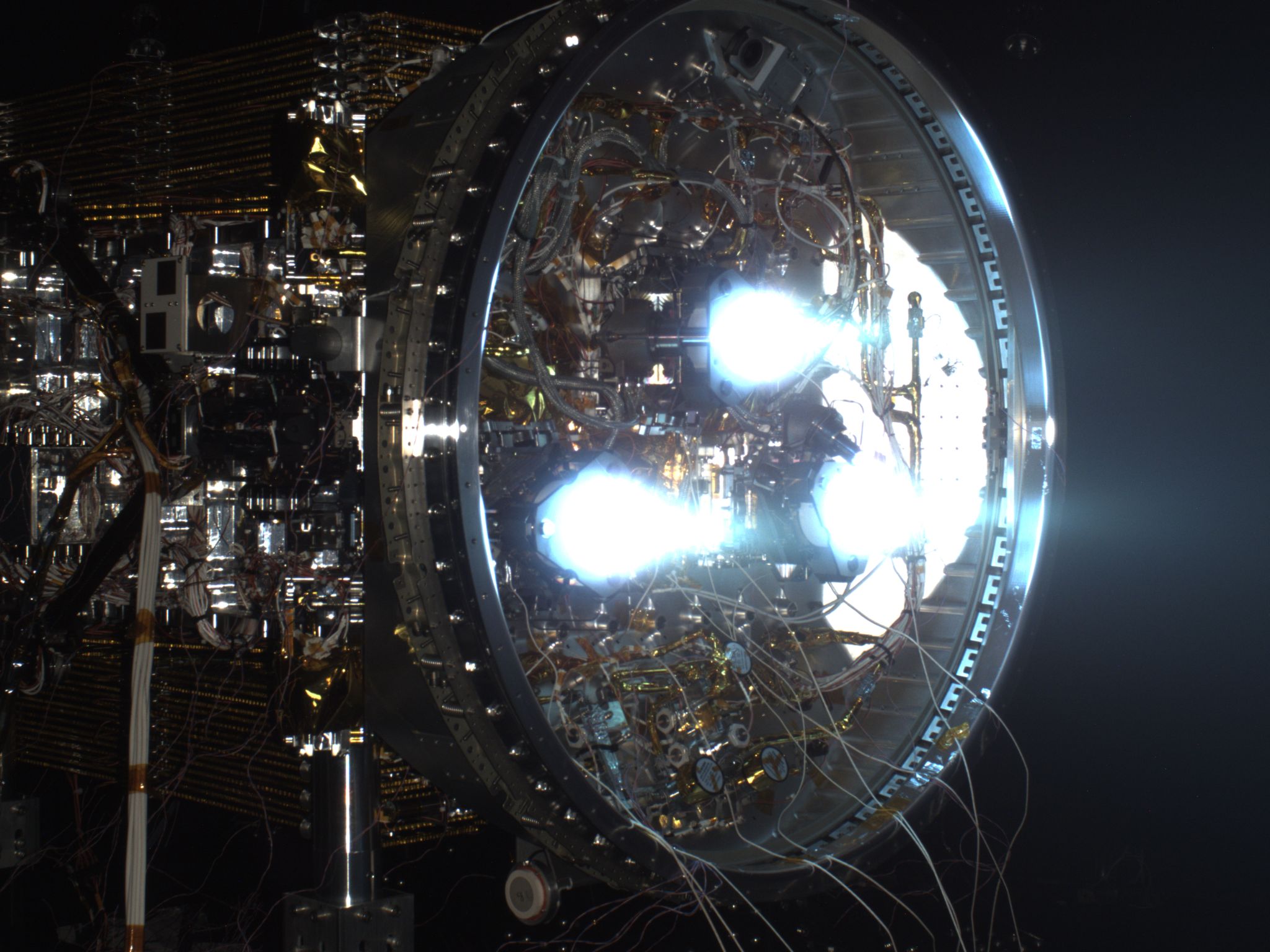
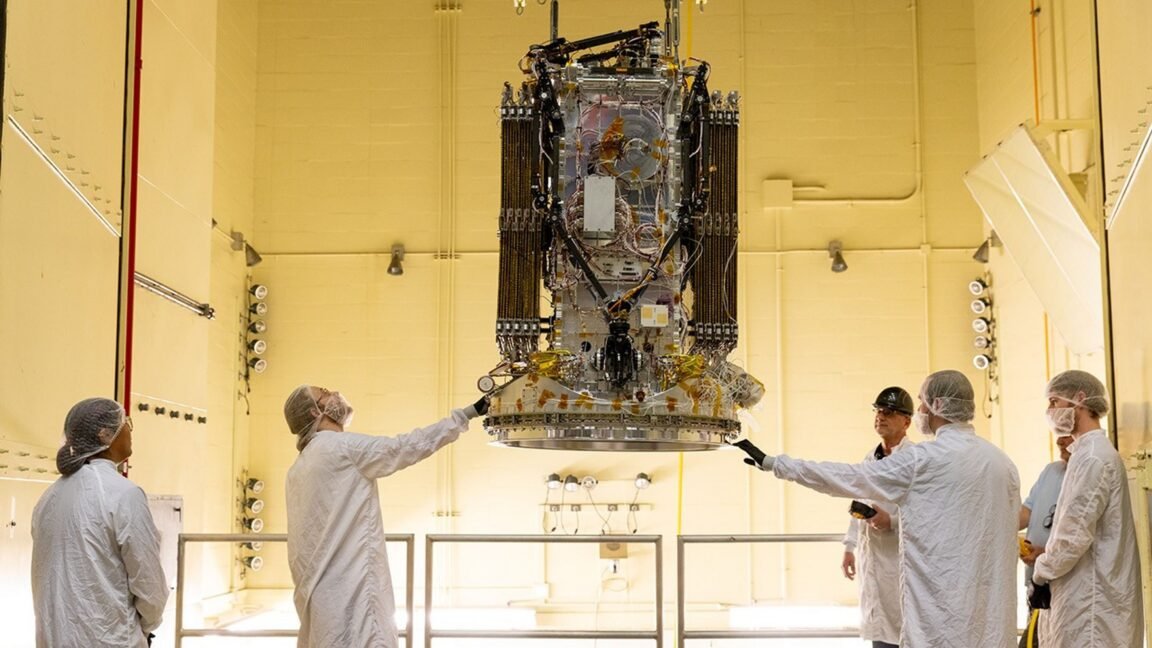
Katalyst’s Link servicing spacecraft is now complete and ready for launch, a prospect that wasn’t a given just a few months ago, when Ars visited the company’s factory in Colorado. At that time, engineers were racing to piece together the Link satellite from a mix of structural components, fuel tanks, solar arrays, thrusters, and robotic arms designed to grab onto Swift more than 200 miles above the planet.
It all came together just in time. Katalyst shipped the Link satellite from its Colorado factory to NASA’s Goddard Space Flight Center in Maryland for a battery of thermal vacuum and vibration tests this spring to simulate the environments it will see in space and during launch. Then the satellite shipped to NASA’s Wallops Flight Facility in Virginia for integration with its ride to space: Northrop Grumman’s Pegasus XL rocket.
The Pegasus XL is an air-launched vehicle. It releases from a modified commercial airliner at about 39,000 feet, then ignites a series of three solid-fueled rocket motors to climb and accelerate into orbit. After 45 missions since 1990, this is the final Pegasus rocket scheduled to fly.
Katalyst selected the Pegasus XL largely for its mobility. Swift is in an unusual orbit that takes the observatory between 20 degrees north and south latitude on each trip around the Earth. That makes Swift hard to reach from a launch pad at Cape Canaveral, Florida, without a dedicated launch on an oversized, more expensive rocket. The Link spacecraft, weighing just under a half-ton at launch, fits snugly within the Pegasus rocket’s payload fairing.
Northrop Grumman’s L-1011 carrier jet will transport the 58-foot-long (18-meter) Pegasus rocket with the Link servicing satellite to a location over the remote equatorial Pacific Ocean near Kwajalein Atoll in the Marshall Islands. The multi-day journey to Kwajalein from the Pegasus integration base in Virginia began Thursday with the L-1011’s departure from Wallops. Launch is scheduled for June 27.
Doing the impossible
It would normally take several years for a satellite of Link’s complexity to be designed, manufactured, tested, and launched. So how did NASA, Katalyst, and Northrop Grumman do it in less than a year?
They did it by throwing out the playbook. NASA’s normal bureaucratic process for soliciting proposals for new missions can take months or even years.
“We didn’t send out a solicitation because we didn’t have time to,” Domagal-Goldman told Ars. “Normally, that’s what we would do, but those solicitations take time for the respondents to respond and for us to review them. Instead, what we did was we looked at who we had on contract already to do technology development, and we asked three teams that were on contract to do a study for what they could do.”
Katalyst was already working on a commercial demonstration mission for its Link servicing platform. Upon its selection by NASA for the Swift rescue mission, Katalyst quickly pivoted that private investment to meet the agency’s need.
In order to do that, the company’s leaders knew they had to accept some additional risk. Katalyst quickly put out orders to suppliers for all the parts required to assemble the Link spacecraft. In some cases, Katalyst found their suppliers couldn’t deliver in time, and they decided to build parts themselves. Engineers also streamlined the Link spacecraft’s test campaign to meet NASA’s deadline.
“We’re in an unusual situation where the schedule dictates how much risk we’re willing to accept, rather than the other way around,” said Kieran Wilson, Link’s principal investigator at Katalyst. “The clock is ticking on Swift’s descent, so we have to find a balance between testing and problem solving that gives the mission the best chance of success.”
Link is just the second space mission developed by Katalyst after a technology demonstration launched in 2024 by Atomos Space, a company Katalyst acquired last year.
“When we kicked off the program, I think everyone recognized the biggest risk would be that we weren’t ready to launch in time, that Swift would fall faster than we could get up. We have been able to retire that risk over the last few months by building, testing, and getting ready to operate a spacecraft,” Wilson said. “So that I think has retired the bulk of the overarching concern. Now, there is a lot of residual risk in the program. We still have to get the spacecraft on orbit and operate the spacecraft there successfully, and as we’ve all seen before, that’s a very challenging thing to do.”
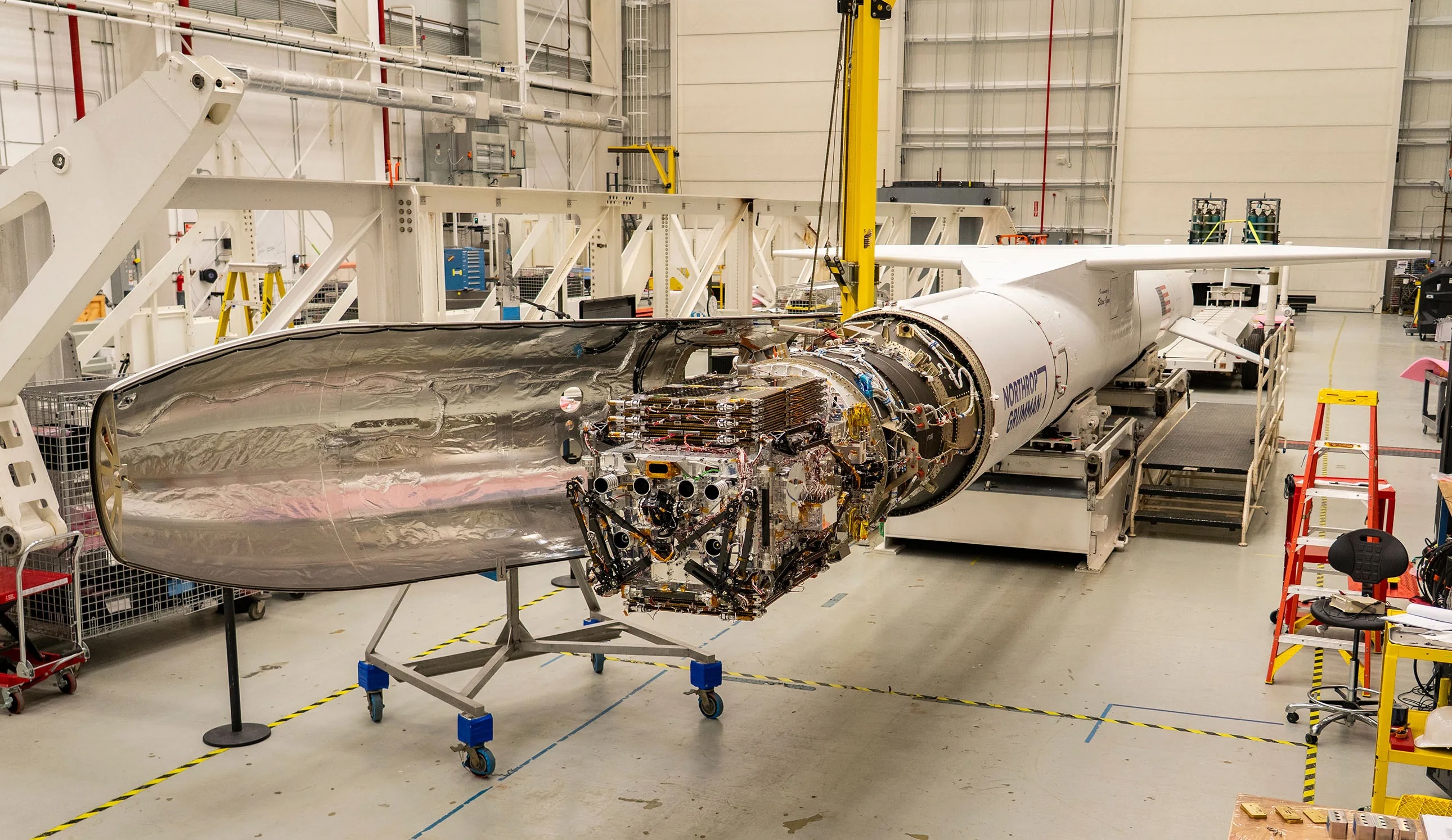
It also helped that Northrop Grumman had all the parts for the Pegasus XL rocket in storage. The last two Pegasus rockets were originally ordered by Stratolaunch, a company originally owned by the late Microsoft co-founder Paul Allen. Stratolaunch gave up the rockets after Allen’s death in 2018, and Northrop was free to sell them to other customers. It sold one to the Space Force in 2021, and the other to Katalyst last year.
Whatever happens after Link’s launch, NASA and its partners believe they’ve written a new template for how to do a responsive space mission.
“Some would call it the first of its kind, a robotic spacecraft that can go and capture an unprepared satellite,” said Robert Lamontagne, vice president for strategic partnerships at Katalyst. “It’s a commercial mission, first and foremost. It’s doing an operational, real-world objective. It’s not just a demonstration, and we’re doing this as a service … This is really a blueprint for commercial and government partnerships.”
“From a programmatics standpoint, I consider this a success already, just from the fact that we’re even going to try this,” Domagal-Goldman said.