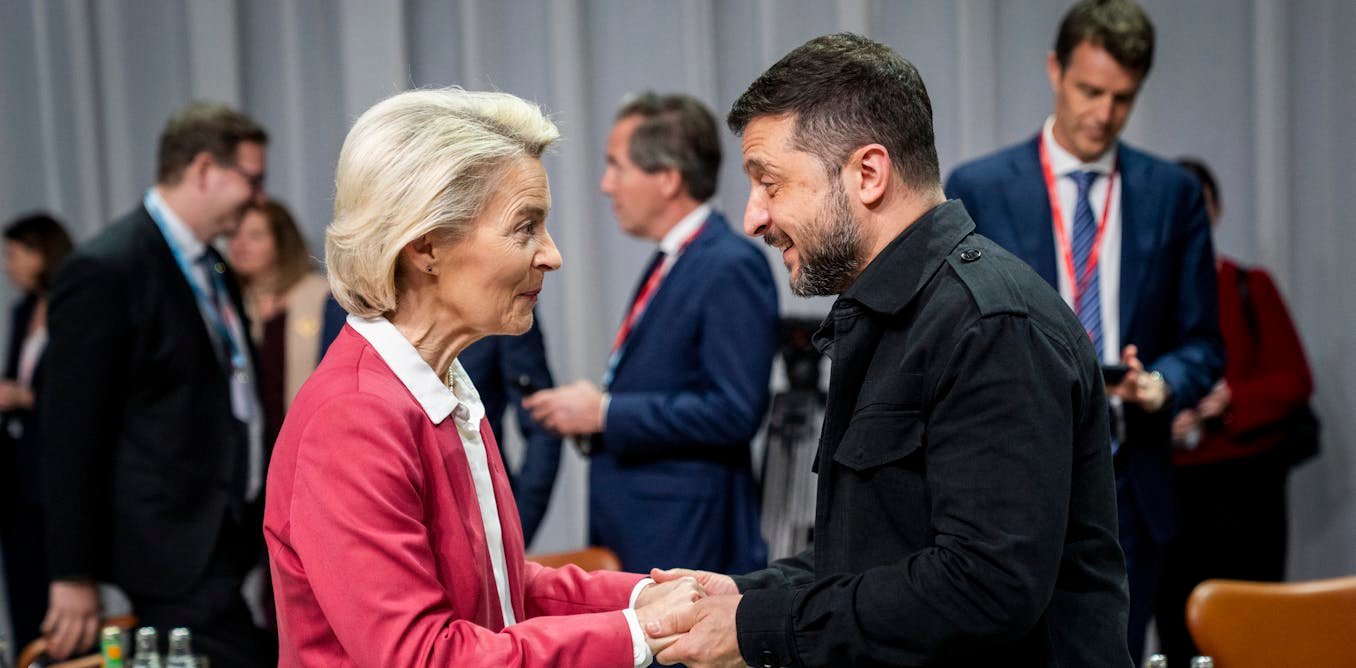
The EU formally unblocked a €90 billion (£78 billion) loan for Ukraine on April 23 after Hungary and Slovakia dropped their opposition. This move came over a week after defeat in parliamentary elections brought the 16-year tenure of Hungary’s prime minister, Viktor Orbán, to an end. He will be replaced by Péter Magyar of the pro-Europe Tisza party.
But at a summit simultaneously taking place in Cyprus, EU leaders struggled to agree on a membership timeline for Ukraine. This is despite the exceptional pace of the war-torn candidate country’s accession-related reforms. The hesitation of EU member states also comes even though the bloc has prioritised its enlargement agenda since Russia invaded Ukraine in 2022.
Meanwhile, another candidate country, Montenegro, is making progress on joining the bloc. Ambassadors from all EU member states said on April 22 that they had decided to set up an “ad hoc working party” to draft an accession treaty for the Balkan nation. The president of the European Council, António Costa, described this as “a big step” towards membership.
Montenegro wants to become the EU’s 28th member by 2028, concluding a process that began when it applied nearly two decades ago. It is aiming to close formal negotiations by the end of 2026 so the accession treaty can then be adopted and ratified by each of the EU’s 27 member states.
However, despite this formal progress, there are reservations about the quality of the reforms Montenegro is carrying out to align with EU standards. These reservations relate to the country’s efforts to combat corruption, ensure judicial independence and guarantee a free and pluralistic media environment.
The accession treaty is thus expected to include extensive transitional arrangements, a period after accession during which a new member does not fully participate in certain EU programmes and policies. This will give Montenegro time to adapt.

Formally, EU enlargement is a merit-based process driven by a candidate country’s compliance with political, economic and legal standards. But politics play a role, too. This is showcased by the contrasting progress Ukraine and Montenegro have made towards EU membership.
Montenegro’s small size and membership of Nato make consensus among member states on its accession relatively easy to achieve. The same cannot be said for Ukraine. Its larger size, wartime context and the scale of its potential accession make Ukraine a far more contentious decision for member states.
Politicisation of enlargement
The politicisation of the enlargement process, where individual member states shape the accession process in line with their domestic preferences, is perhaps the main factor explaining why the EU has struggled to replicate Montenegro’s progress across other candidate countries.
Despite their readiness to move forward with opening negotiations, Ukraine and neighbouring Moldova’s formal accession progress has been stalled for several months. Decisions related to Ukraine’s EU membership, in particular, have been vetoed multiple times by Orbán.
The outgoing Hungarian prime minister leveraged bilateral disputes with Ukraine to justify blocking progress in accession talks. He linked concerns over energy security, as well as a disagreement over disrupted Russian oil supplies through Ukraine, to the country’s EU path. Orbán used these disputes to veto the opening of negotiations.
Even Montenegro may not enjoy a smooth path to EU membership if Croatia continues to link bilateral issues such as maritime disputes to enlargement. The disagreement between the two countries primarily concerns the Prevlaka peninsula. This is a strategically significant area, which controls access to Montenegro’s only deep-water bay and main naval base.
According to Zvezdana Kovač of the Centre for Civic Education, an organisation that monitors Montenegro’s progress towards joining the EU, Croatia is a “manageable risk” in Montenegro’s accession process. In a 2025 interview with the New Union Post website, she noted that Croatia’s responses “are not driven by a strategic desire to block Montenegro” and it retains “a clear interest” in having EU member states as its neighbours.
Vetoes driven by bilateral disputes have contributed to disillusionment in some candidate countries. In North Macedonia, which first applied for EU membership in 2004, Bulgaria’s continued veto over deep-seated language and identity disputes has helped bring to power a government led by Hristijan Mickoski that no longer prioritises accession at all costs.
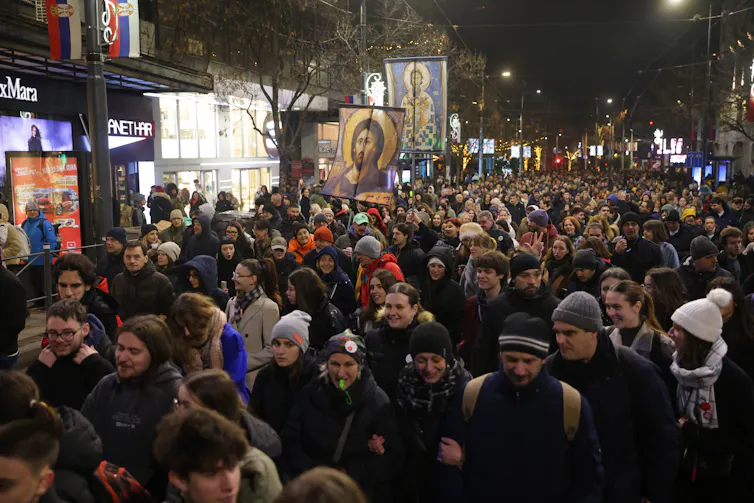
The EU’s varied responses to protests and its contrasting relations with governments in Georgia and Serbia, two other candidate countries, have also alienated many particularly in Belgrade.
While the EU’s response to democratic backsliding in Georgia has been strict, targeting the ruling party by imposing visa restrictions for diplomatic passport holders, the approach to Aleksandar Vučić’s government in Serbia has been more cautious. Serbian opposition groups have reacted to this with dismay.
If the EU sees enlargement as central to its security, decisions cannot risk being derailed by one or two member states. Moving from unanimity to qualified majority voting in enlargement-related decisions would help speed up decision-making in the Council.
But, at the same time, the EU must ensure it does not admit countries that later fail to uphold its standards – a lesson drawn from Hungary’s increasingly authoritarian trajectory over the past 16 years of Orbán’s rule.
While Montenegro appears to be entering the final stage of its path to EU membership, disagreements over Ukraine’s timeline show that some member states have not fundamentally shifted their approach to using enlargement as a geopolitical tool.
For now, the EU is managing rather than overcoming politicisation in its accession process. This risks an enlargement policy that remains inconsistent and unreliable.