A new chapter in the Bugatti story begins today. Twenty-eight years after bringing the storied luxury brand back from the dead, Volkswagen Group no longer counts Bugatti among its stable of brands. Porsche, which became the VW Group steward of Bugatti in 2021, is selling its stake to a consortium of investors.
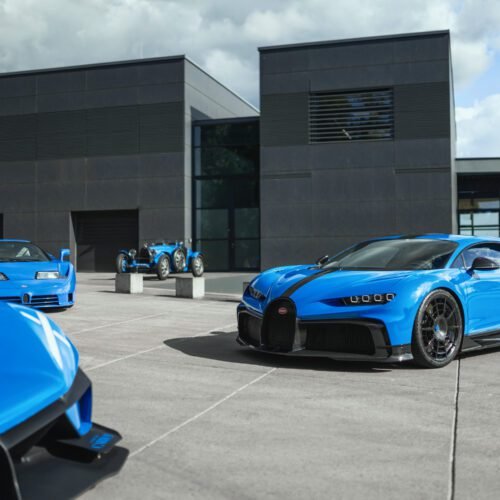
Bugatti dates back to 1909, when its eponymous founder Ettore Bugatti started making cars in the Alsace region contested by France and Germany. That incarnation lasted through two world wars but was gone by 1963. The supercar boom of the late 1980s brought Bugatti back for the first time with the high-tech EB110, a car that combined a carbon fiber monocoque built by Aérospatiale (now better known as Airbus) with an F1-sized V12 (with four turbochargers) and all-wheel drive. As spectacular as that sounds, the twin threats of the even more superlative McLaren F1 and an economic downturn saw it fizzle out in the mid-’90s.
The Bugatti you know now returned in 1998, one of a number of projects of Ferdinand Piech, who was then boss of VW Group. Piech wanted to show off the superiority of VW Group’s engineering. One project was an ultra-streamlined commuter car, the XL1. Another was the Bugatti Veyron, a hand-built mid-engined two-seater with a thousand metric horsepower and manners so docile his grandmother could drive it to the opera.
But in 2021, VW Group pulled back some of its stake in Bugatti when it formed a joint venture with Rimac, a specialist in high-performance electric powertrains based in Croatia. With rapid electrification of the auto industry looking like a fait accompli back then, it made perfect sense for Bugatti to have direct access to the technology that had already made internal combustion performance look quaint. Bugatti Rimac was owned 45 percent by Porsche (and therefore VW Group), 55 percent by Rimac Group (which Porsche owned a 24 percent stake in, having first invested in Rimac in 2018).
But the world looks quite different in 2026. Electrification might still be on for the masses in China and Europe, but the people who buy cars with price tags that look more like telephone numbers don’t want all-electric hypercars.
The good times aren’t rolling
Then there’s the parlous state of VW Group itself. Porsche is not having the best time of things after betting too heavily on EVs, which looks even worse in the vital US market thanks to Trump’s tariffs. Sales were down 15 percent in Q1 2026, the company reported earlier this month. At the VW Group level, CEO Oliver Blume (formerly Porsche’s CEO before his promotion) told Manager Magazin earlier this week that overall capacity across VW Group brands would be cut by a million of cars a year and that tens of thousands of job losses were forecast over the next few years.
So Porsche is selling its stake in Bugatti Rimac, as well as its stake in Rimac Group, to a consortium of investors led by HOF Capital.
“In setting up the joint venture Bugatti Rimac together with Rimac Group, we successfully laid the foundation for Bugatti’s future,” said Porsche CEO Dr. Michael Leiters. “And as an early-stage investor of Rimac Group, Porsche made a significant contribution to developing Rimac Technology into an established Tier-1 automotive technology company. Now, with the sale of our stake, we demonstrate that we will focus Porsche on the core business. We would like to thank Mate Rimac and his team for the constructive and trusting cooperation over the past years.”
“Porsche has been a crucial partner, and we are deeply grateful for their role in establishing Bugatti Rimac,” said Mate Rimac, CEO of Bugatti Rimac. “With the strong foundations their support has provided, we now have a structure that allows us to execute even faster on our long-term vision. We look forward to our collaboration with our new partners.”