MONTEREY COUNTY, Calif.—Bicycles are a strange technology.
While there have been some notable modifications from the dandy horse to the penny-farthing, since the advent of the “safety bicycle” in the 1880s, the fundamentals of bike design haven’t changed all that much. Put another way, most bike riders today could understand how to use a bike made in the 1890s.
Still, for any bike fan, Sea Otter Classic—the biggest consumer trade cycling show in the world—showcases all kinds of new rigs and creative accessories. It’s basically Christmas for bike dorks.
From April 16 through April 19, at the Laguna Seca Raceway, on a hilltop in Fort Ord, just outside Monterey (roughly 115 miles south of San Francisco), this show has hundreds of exhibitors showcasing new products from major companies to smaller firms.
It’s worth noting that over the last two centuries, the bike universe has expanded considerably: now exhibitors represent not only road and mountain bikes but also, increasingly, e-bikes, gravel bikes, cargo bikes, and much more.
Many major industry brands are represented at Sea Otter: Continental, Trek, Specialized, Abus, among others. (This year, there’s even an entirely separate “Bikepacking Campout and After Party,” highlighting maybe the most punk rock galaxy within the bike universe these days.)
But oftentimes, most new offerings aren’t really that different or meaningful to all but the most discerning fan. How much contrast is there really from last year’s crankset? Does bag technology vary considerably year to year? Do bike locks actually improve? How much cooler will I look on a slightly upgraded version of the bike I already own?
After riding two days to get to Sea Otter, Ars spent the better part of a day wandering around the festival area—we weren’t there for the numerous races that were also going on—we were there to suss out what was new and useful.
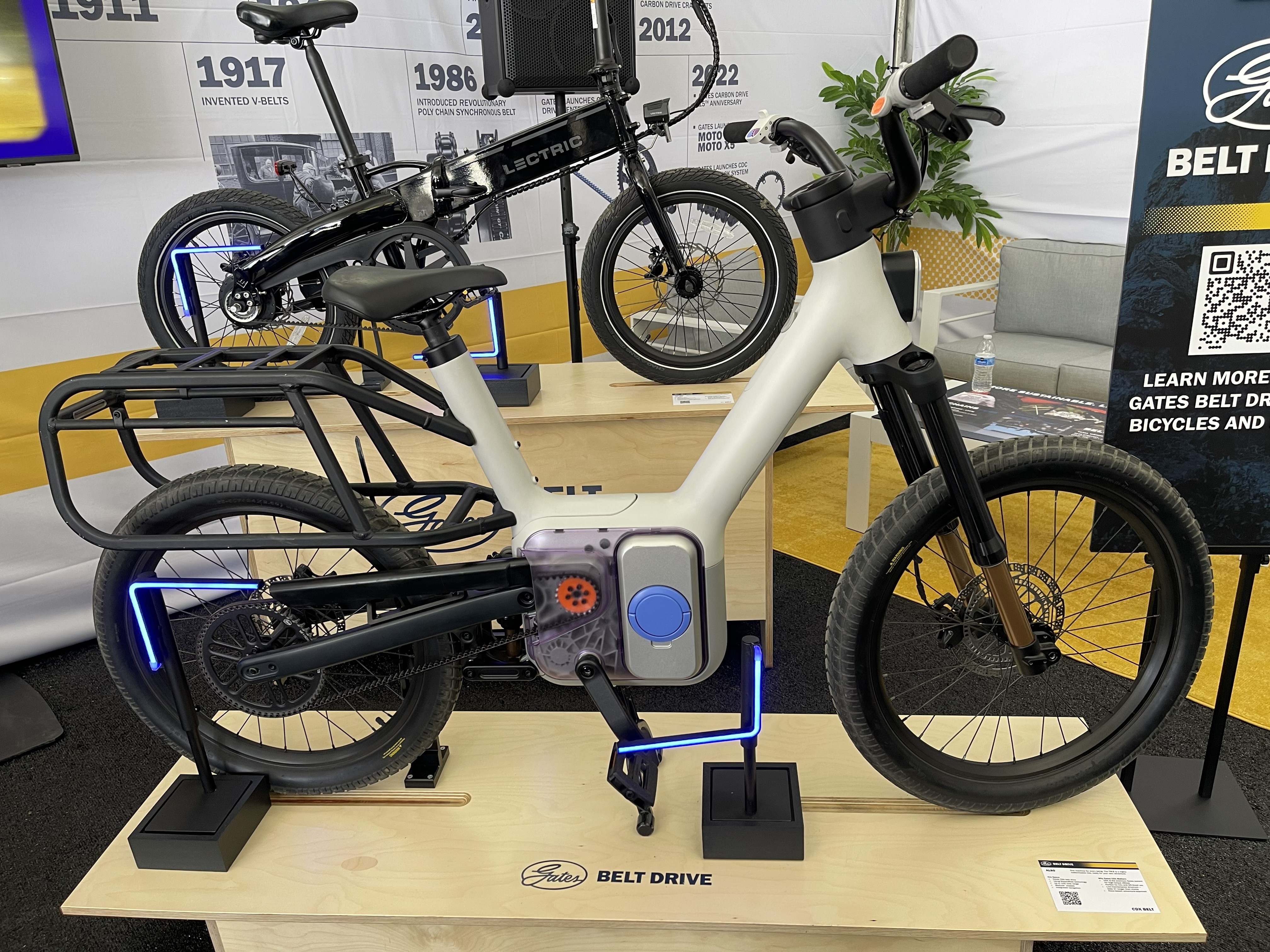
Yes, there were all kinds of new bicycles turning heads, ranging from the standout Salsa Fargo 32—a bike with the emerging 32-inch wheel diameter standard—to the intriguing Xtracycle OmniTierra, a new titanium mid-tail cargo bike built in collaboration with Canadian bikepacker John Freeman. Even Rivian, the EV maker, showed off its sleek electric cargo bike.
Gizmos galore
But there were also a handful of smaller and newer accessories that caught our attention—usually they were positioned out of the way, on the periphery of the trade show area. They ranged from an innovative bike helmet to a clever way to transport bikes on a car to, finally, an ingenious way to tow another bike.
The first was a newly designed helmet from a Canadian company, Pikio Labs.
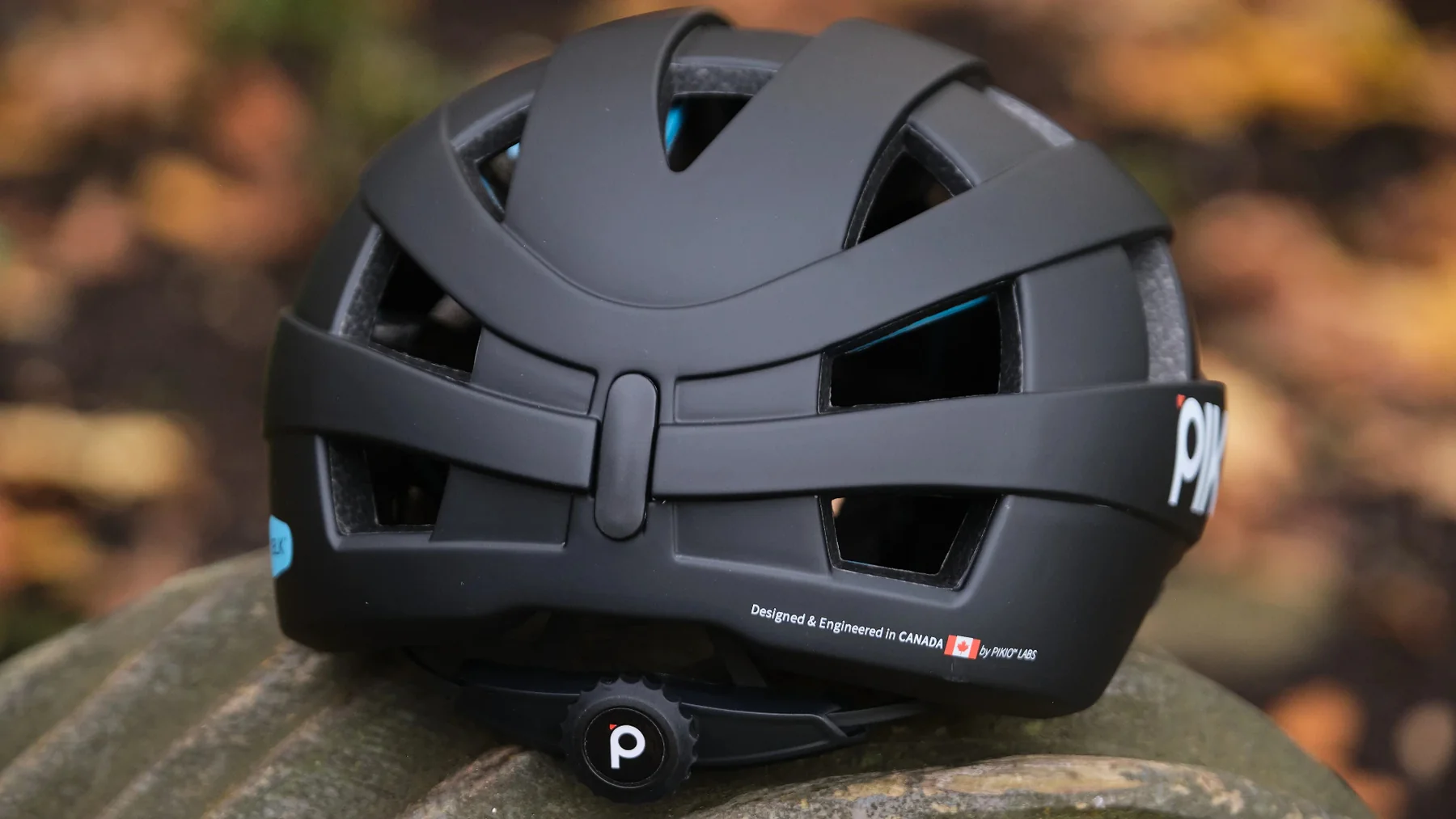
At first, one might think that helmets are more or less all the same. It’s foam and a thin plastic shell—how complicated can it be? The main innovation of Pikio’s design is that rather than have a solid piece of foam, it has almost a skeleton-like structure, arcing from the front of the head to the back. Additionally, these strips can move side-to-side in a system it calls OBLIK, an entirely new way to design helmets.
Many helmets made in the last decade use the “MIPS” (multi-directional impact protection system) design, which allows for the liner to rotate slightly during an angled fall—more likely in a real-world bike crash.
The OBLIK system takes this idea further by adding small pin-like shapes between the shell and the inner core, which the company says reduces the force of impact on the head by allowing the shell to move in any direction.
“We have changed the structure of the helmet entirely,” Daniel Abram, the founder and CEO, told Ars.
“That means the entire helmet system is a new system that not only provides better rotational forces because we have independent modules—they can move based on the direction and location and intensity of the impact.”
Abram was quick to point out that Virginia Tech’s Helmet Lab, which has rigorously tested various types of helmets , rates his PIKIO Si OBLIK ($379) as the safest among the hundreds of helmets they have reviewed.
We were intrigued, and as daily cyclists, we might consider upgrading our helmets sooner rather than later.
Hitching a ride
Beyond protecting one lid, sometimes you’ve got to get your bike from place to place by car. Traditionally, car racks are kind of a necessary evil. Most cyclists would rather just be riding, but at some point, we all encounter a situation where that’s impractical.
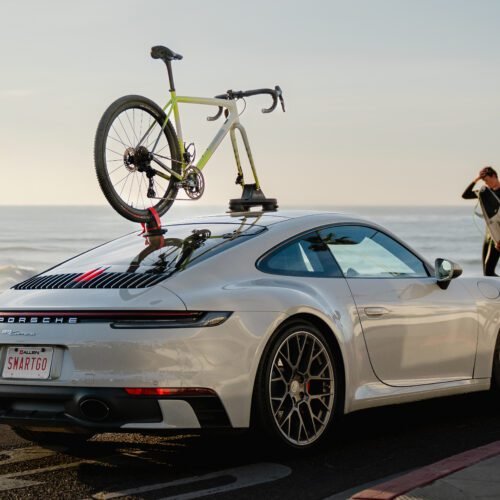
Many modern car racks use trailer hitches. But unless your rack is always on the car, getting it on and off can be a pain. (Ask us how we know!) Enter the Smart Suction Go ($299), from Allen Sports.
At its core, these are palm-sized suction cups that allow a bike to be held in place upright on top of a car’s roof. The idea is that it makes setting up a bike rack incredibly easy—the discs can be stored away when not in use. (When Ars was at the booth observing these, Allen Sports had a Porsche set up with them on the roof, suggesting that these suction cups may also be for people with higher-end cars that they don’t want to get scratched or jostled.)
It takes just a few seconds to “pump” the suction circles and get them in the right place. These discs transmit suction status to a smartphone via Bluetooth to indicate adequate adhesion.
While Ars didn’t get to test it in a real-world situation, the Smart Suction Go felt very solid; we couldn’t dislodge it with just our hands.
Allen Sports also makes a related, albeit smaller, product, the Smart Suction Snap Camera Mount ($70), which, as the name suggests, is for the person who wants to mount a camera on the outside of their car, or maybe a bike, if somehow you have a bike that has a large enough solid, flat surface.
Finally, we were also very taken with a newly available and simply designed bike tow rope made by a German company, Kommit (“Komm mit mir” means “Come with me”).
While this product ($65) has been around in Europe for six years and has won numerous industry and design awards, it’s new in the US and is sold via a small accessories firm based in Boise, Idaho, Miles Wide.
The whole premise of a tow rope is usually for parents who might need to pull their kids up a hill when they’re unable or unwilling to make the climb on their own, or when even the lure of ice cream at the end isn’t enough.
“If your buddy’s got an e-bike and he’s smoking you on the climb, you put this underneath his saddle, and it easily straps up onto it, and you leave it underneath your saddle,” Miles Schwartz, the head of Miles Wide, told Ars.
“It’s got a retractable cord that attaches to your stem, and this way he can pull you up.”
The end of the cord attaches easily to a bike stem, but there is an add-on product that makes it a little easier: a mini-bungee receiver.
While there are other similar bike tow ropes, the Kommit retains tension at all times, and its compact size, which fits in the palm of the hand, means it can always stay on a bike. At only 138 grams, or under five ounces, a cyclist is unlikely to notice the added bulk.
These were just a few of the myriad items that caught our attention at the show. If you found anything else that we missed, let us know.